
Cosmic traveler: A Ronnie lobello memorial exhibition
Cosmic Traveler: A Ronnie LoBello Memorial Exhibition
Curated by Andrea Kaspryk
Supported by Justyna Frank and Chris Stodder of Cosmic Bikes
Ronnie LoBello was a long-time bike mechanic and artist, who worked for and became part of the family of Cosmic Bikes and Rapid Transit Cycle Shop. Cosmic Bikes. The owners of this bike shop, Justyna Frank and Chris Stodder, shared this about Ronnie on their website:
"Ronnie LoBello "Renaissance Man" (March 20, 1954 - March 29, 2026) Ronnie worked with us for over three decades. He repaired everything from vintage Schwinns to high-racer recumbents. He also helped build both of our shops from the ground up finishing floors, painting walls, building cabinets, displays and work stations."
The generosity of the owners of Ronnie LoBello's paintings who loaned them for the exhibition made it possible include Justyna Frank, Chris Stodder, Kevin Womac, Alex Wilson, and Dennis Slusher.
Ronnie LoBello
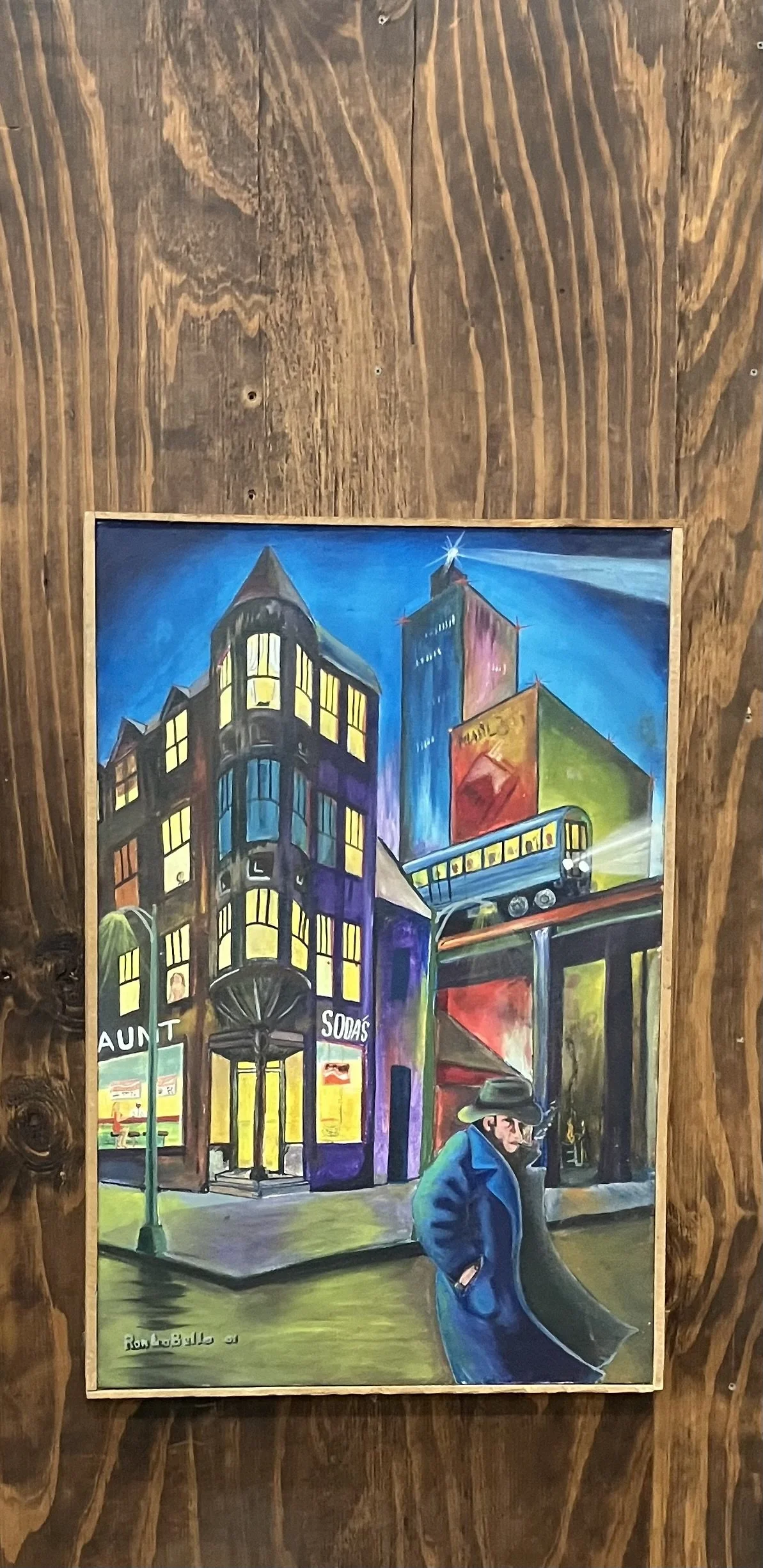
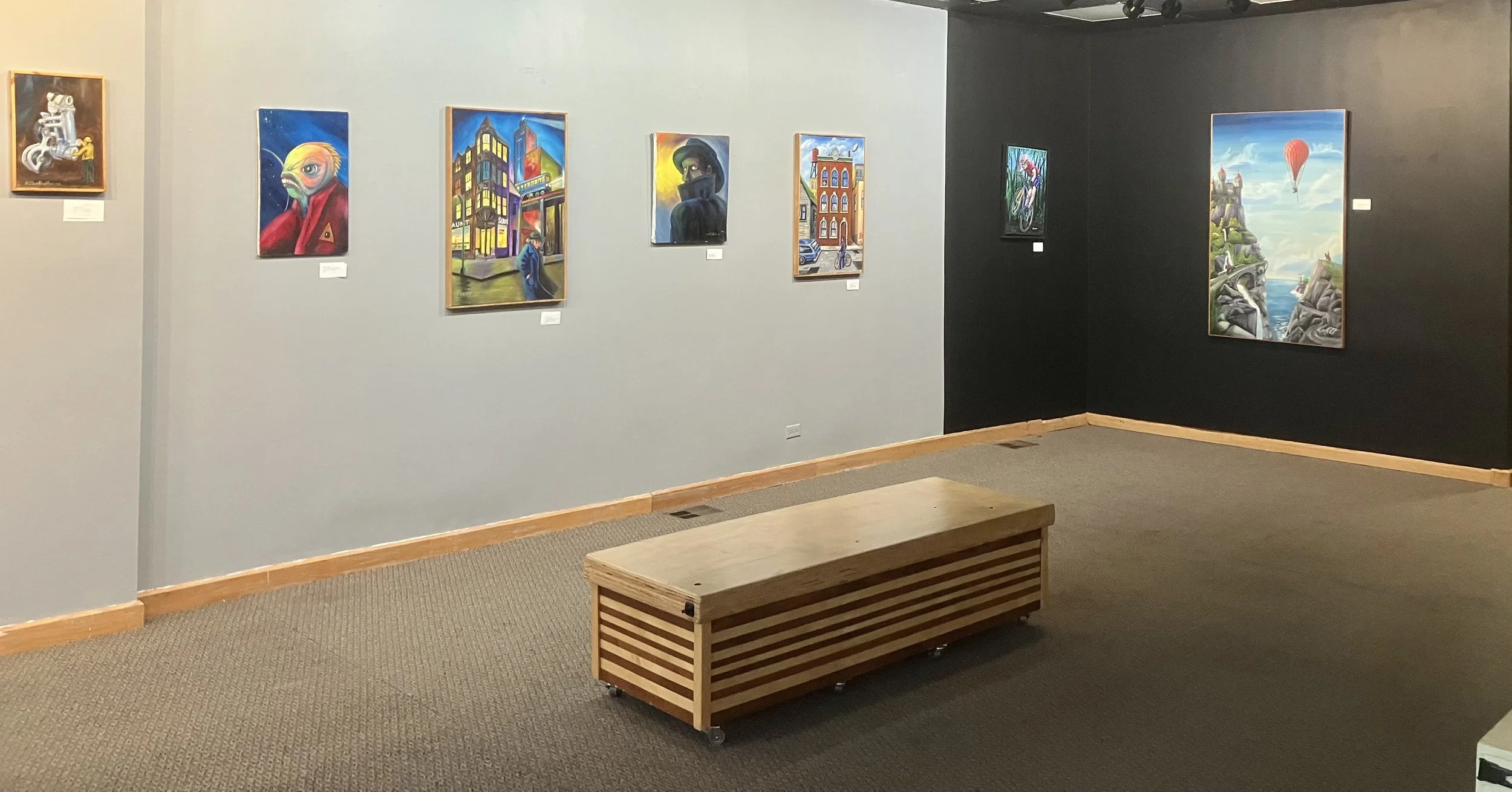
Untitled, [Restaurant-Sodas Building] 2001
Oil on canvas, 38 x 22 in.
The Restaurant-Sodas cityscape painting by Ronnie LoBello features a distinctive Chicago element: an El (elevated) CTA (Chicago Transit Authority) train in the background and a corner four-story brick building with a circa 1890s Victorian Queen Anne style cylindrical entrance capped with a pointed tower.
Quite striking, if not slightly visually jarring, is the intensity of the bright yellow lights in many of the building windows that give this painting its vibrant character of a lively city despite the dismal cold evening. The passerby that dominates the foreground of the painting, the man in the long blue coat, has apparently walked past the building with the bright lights which cast light on his back. As in many of Ronnie's paintings, the lone figure pictured in this scene echoes the theme of loneliness in America that Edward Hopper is so well known for.
Looking at the details in this painting, one notices several other figures who are alone. One in the far left warms up from a fire in garbage can, and another in a second floor window of the building, a nude woman, perhaps seeks the warmth of another person. A third woman wearing a bright red dress sitting at the restaurant looks in the diretion of the passerby wearing a long blue coat in the foreground. However, he seems lost in his thoughts, looking downward, and may not have even noticed the woman in the restaurant, nor the one in the window, perhaps not even have looked in their direction.

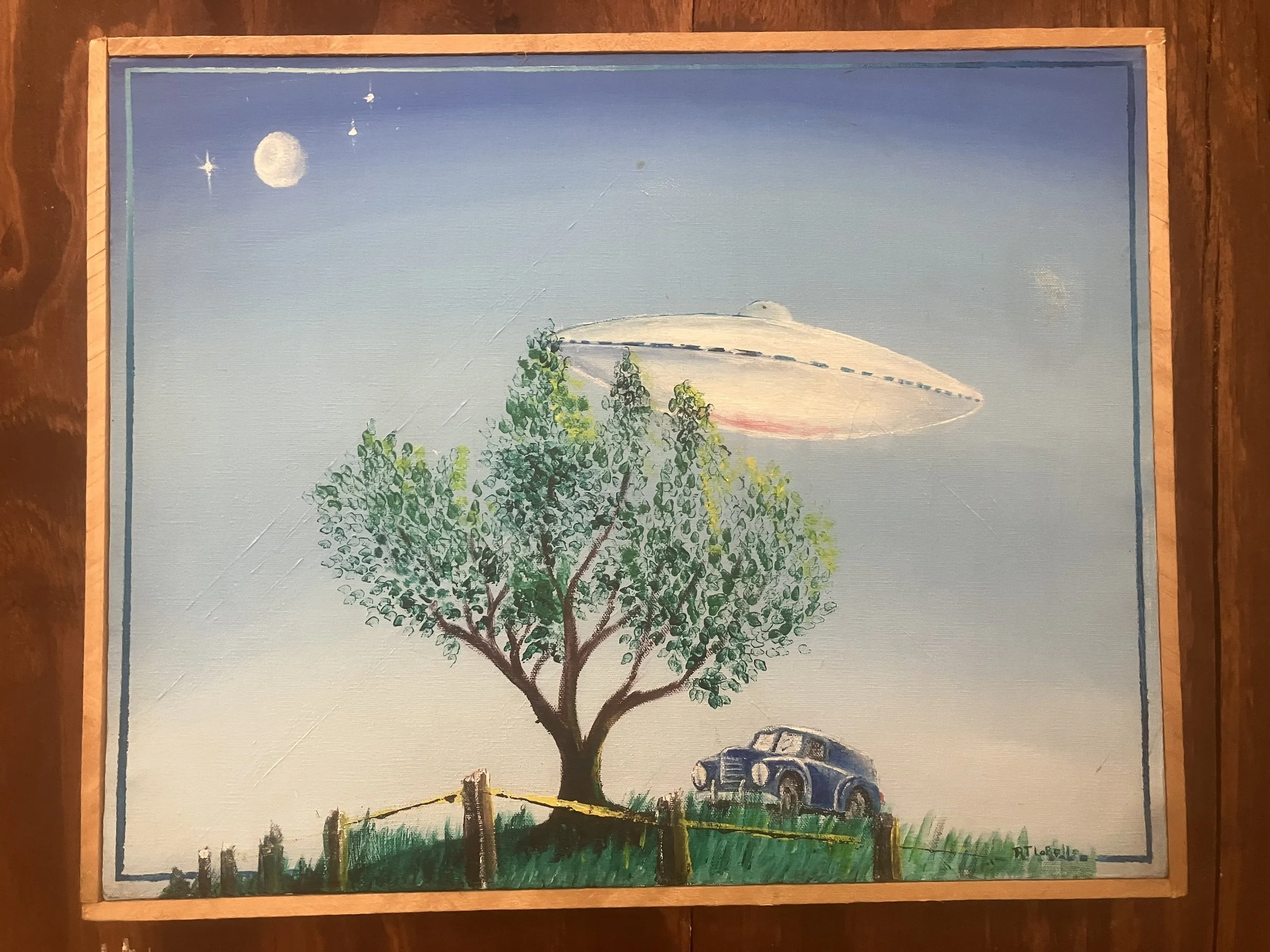
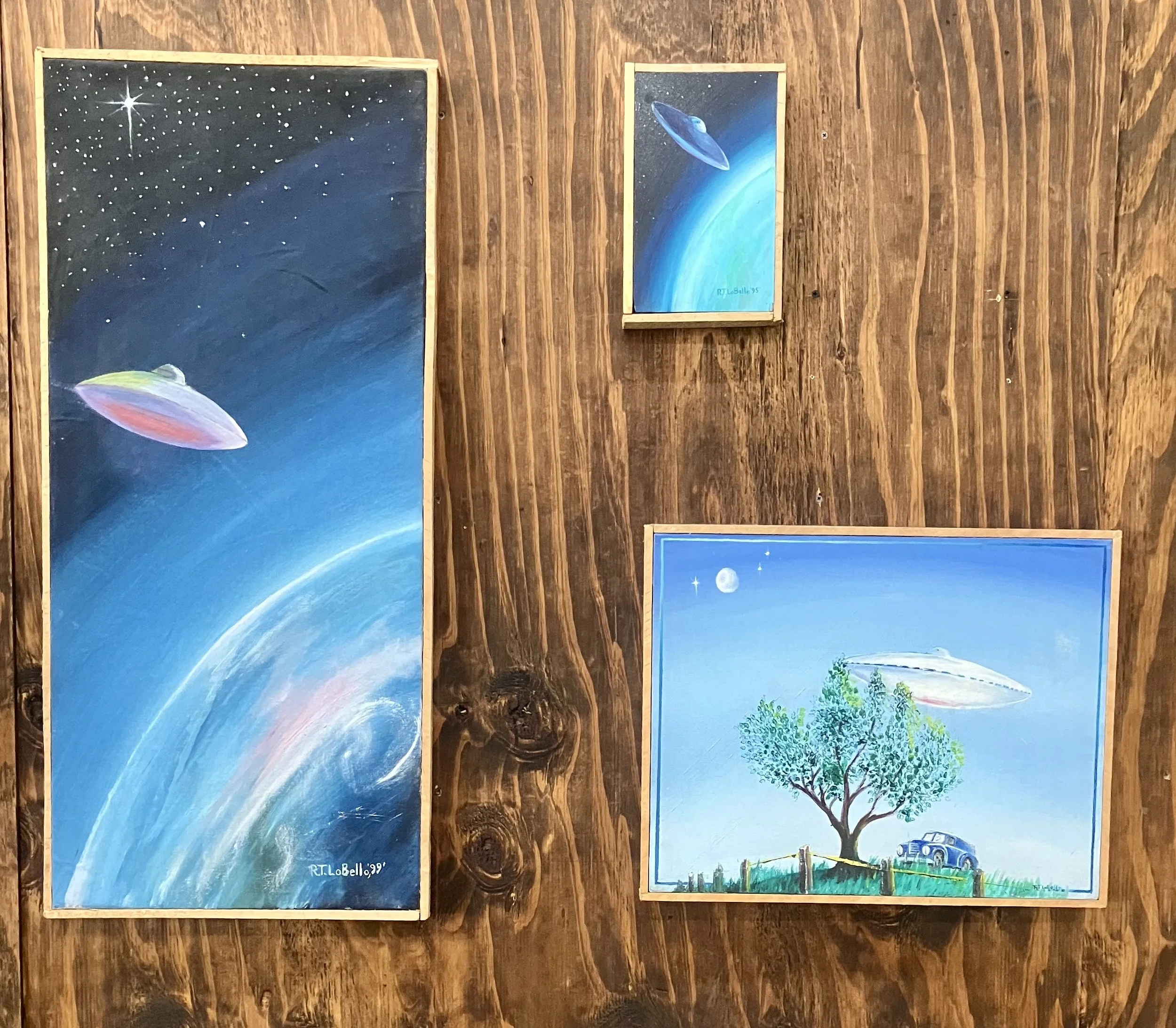
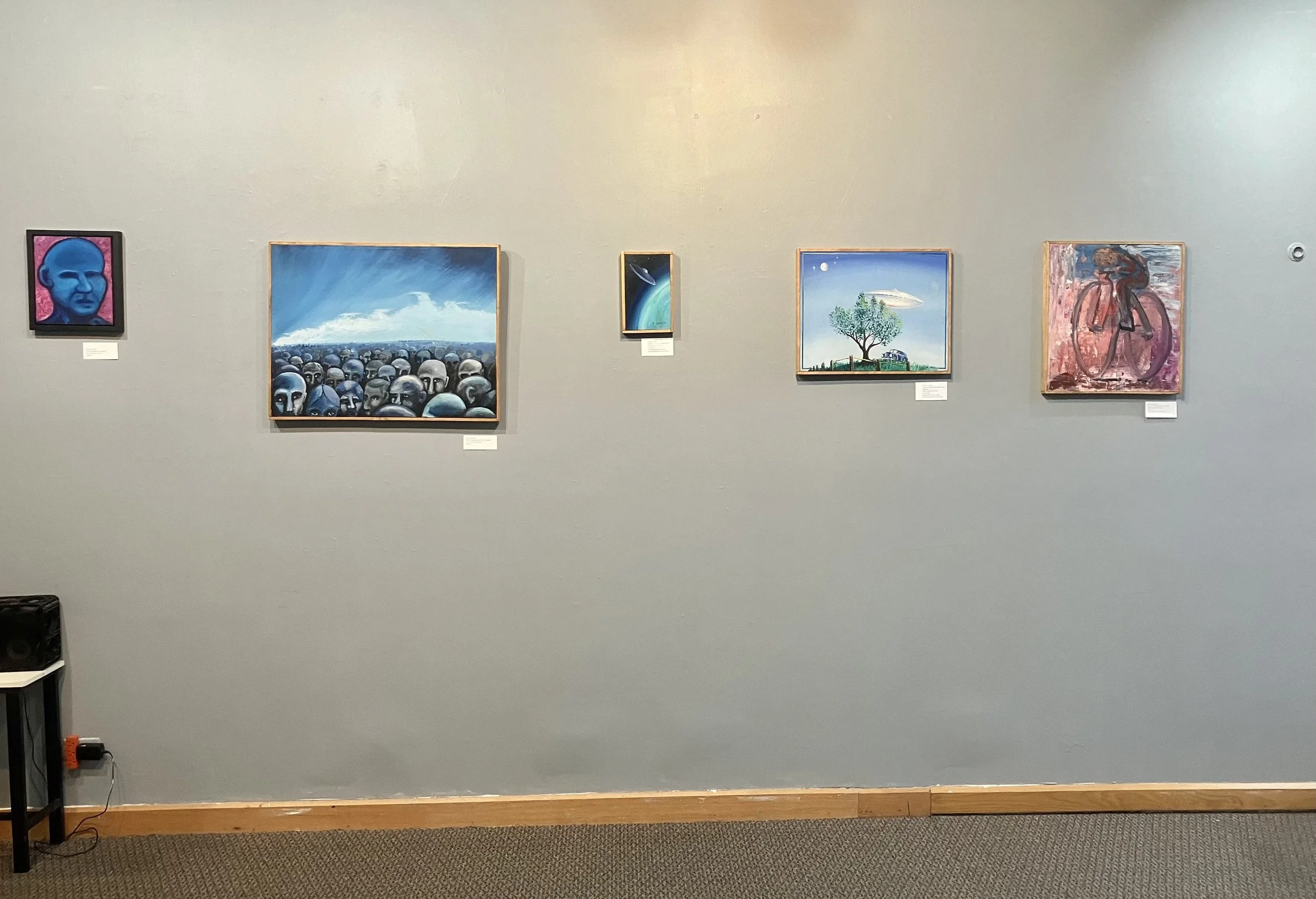
Ronnie LoBello, Untitled, [UFO Over a Country Road] Undated, Oil on canvas, 16 x 20 in.
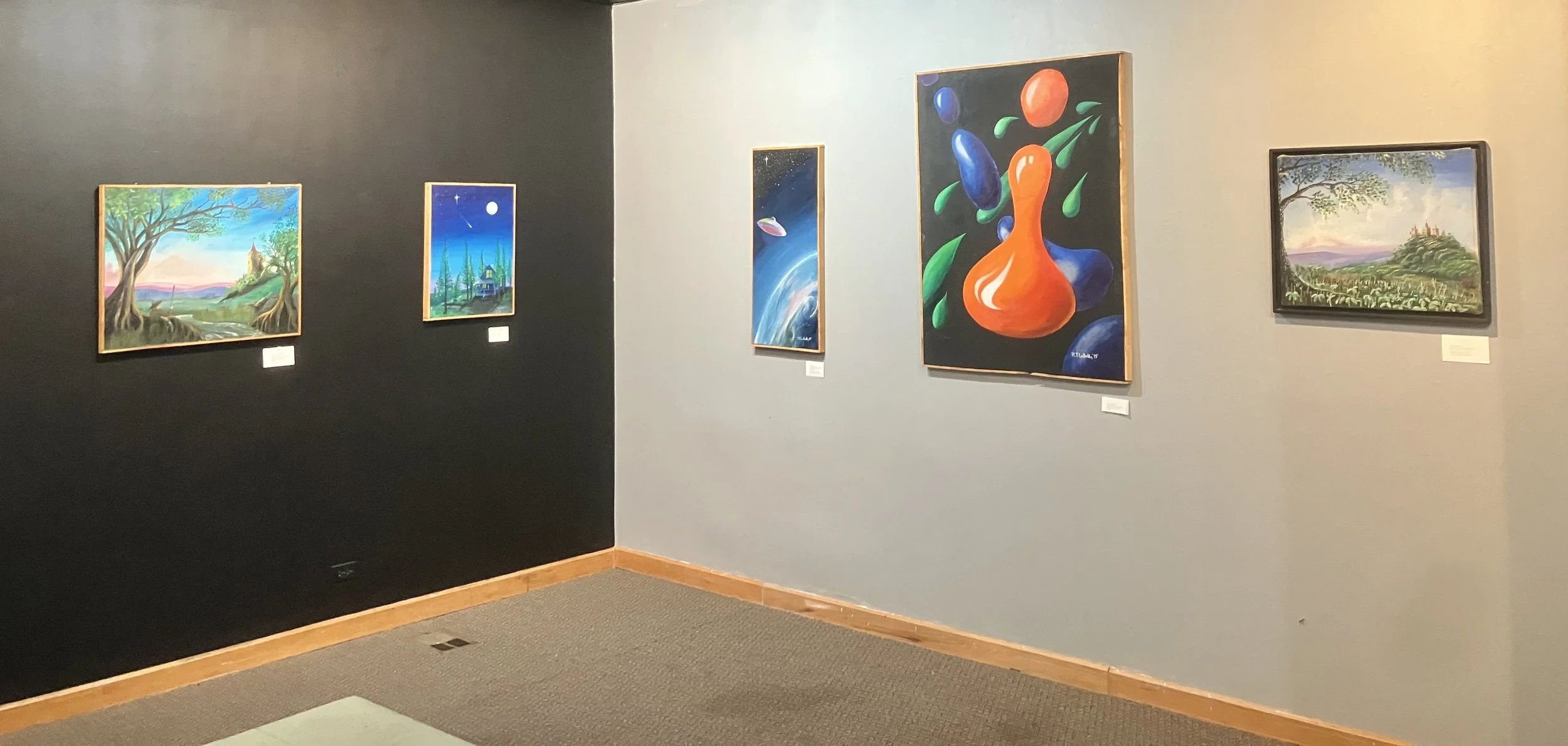
This is one of three of Ronnie LoBello’s UFO of themed paintings in the Cosmic Traveler exhibition, and it offers an idyllic landscape scene with a retro-future in style spacecraft hovering over a 1940s style sedan car. This car appears approaching the top of a grassy country knoll crowned with a tree, with a simple do-it-yourself wooden fence, which seems to indicate the road ends there. Yet the imagined ending of the story for this painting, seems pleasant and serene. For the retro saucer shaped UFO is not menacing, but seems to be as natural a part of this harmonious scene with a shining full moon with a few twinkling stars at dusk.
Noteworthy is an impressionist style used in this landscape and many other of Ronnie LoBello's landscapes. Leaves on the tree and blades of grass are rendered with a single brush stroke or dab, and from a distance create an effect of a shift in value, high lighted and shadow areas, light and dark green.
The limited blue, green, white palette and a limit on compositional elements makes this an effectively nostalgic and charming vision of a lost American rural world. This is the sort of world that in the 1930s prior to WWII that Thomas Hart Benton and Grant Wood were painting.
Ronnie LoBello
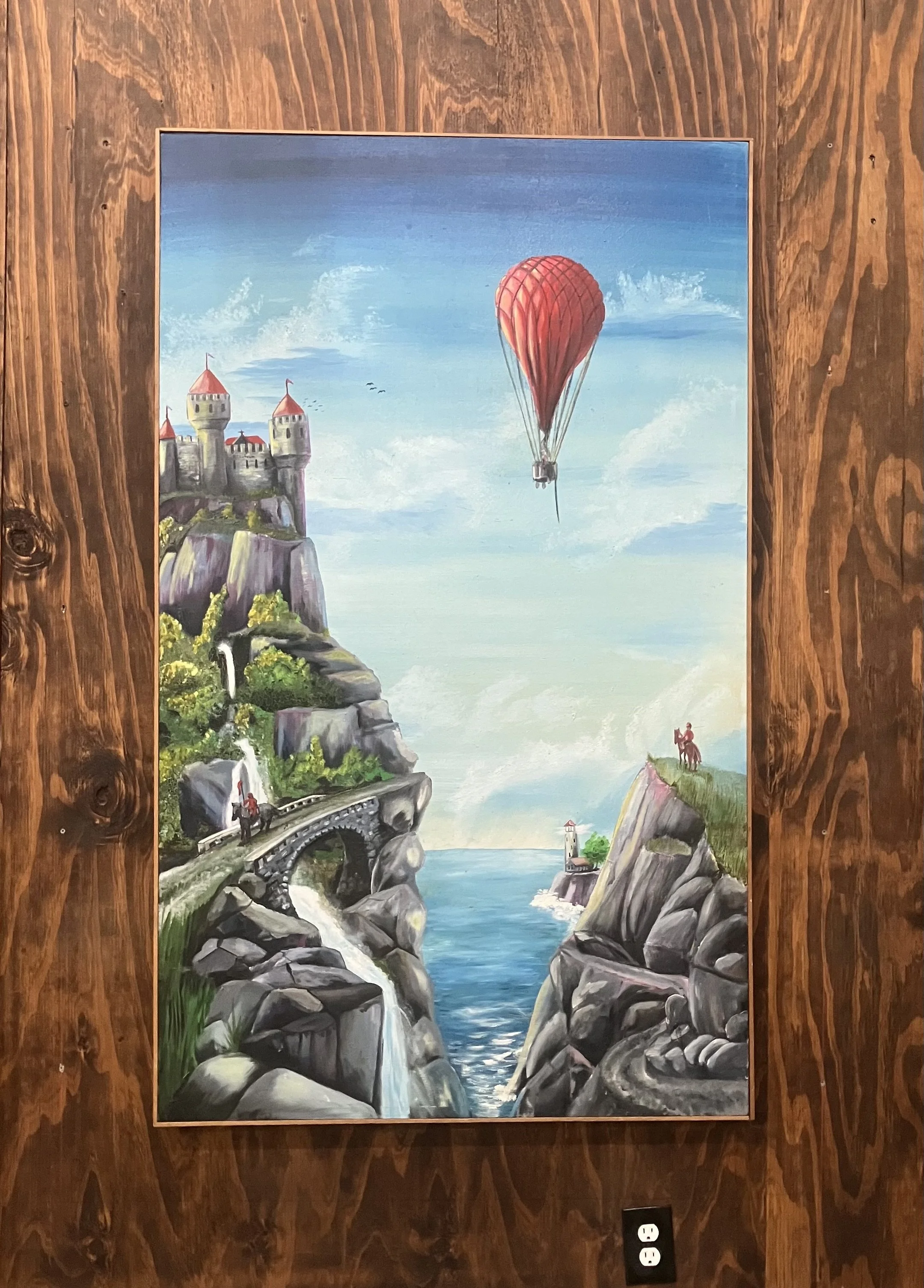
Untitled, [Castle with Dirigible] 1999
Oil on canvas, 60 x 36 in.
On loan from Justyna Frank and Chris Stodder
One of the most striking and ambitious of Ronnie's landscapes is the large painting (five by three feet) with a castle and dirigible on a seashore that is generically charming, yet also unexpectedly disconcerting. For its rock formations at the base of the steep hill on which the castle stands are depicted in a manner that does not adhere to the laws of perspective. The rocks below the bridge seem to be much too large relative to the scale of the mountain above the bridge.
But it is this feature of two perspectives, one closer to the viewer that does not correlate with the distant perspective just below the castle that makes this painting so engaging and compelling. In fact, the boulders in the lower half of the painting, their careful rendering, draw the eye towards them initially and more than to the castle in the distance.
This visually jarring detail echoes the skewed perspectives of Giorgio de Chirico’s cityscapes, an artist who inspired the surrealists to push the boundaries of perception of the everyday world, to re-enchant it with mystery.
Observing some details in this painting, it is also evident that three time periods are included in it. The knight on horseback and castle on the left, and the horse jockey and a modern looking lighthouse on the right; and finally, an air balloon on the edge of the right side that looks like a late 18th century model of one.
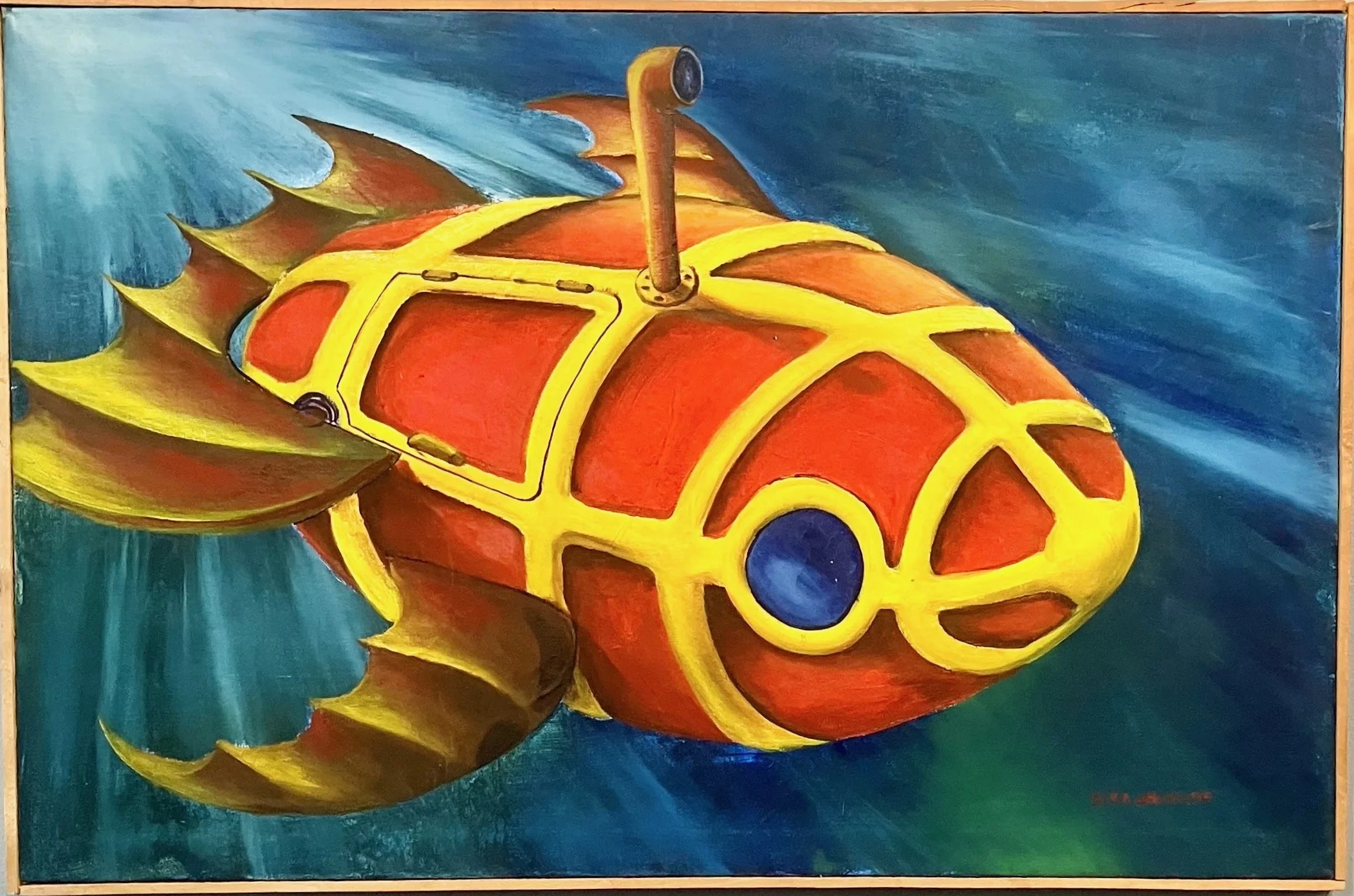
Ronnie LoBello, Untitled [Fish-Submersible], 1999, Oil on canvas, 30 x 46 in.
On loan from Kevin Womac, Boulevard Bikes
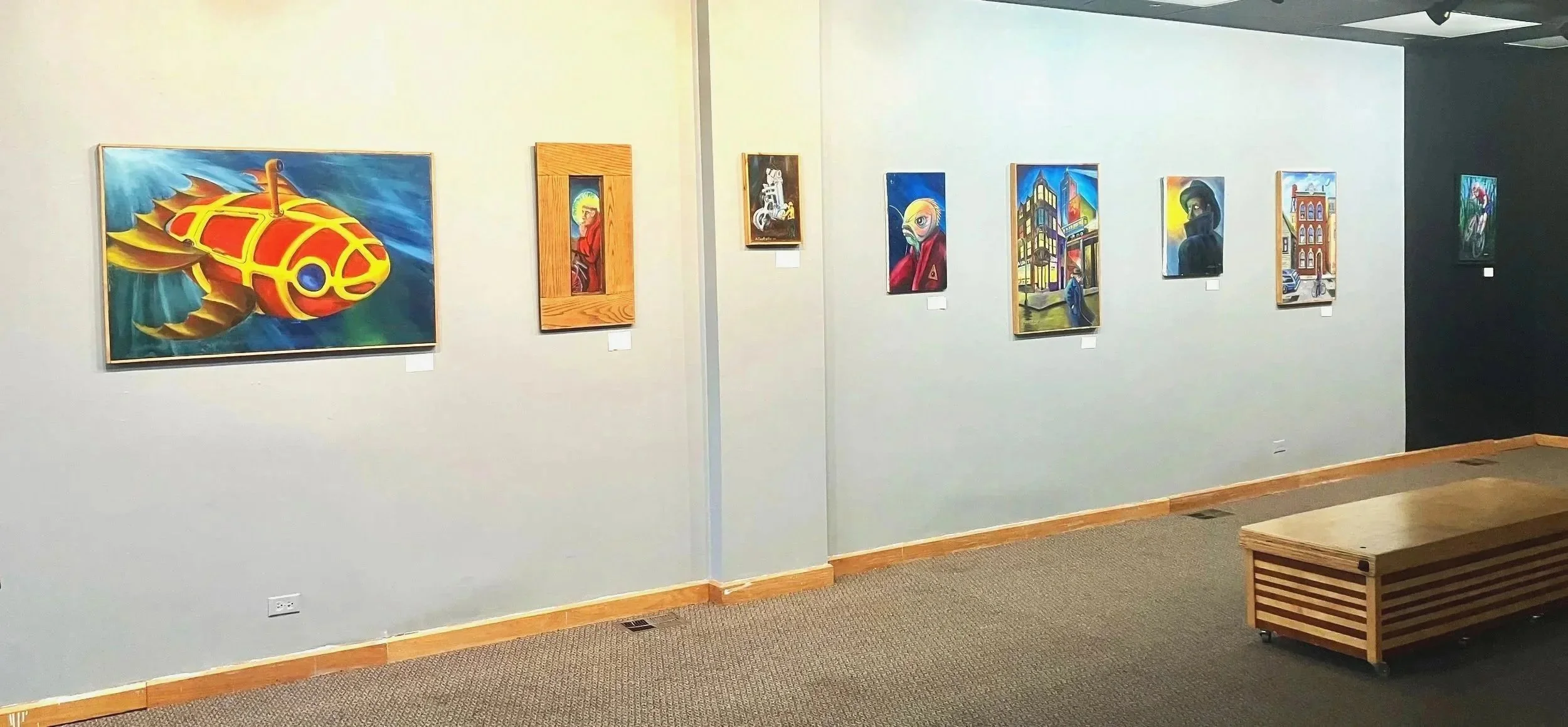
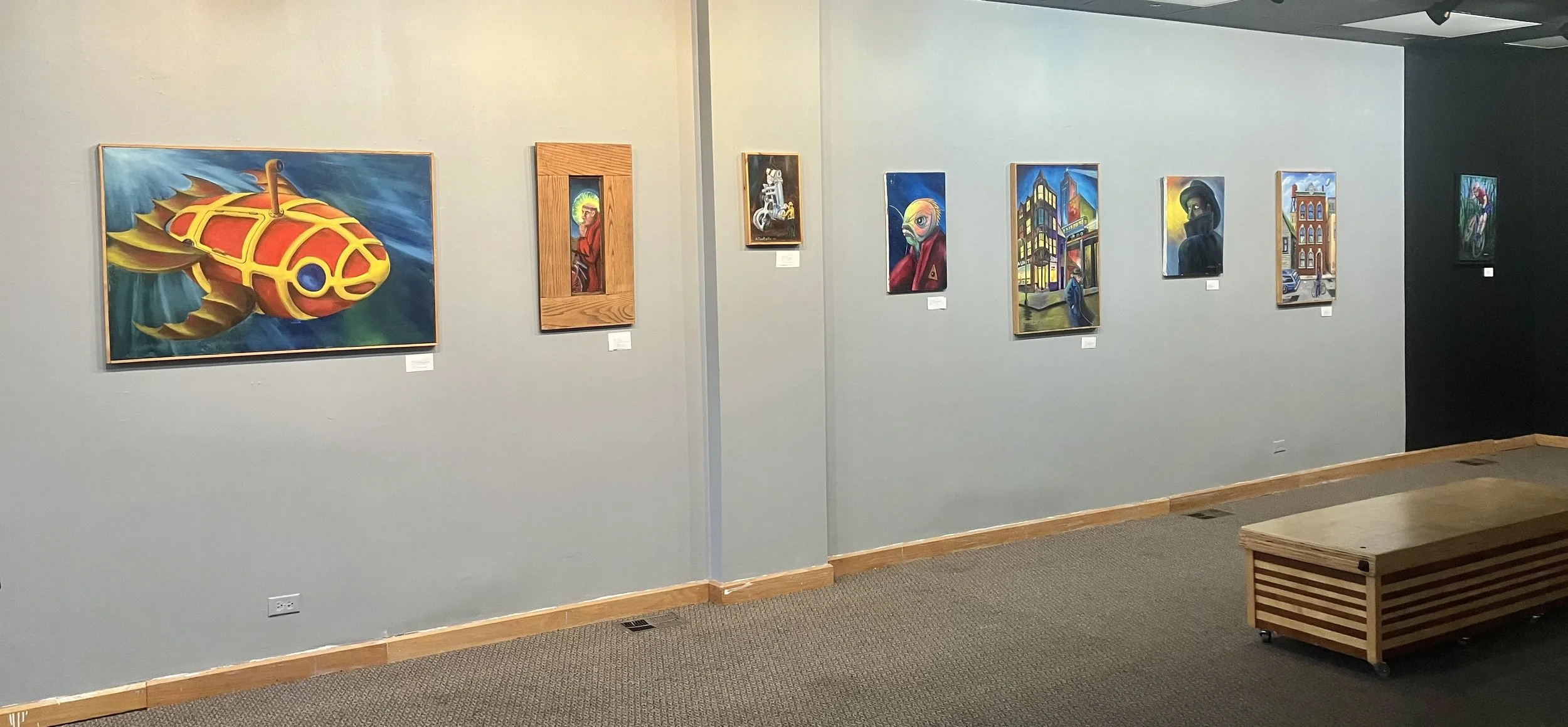
This painting by Ronnie LoBello features his distincive version of a steam punk submersible, notable for its bright yellow framework that encases its red hull. The dorsal and posterior fins are a notably duller or a worn tone of yellow.
The large circular eye or window, adds an element of charming appeal to this imaginary vessel that positively radiates vibrant energy, in particular, when seen in person.
Judging by the hatch size, this looks like a submersible for several people at most. An odd detail of this submersible is that the periscope does not seem to be ever fully retractable: its tubular form narrows towards its base!
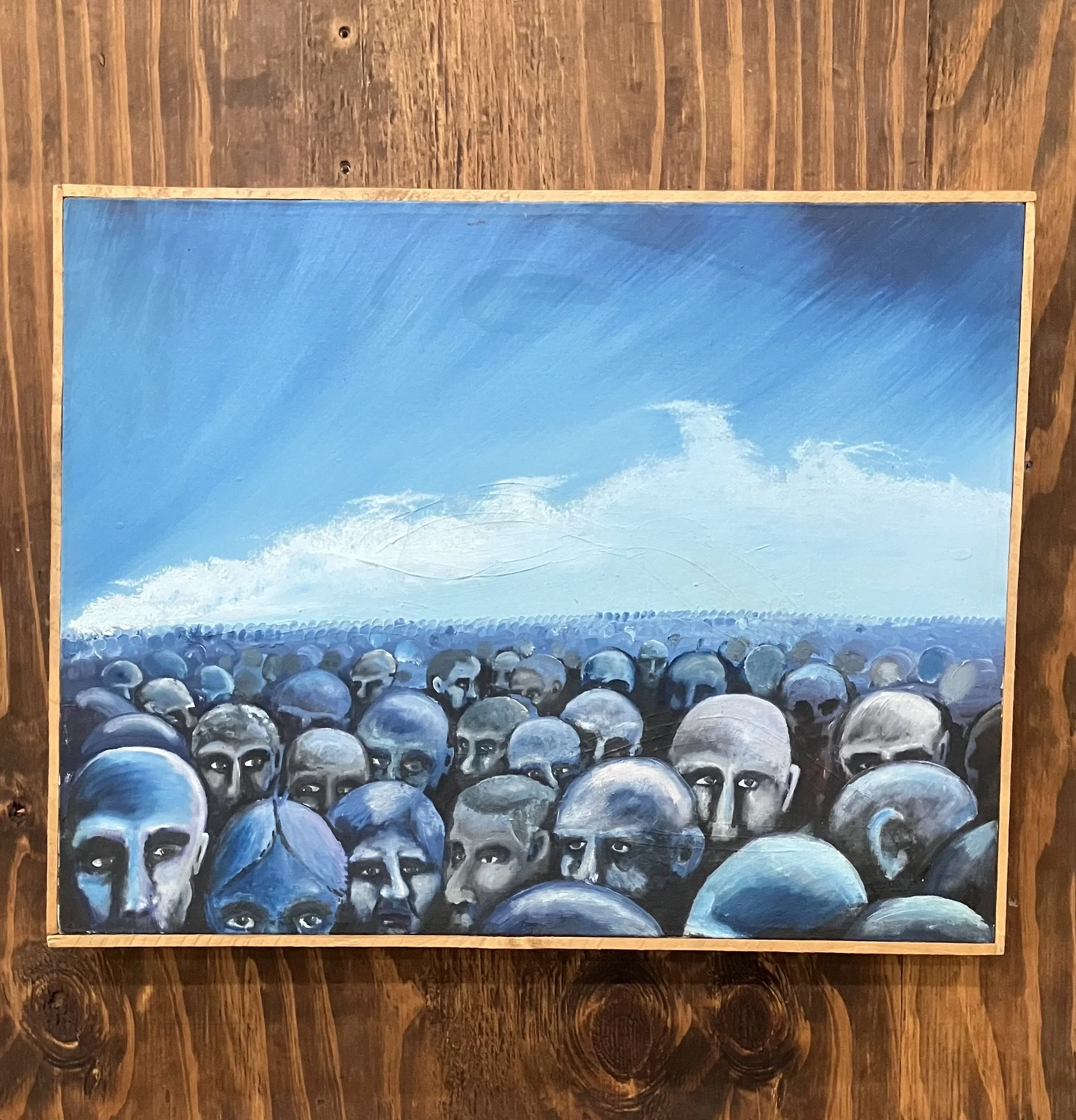
Ronnie LoBello's Faces of a Crowd, a primarily a monochromatic blue painting, offers a puzzling and dystopian vision of people standing, crowded very closely together. Only their heads, faces and eyes are visible, yet not their shoulders. Leaving shoulders literally out of the picture, though physically impossible, serves the goal of intensifying the dramatic effect of people being uncomfortably very close to one another. It echoes a post-Impressionist painting, like James Ensor's Self-Portrait with Masks (1899).
Most of the faces visible in the crowd don't have hair, scalp or facial, nor other distinctive facial features, which causes them to appear anonymous and depersonalized. Removing most of someone's hair, which can serve as distinctive markers of personal identity, has become a common practice in prisons and military forces.
Ronnie's painting evokes sadness, loss of hope, and the bewilderment of people who are visibly ill at ease at their situation. The crowd extends into the distant horizon and presumably to the left and right of the picture frame, as if to suggest it is vast, perhaps even without a visible end. Thus, one can well ask: is this is simply an imagined nightmare space rather an actual one of mass confinement?!
On the left side two faces look directly towards the viewer, and both have hair. The dark blue face with hair parted down the middle and that is cropped below the eyes is closest to viewer. The eyes of this face have the most direct gaze that seem to be trying to establish contact with the viewer. Other faces notably look to the left or right of the viewer, or their eyes are doing so.
The most dynamic and appealing aspect of this painting is the distant horizon with its unusual cloud formation along the horizon line with a suggestion of dynamic movement conveyed through brushstrokes sweeping towards the right. The grandeur and openness of the horizon contrasts starkly with fixed and sad faces of the crowd. Perhaps this sublime sky can lead one to believe the people in this crowd can someday and somehow escape from their dismal fate of internment?!
Untitled, [Faces of a Crowd] Undated, Oil on canvas, 22 x 28 in.
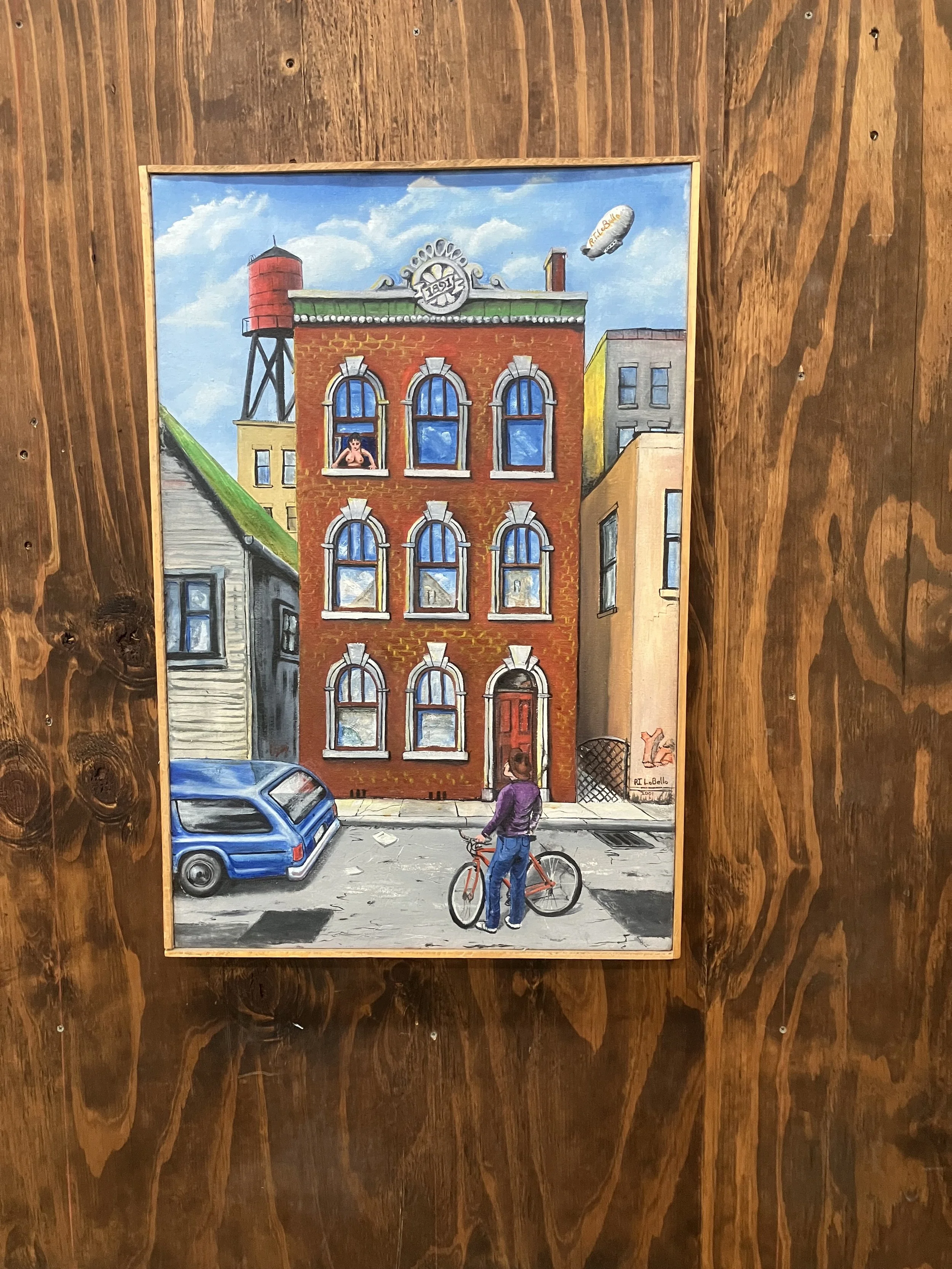
Ronnie LoBello's 1891 Building painting is one of his cityscapes that features a building and people in an urban setting. Ronnie clearly admires the design and workmanship of turn of the nineteenth-century Chicago buildings, and in his 1891 painting he features a red brick three-story flat with distinctive moldings around the entrance door, the windows and its top, which is crowned with date of the building's construction. This painting focuses on connection between people: a man on the street just outside the building stands next to his bike, who is looking up at a woman standing in a third-floor window nude, exposing her breasts.
This type of risqué and unlikely scene echoes panels from underground comics, in particular of the cartoonist R. Crumb, who is well-known for featuring nude women. Presumably, in Ronnie's painting, the man in the street and the woman in the window may meet, or perhaps they are discussing the possibility of meeting, as the man has perhaps briefly paused from his bike ride to exchange a few words with the woman in the window. One can note that his figure is also positioned in front of the entrance door to the building, so he is thinking about entering the building at some point.
The painter Ronnie makes a surprising appearance in this painting by writing his name on the large airship floating in the upper left of the painting, as if he is observing and adding his blessing to this brief encounter in the city in which lone figures and loneliness tends to prevail instead of connection.
Ronnie LoBello, Untitled, [1891 Building] 2001, Oil on canvas, 38 x 32 in
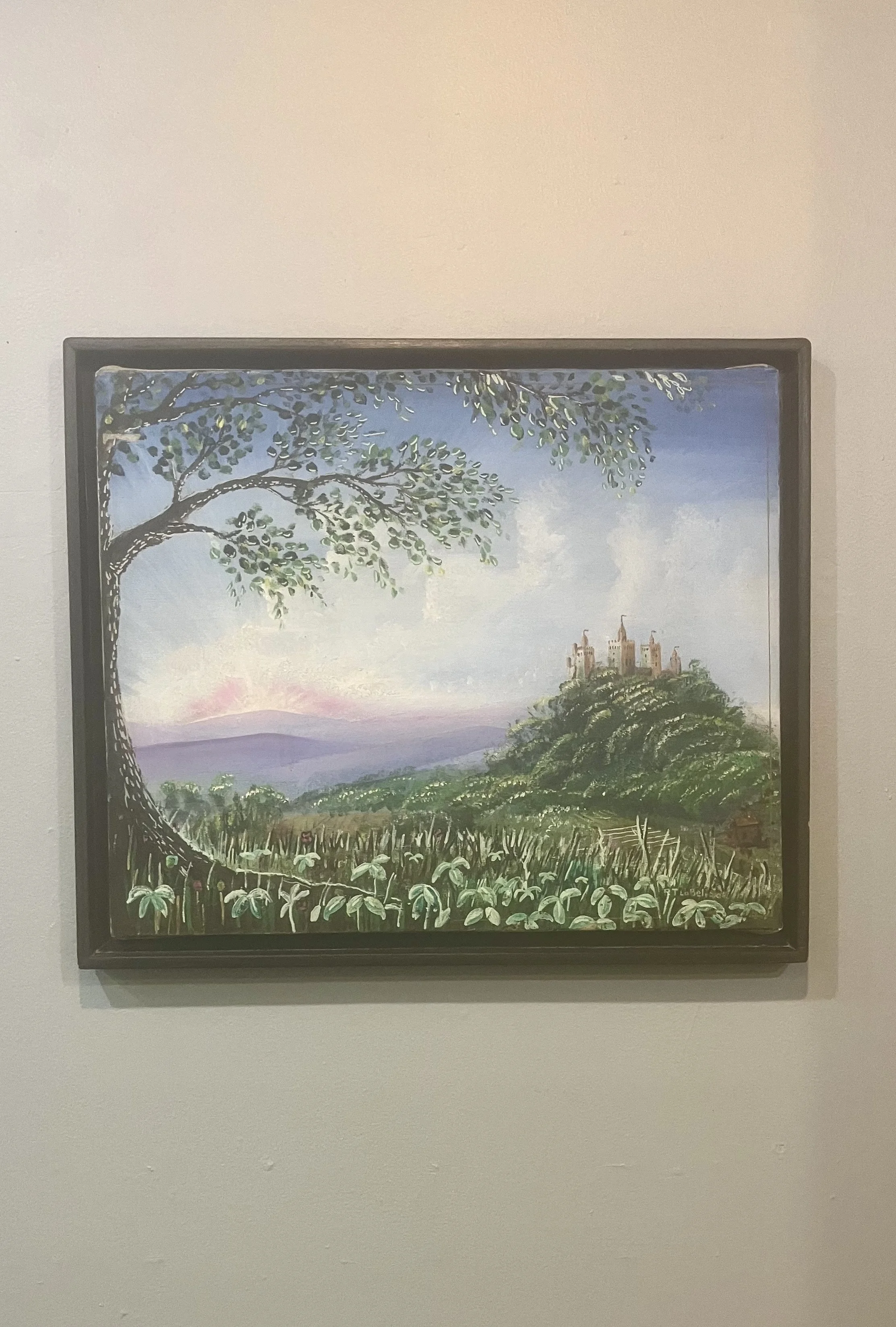
Ronnie LoBello, Untitled, [Castle on a Hill] 1995, Oil on canvas, 20 x 24 in. Floater frame, 22 x 26 in. (On loan from Dennis Slusher)
Another painting was unexpectedly added to the Cosmic Traveler exhibition thanks to the generous loan of Dennis Slusher who responded to the open call made on social media, asking if anyone can loan artwork to this exhibition.
This painting is another in a series of Ronnie's landscape paintings with a tree framing the composition on the left and top of the canvas, a castle in the distance on a hill, and a the soft bright red and purple horizon line of a sunrise in the distance.
A Post-Impressionist style that echoes the pointilism of Georges Seurat is prominent in this painting with its frequent use of white highlights in the foreground leaves of ground plants, the tree leaves, as well as hill in the distance. The white dabs of paint likely represent the early morning dew that causes the plant leaves to glisten in the light.
A more established and traditional technique of sfumato, a soft blending of colors and outlines that became widespread in the Renaissance and employed by painters, like Leonardo DaVinci, is also used for the distant horizon in this painting that shows the rising sun at dawn.
Ronnie's painting Castle on a Hill combines two different historical painting styles, and this is distinctive feature of modern twentieth century painting. Such a heterogeneous approach was regarded as inconsistent until the twentieth century, but it is one which Pablo Picasso initiated as he challenged prior painting conventions.
Ronnie LoBello
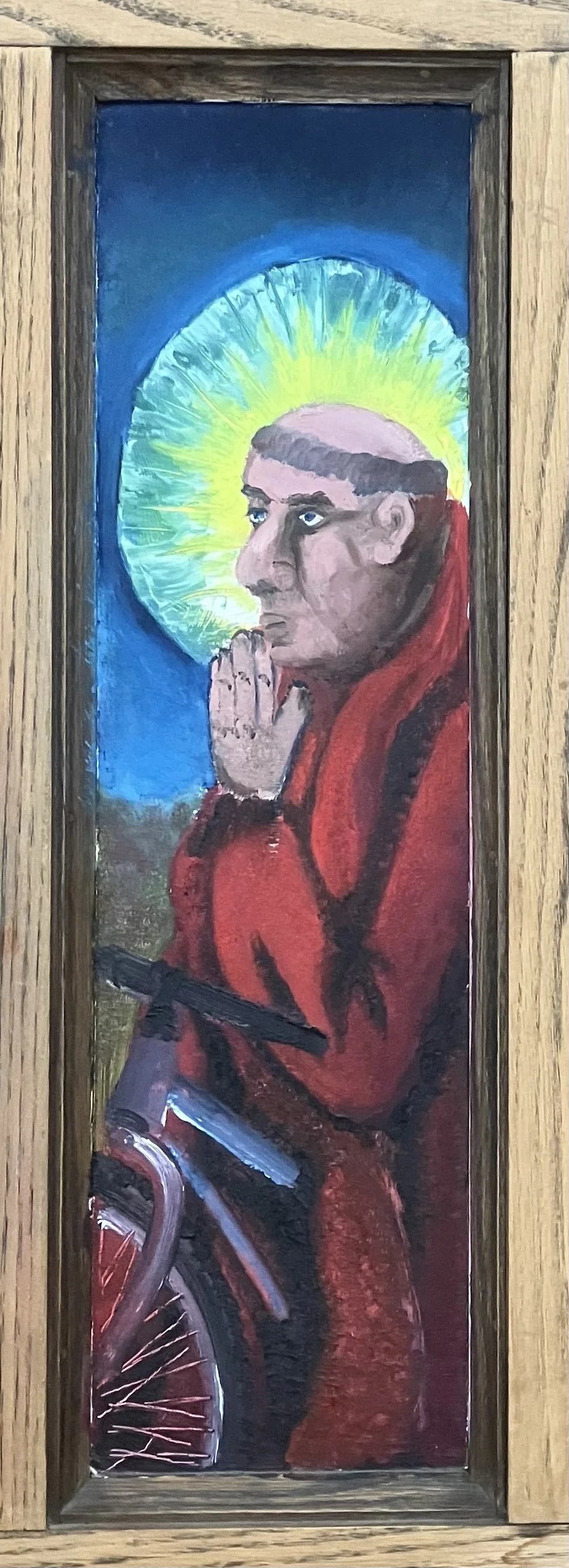
Saint Velo, Undated
Oil on board, 19 x 6 in.
31 x 17 in. frame
On loan from Cosmic Bikes
Justyna Frank and Chris Stodder
This unsually formatted painting by Ronnie LoBello in the curent exhibition at Agitator Gallery with its long rectangular composition is titled Saint Velo. The face in this full-length portrait painting has some similarity to those found in the group portrait Crowd of Faces painting with the large, bulbous nose, large ear, and rendering of the eyes.
The term Velo in the title of this painting is an abbreviated for of the term velocipede, which is a term that came to be applied in the 1860s to a version of the bicycle invented in France in which the crank with pedals was attached to the bicycle's front wheel.
This particular saint looks like a monk with a distinctive monastic tonsure hair style and wearing a long robe. While standing over a bicycle, this monk is presumably praying for the safety of cyclists. The halo around his head has some semblance appropriately to a bicycle wheel with spokes, and compositionally it repeats the cropped front wheel of the bicycle the monk is standing over.
This painting has been on display at Cosmic Bikes and prior to that at Rapid Transit Cycle Shop where Ronnie LoBello worked for over three decades.
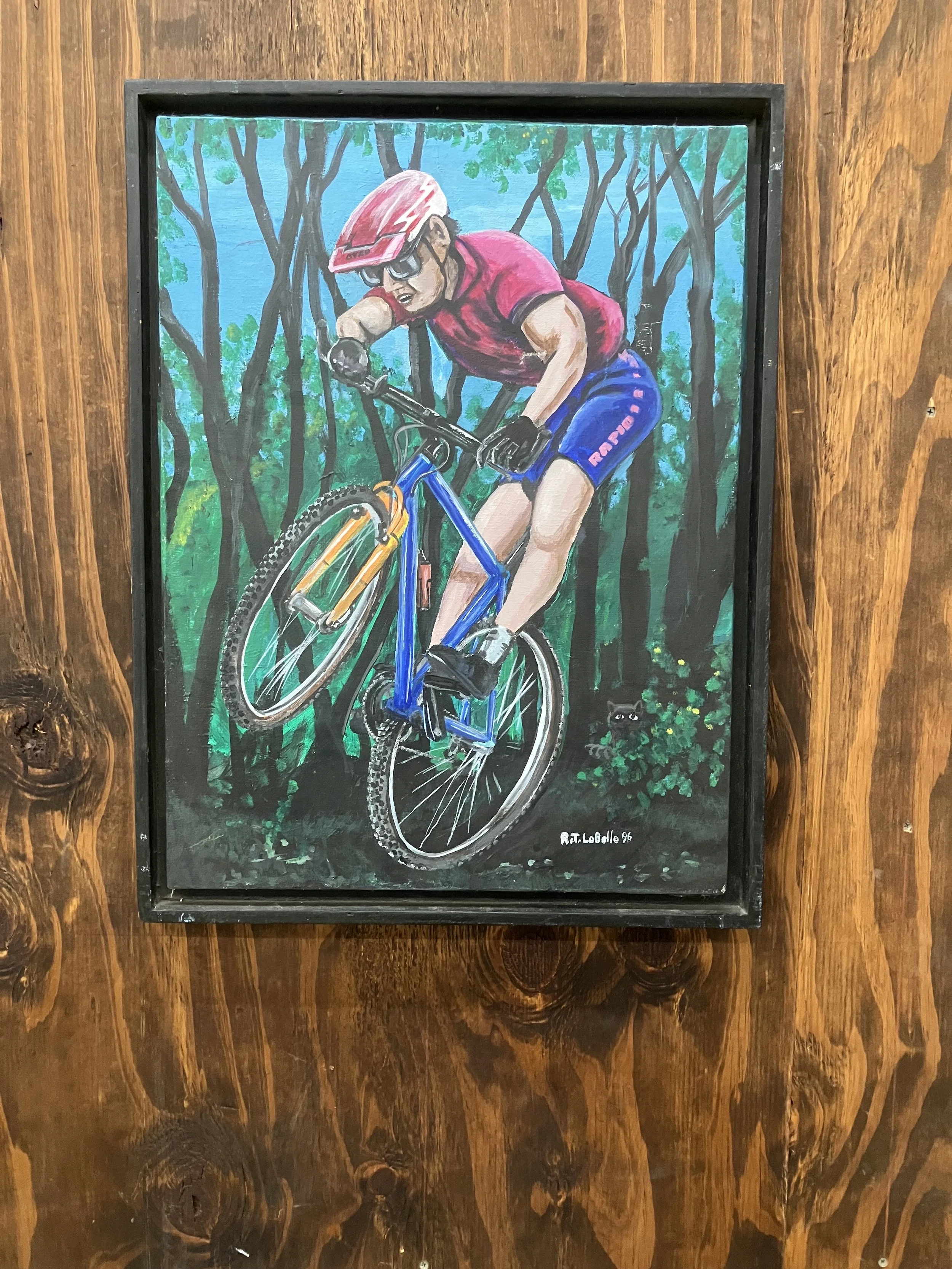
Ronnie LoBello’s Mountain Biker painting conveys movement by the raised and slightly turned front wheel of the mountain bike that creates a strong diagonal composition.
Often in Ronnie LoBello's paintings, like Mountain Biker, small and personal details are added. In this one it is a black cat with glowing yellow eyes in the lower right of the painting, as well as the word, Rapid on the cyclist's bike shorts, which references Rapid Transit Bike Shop where Ronnie was a long-time employee.
Ronnie LoBello
Untitled, [Mountain Biker] 1996
Oil on canvas, 24 x 18 in.
Floater Frame 26 x 20 in.
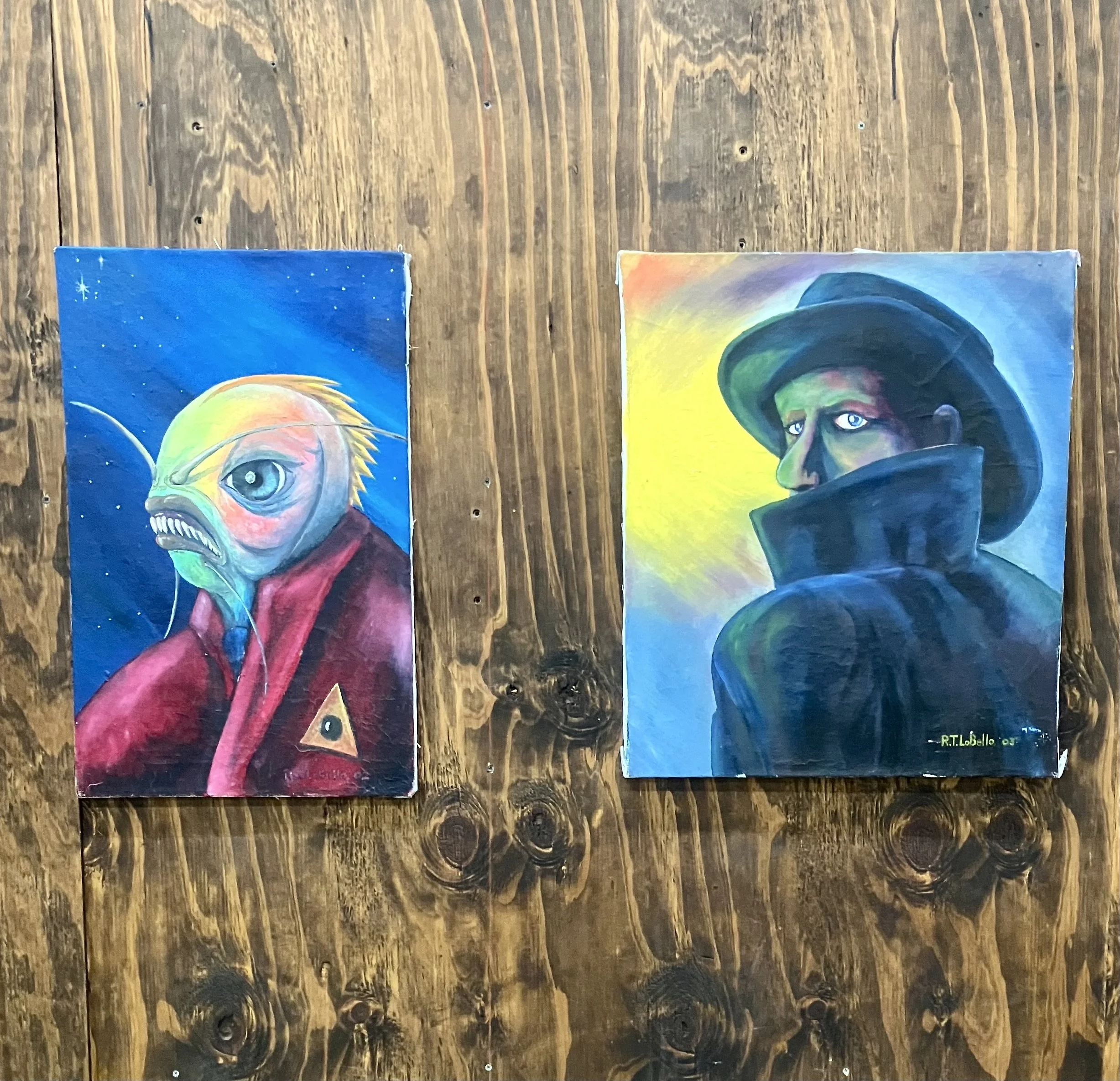
Portraits are a common subject in Ronnie LoBello's paintings. The fish humanoid alien on the left is drawn from imagination or a perhaps a composite image based on several sources, while the one on the right may be based on a photo of a person who Ronnie met or knew.
These two portraits can be thematically related to Ronnie's land- and cityscapes: the scary looking fish humanoid to the three UFO flying saucer paintings, and the Boy Alone portrait to the Restaurant Soda's painting where a figure wearing a fedora and long overcoat walks alone in the city. Both portraits are similar stylistically, posing in profile or almost profile, and they have unusually lit and colored faces with greens, purples, and reds, and they feature similar jackets with distinctive collars.
Ronnie LoBello, Untitled, [Fish Humanoid Alien Portrait] 1996
Oil on canvas, 24 x 15 in.
Boy Alone in the Dark, 1993
Oil on canvas, 23 x 20 in
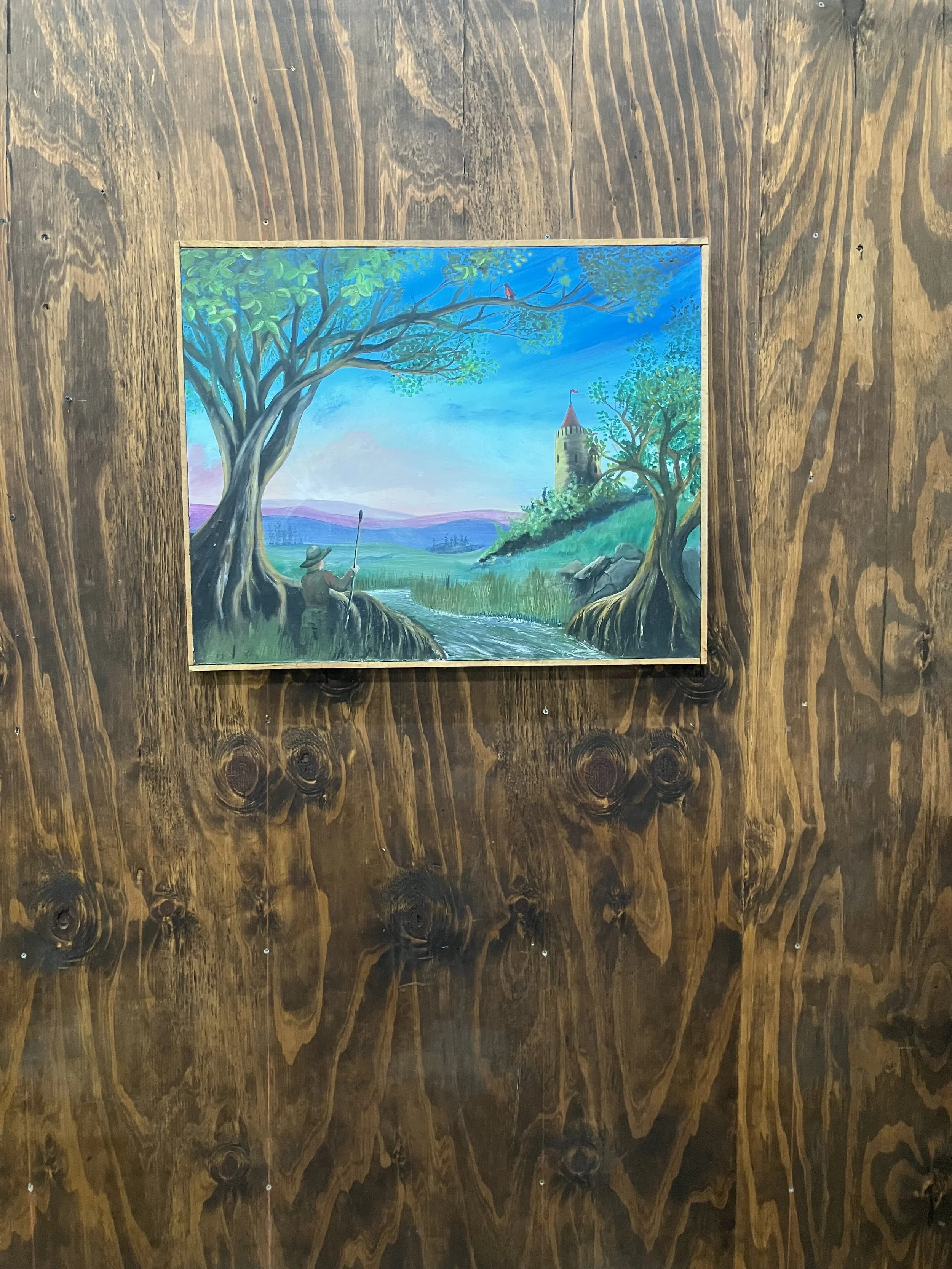
Ronnie LoBello, Untitled, [Landscape with a Castle] 2001,
Oil on canvas, 24 x 30 in.
Ronnie LoBello's painting Landscape with a Castle is one in a series of many impressionist in style landscapes that are visually inviting, as well as compositionally and technically accomplished. These are not paintings that pose thematic or conceptual challenges to the viewer, but rather primarily appeal to the viewer's expectation to find beauty and harmony in a landscape. Likely, they were made with a working artist's aim to ensure sales of their artwork, while he also created more personal and quirky paintings less likely to sell.
In his painting Landscape with a Castle, Ronnie effective creates a pleasant framing, enclosing effect with a pair of trees growing along a river, with the one of the foreground looming large, as it is closer to the viewer, and it takes up the left and top of the composition, while the tree on the right is smaller, and it provides a sense of scale to the castle tower on the right in the distance. A lone figure appears in the foreground of the painting surveying the scene with a staff in hand, and the viewer can identify themselves with this traveler.
The sky has rosy glow on the distant horizon, and the hills are rendered with a muted and light wash of light red and dark purply blue, as objects seen in a distance have less resolution. If a story is imagined for this painting, one likely for this painting is that the traveler has reached his destination in a timely manner and can find safety in his stay there.
Ronnie LoBello
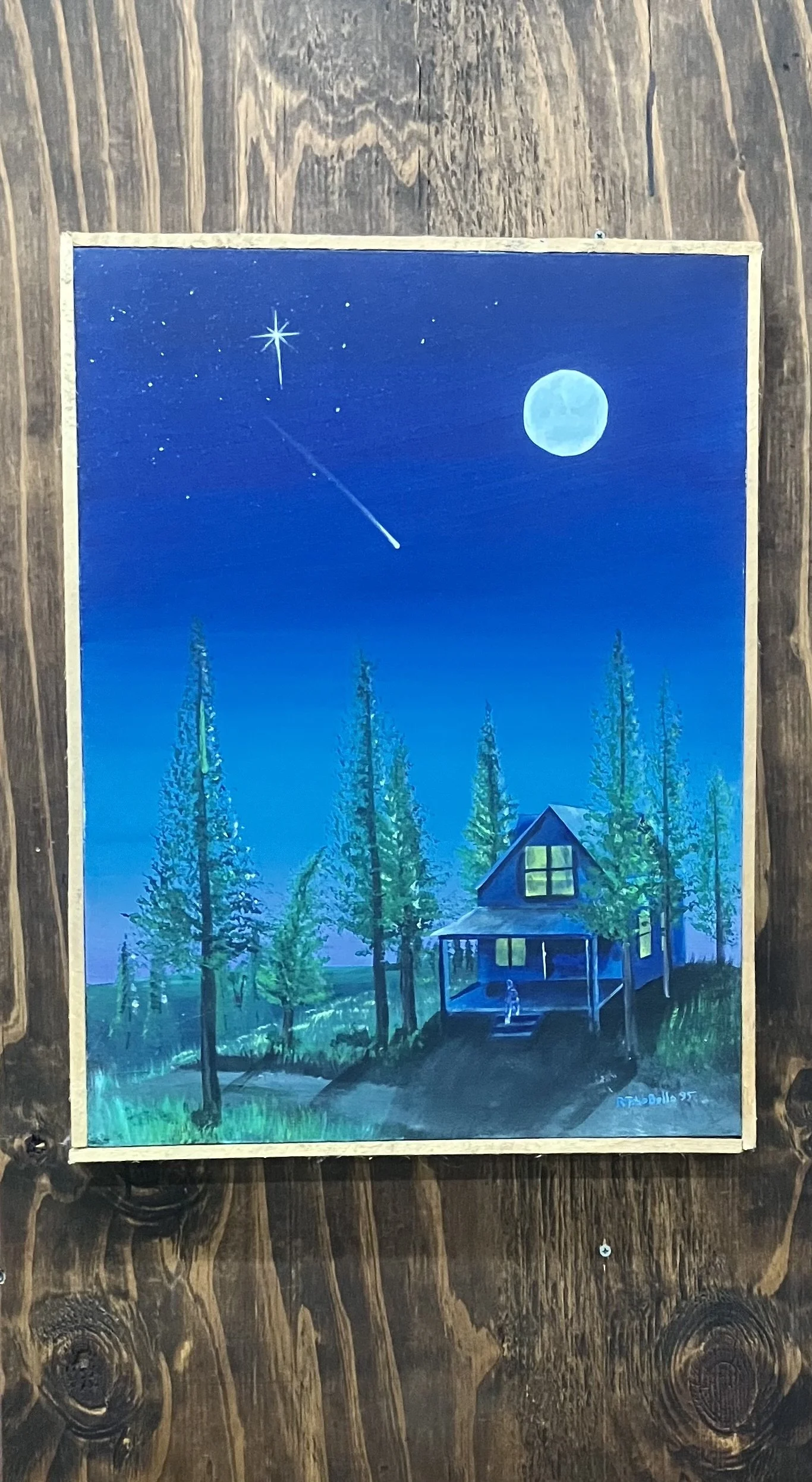
Untitled, [Country Home] 1995
Oil on canvas, 24 x 18 in.
Country Home is one in a series of Ronnie's idyllic paintings rendered in an Impressionist style featuring a house in a landscape in an ideal setting at sunset.
The cool color scheme of dark blues and greens also includes a glowing light seen from the house with its yellow-green tinged windows, giving a the sky at dusk and the scene a very warm and pleasant aura. And the yellow glow also and even prevails to the left of the house and in the pine tree branches. Such intense use of color began with the impressionist painters with whom Ronnie shares an affinity.
A lone figure is seen entering the front steps leading to the home’s large front porch, likely looking forward to the security and calm a home can provide. Though this painting overall projects a sense of calm, there is a hint of potential menace: a meteor plunges downwards above the home at a sharp angle. Yet it may well be harmless and burn itself up in space.
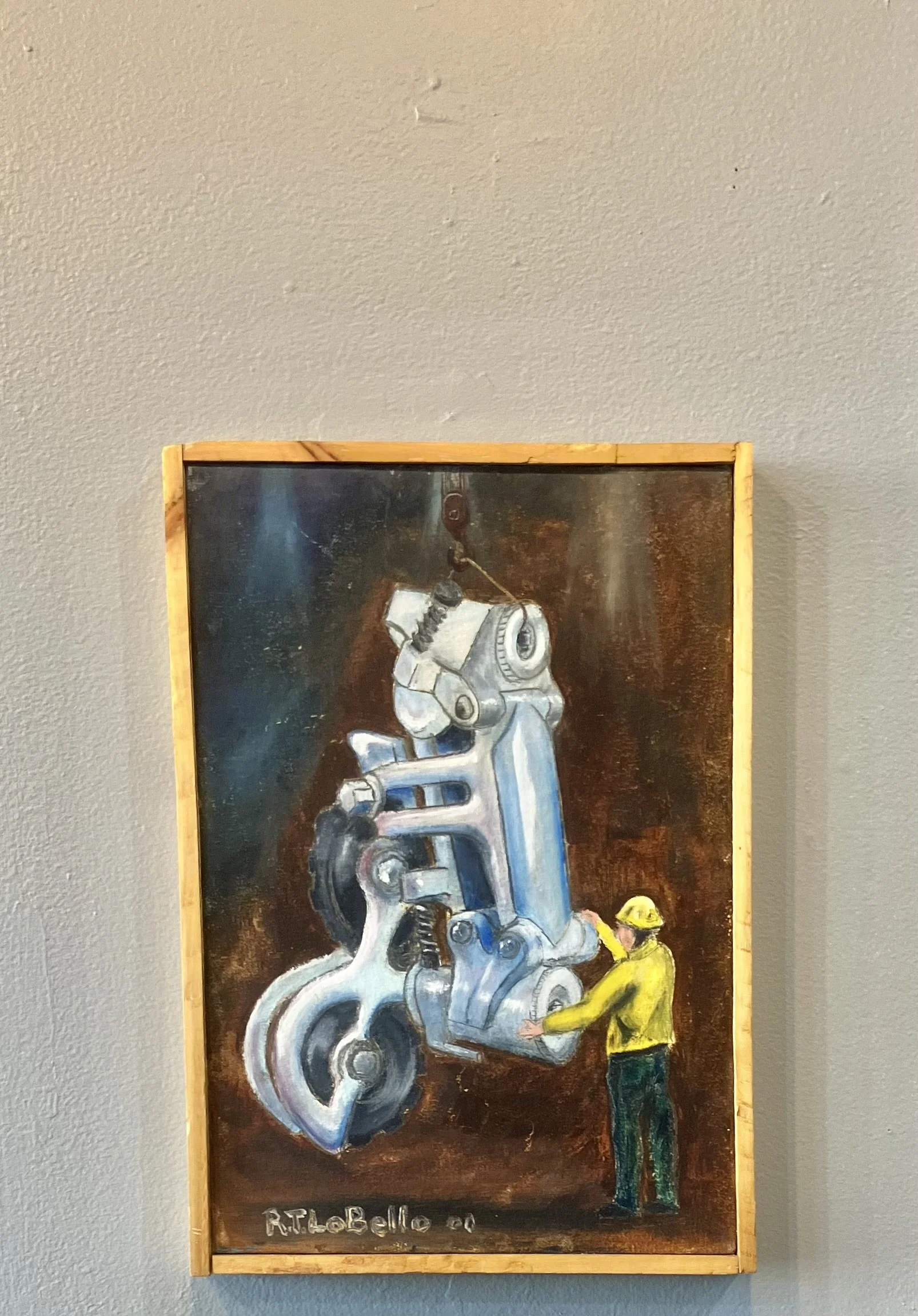
Ronnie LoBello, Untitled, [Derailleur] 1999
Oil on canvas and mixed media, a wire and a clasp, 20 x 18 in. On loan from Alex Wilson
Looking more closely at Ronnie LoBello's painting Derailleur, one can see an actual physical wire held by a clasp, which is holding up this bike mechanical part for inspection by the construction worker. This is a subtle touch and addition to this subtly amusing painting with an oversized bicycle part.
This painting also brings to mind the enormous public sculpture of the Swedish-American artist Claes Oldenburg, who made everyday objects, like a clothes pin, which can be held in one's hand, larger than a person in his large, often outdoor, public sculptures.
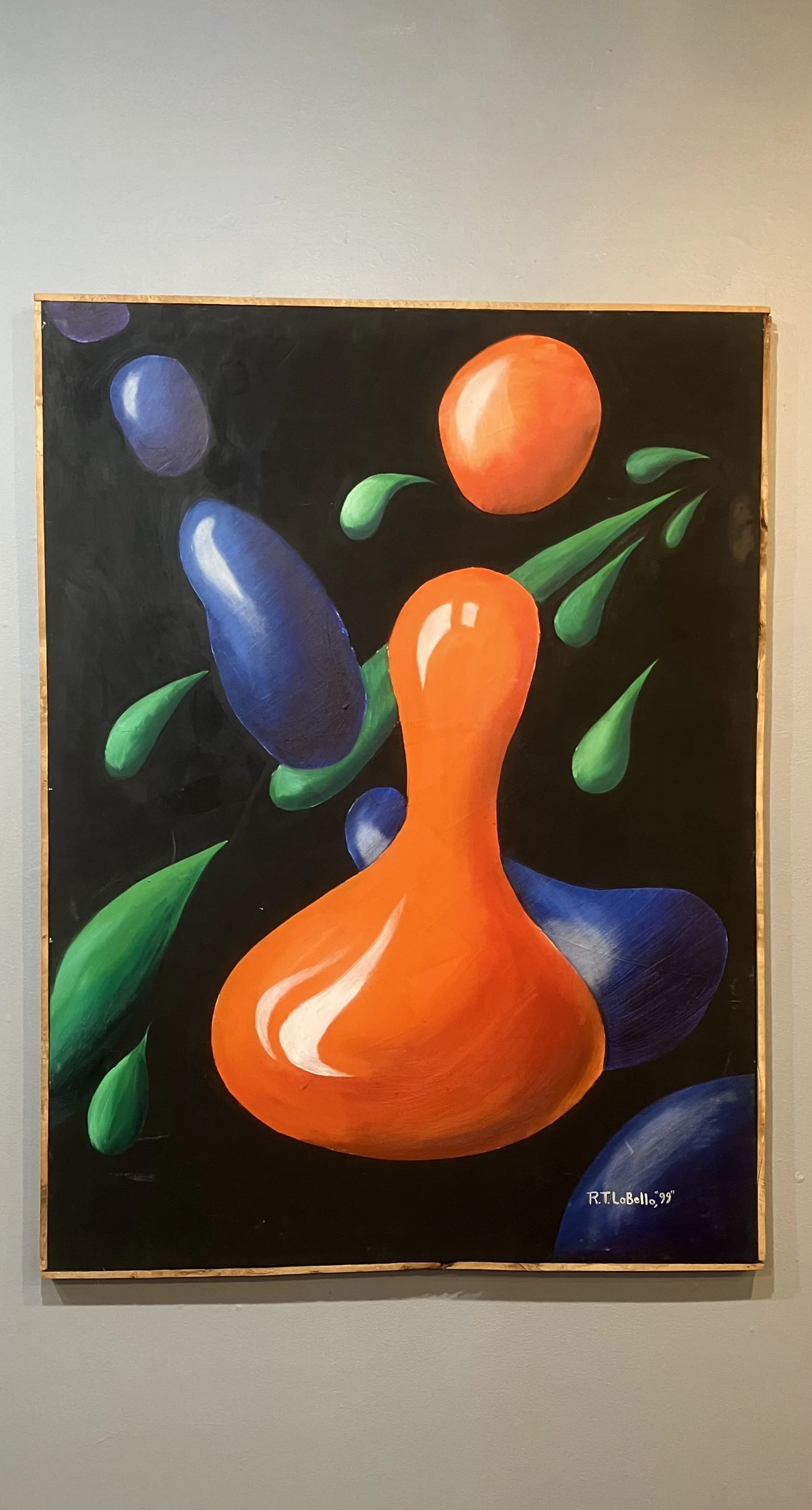
Ronnie LoBello, Untitled, [Big Red Drop] 1999, Oil on canvas, 48 x 36 in.
In this large painting (four by three feet) what look like enormous drops or globs of a viscous liquid crisscross the canvas in a three-layer overlaid pattern of red, blue, and green, like a color study in a fanciful paint chart, with the largest red drop dominating the composition in terms of the intensity of its bright red saturation and size.
The drops or globs in this painting bring to mind the enormous public sculptures of the Swedish-American artist Claes Oldenburg, who made everyday objects, like a clothes pin, which can be held in one's hand, larger than a person in his large, often outdoor, public sculptures.
Spending some time looking at this painting, the viewer comes away with the perception that the red drop dominates the painting too much with its intense and highly saturated color and size. And though the crisscrossing blue and green drops-globs behind the red drop prevent that perception from fully crystalizing, the red drop still upstages all the other elements in this painting.
A painting like the Big Red Drop can also provoke different associations in a viewer, and my reaction includes seeing the red drop as an enormous pacifier.
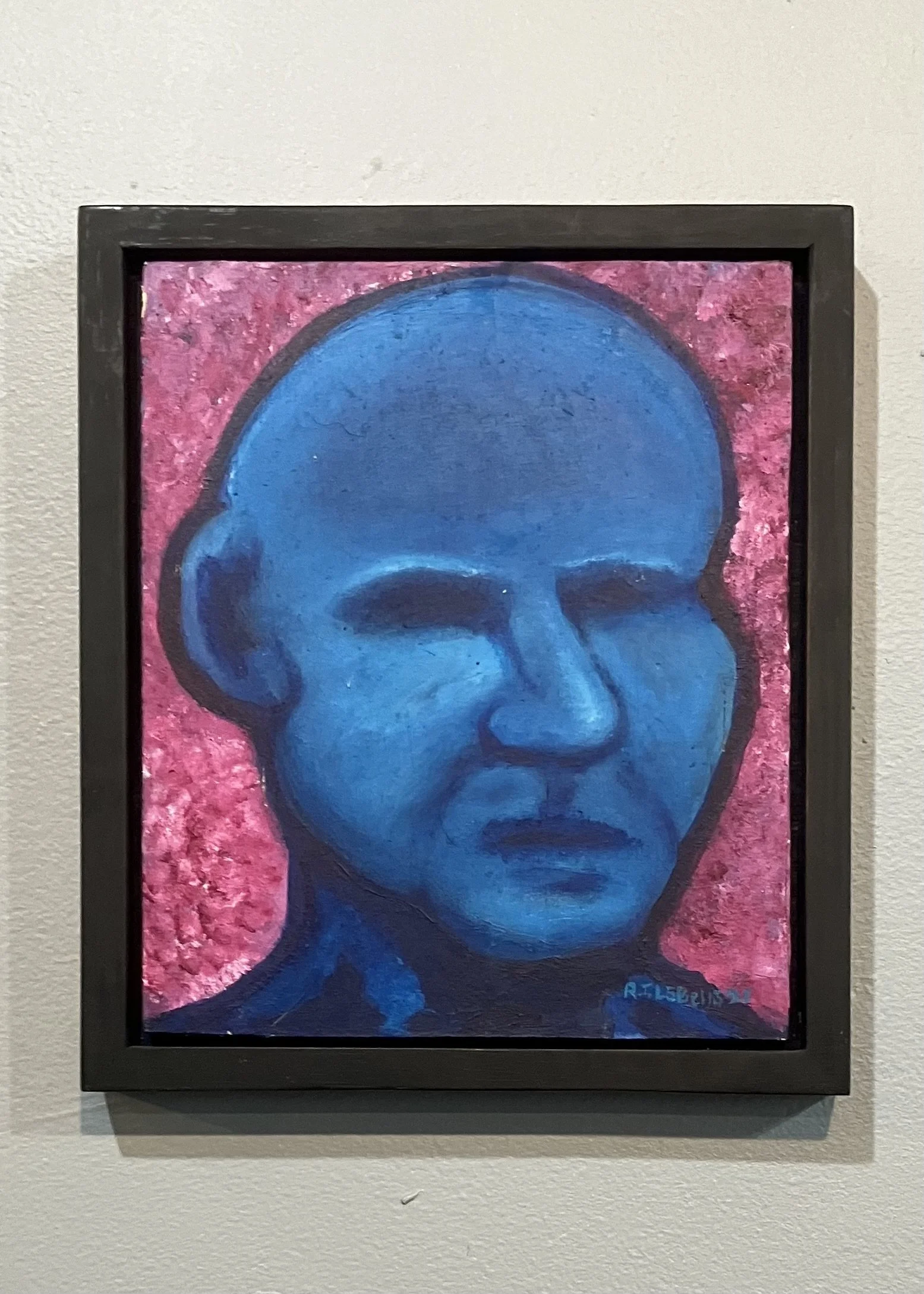
Ronnie LoBello, Untitled, [Blue Man] 1995, Oil on board, 11 x 9 in.
The Blue Man by Ronnie LoBello is a mysterious portrait that had some type of special significance to the artist to merit a custom-made wooden floater frame.
The Blue Man's gaze is steady with eyes hidden (or unpainted?) in their sockets, looking off to the right of the viewer.
One can wonder whether this portrait is connected to Ronnie's painting of Faces in the Crowd that is full of similar blue, gray, and white portraits. Or is this simply a stylized manner of rendering faces that the artist relies on?
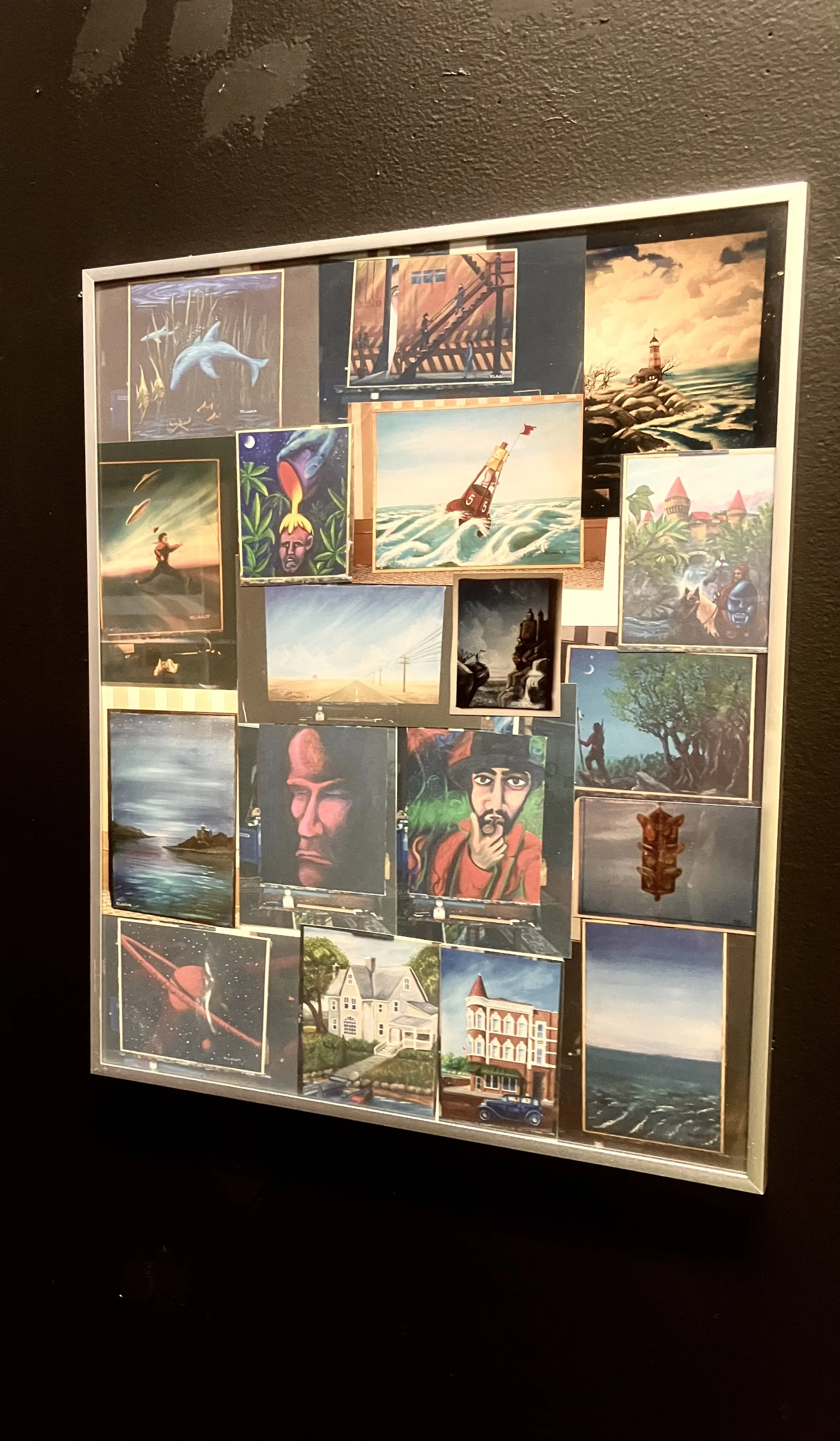
Photos of eighteen more paintings by Ronnie LoBello whose location, date, and status are unknown.
Collected and framed by Justyna Frank, co-owner of Cosmic Bikes
Among the paintings in the collection of photos of Ronnie's documented paintings, there are five land- or seascape paintings with wide open vistas, with one featuring a floating buoy, another a light house, another of what looks like a telephone pole, and two more with an open sky line.
Land- and sea- and city-scapes are common subject matter in Ronnie's paintings, as are portraits. Notable is the cosmic or outer space painting of a red planet with rings in this collection of photos of his work, and a painting featuring a figure running, seemingly away, from UFO flying saucers, in an open field.
Notably, only of these paintings has a landscape orientation; the other four are all vertical portrait oriented.
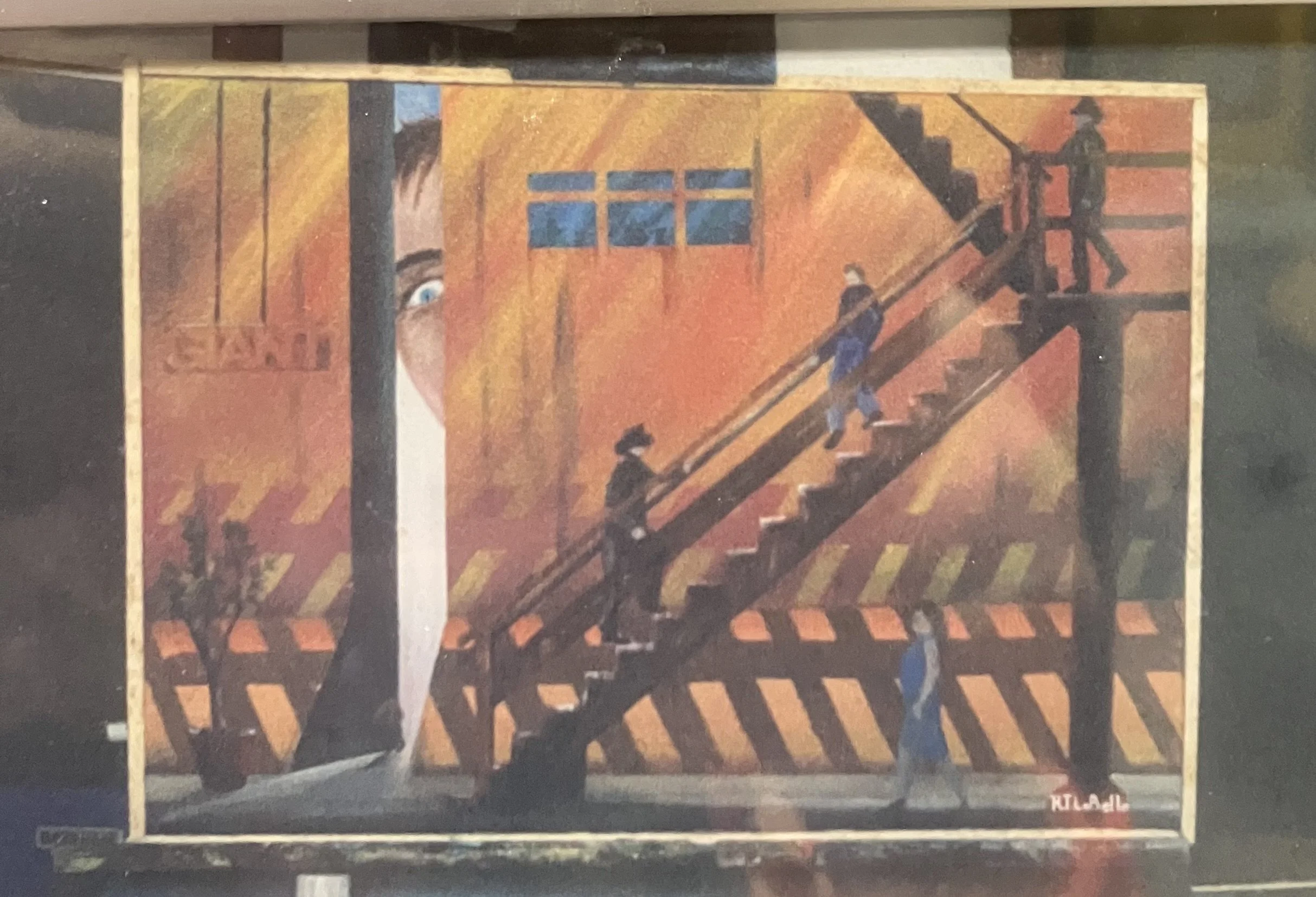
This cityscape painting, whose location and status are unknown, by Ronnie LoBello shows the CTA (Chicago Transit Authority) El (elevated) train stop with a stairwell leading to its upper level. Though only a small photo of it was included in the Cosmic Traveler exhibition, it is a painting that deserves attention and some comment.
It features a pattern of alternating rectangles of shadow and light cast by what may be a fence, which angles slightly to the left along the ground, then to the right on a wall. The stairwell also adds two triangles that disrupt or complicates repeating pattern of the strips of shadow and light, while the three figures blend into and complement the alternating light and shadow rectangles and share its brown color.
This painting radiates an unexpected pleasant warmth to what may be a gritty street scene withs its yellow to tan light areas and deeper dark brown stairwells, and it includes a playful reference to the artist, whose reflection appears unexpectedly in one of the pillars eyeing his creation.
Underlying this painting is a spirit of admiration for the distinctive structures and architecture of a city and its residents that one finds in paintings by WPA artists in the 1930s, like O. Lewis Guglielmi in his painting View in Chambers Street (1936).
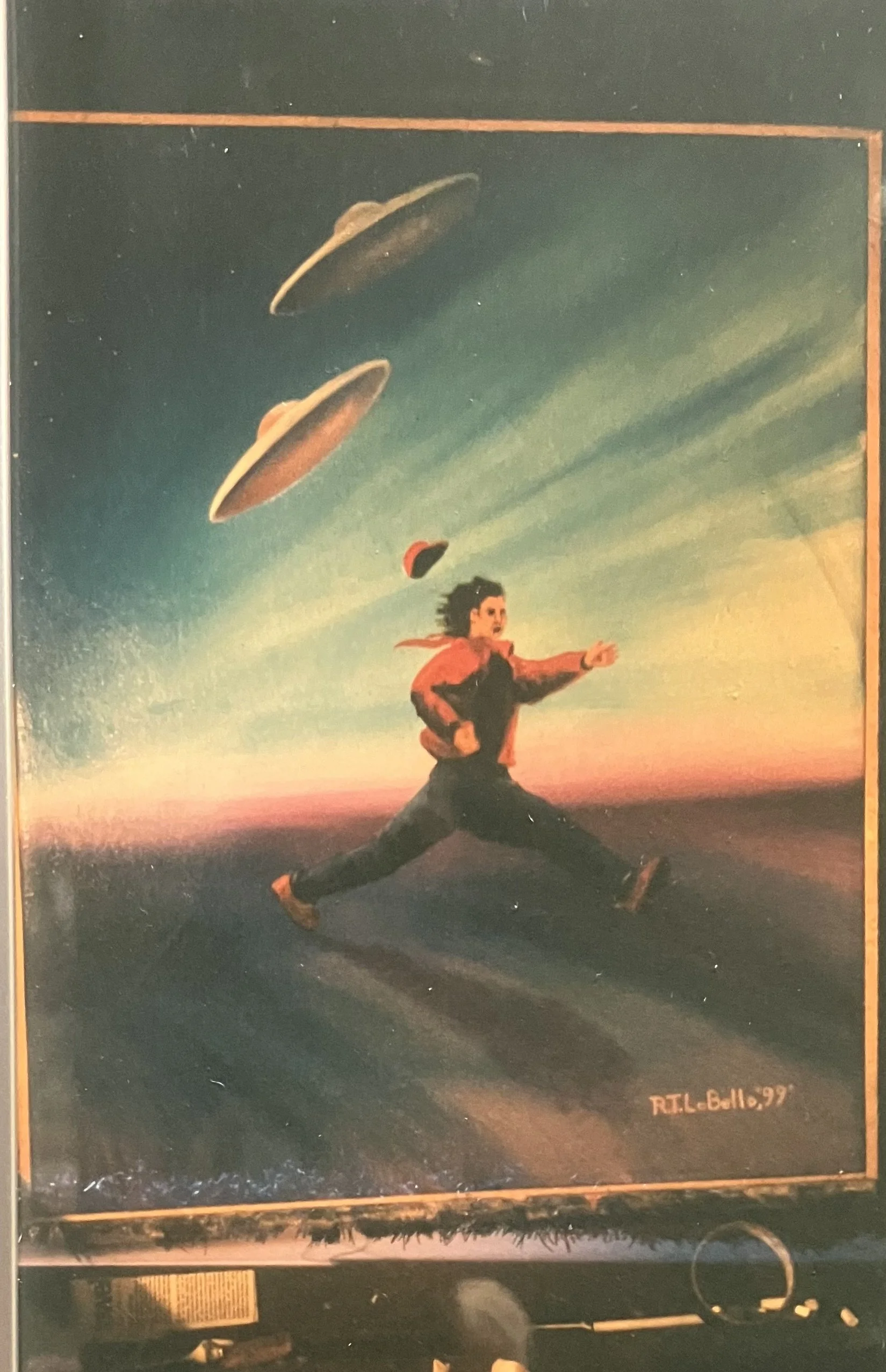
Though only a small photo of it was included in the Cosmic Traveler exhibition, another painting by Ronnie LoBello deserves attention and some comment.
This painting, whose location and title are unknown, could be named On the Run from UFOs, introduces a humorous element of a figure running or race walking in an open field with two retro-future looking UFOs above him.
The sense of dynamic movement in the painting is emphasized with the UFOs tilted at a sharp angle, and the diffusion of light from the lower left corner of the painting that expands towards the right.
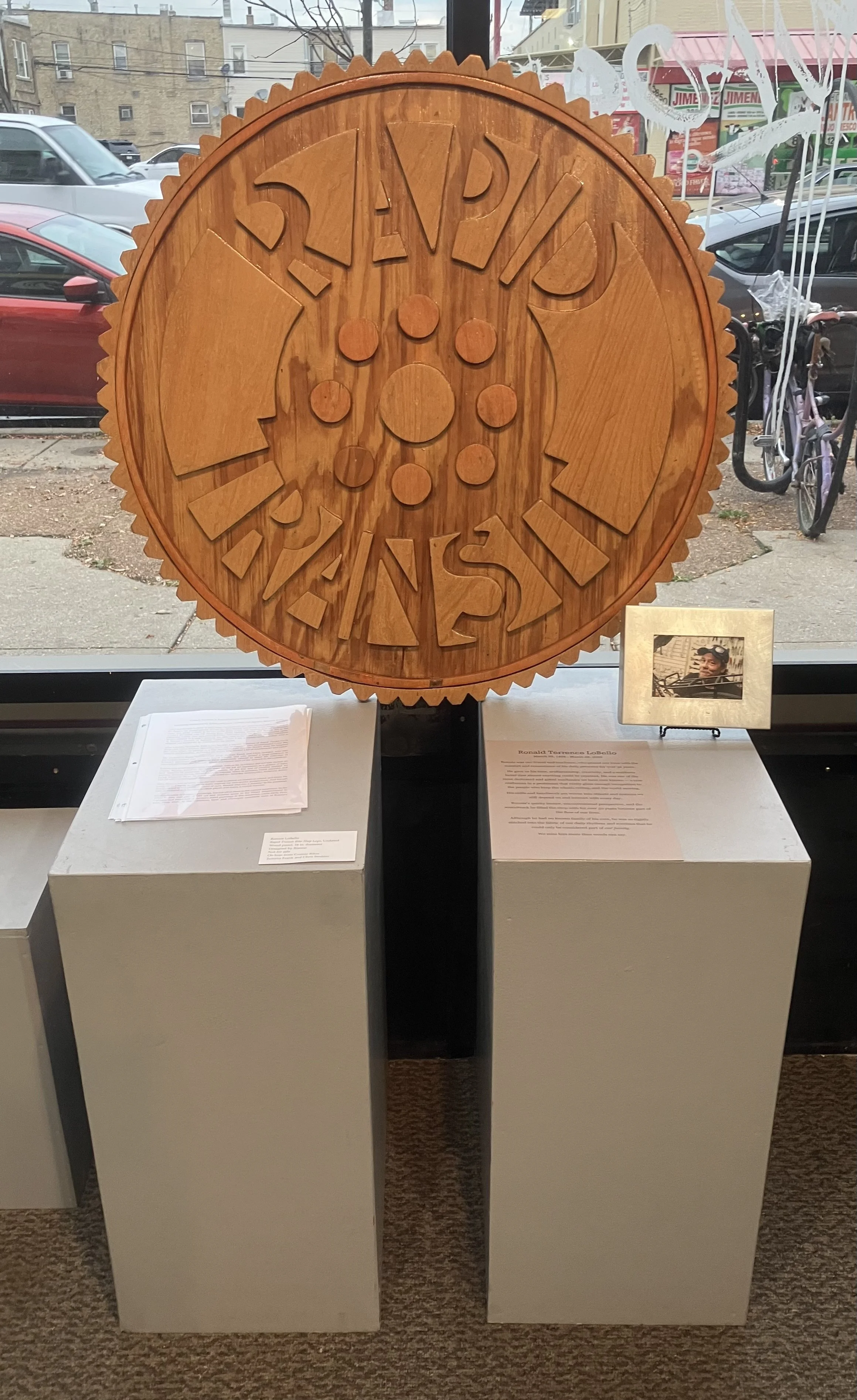
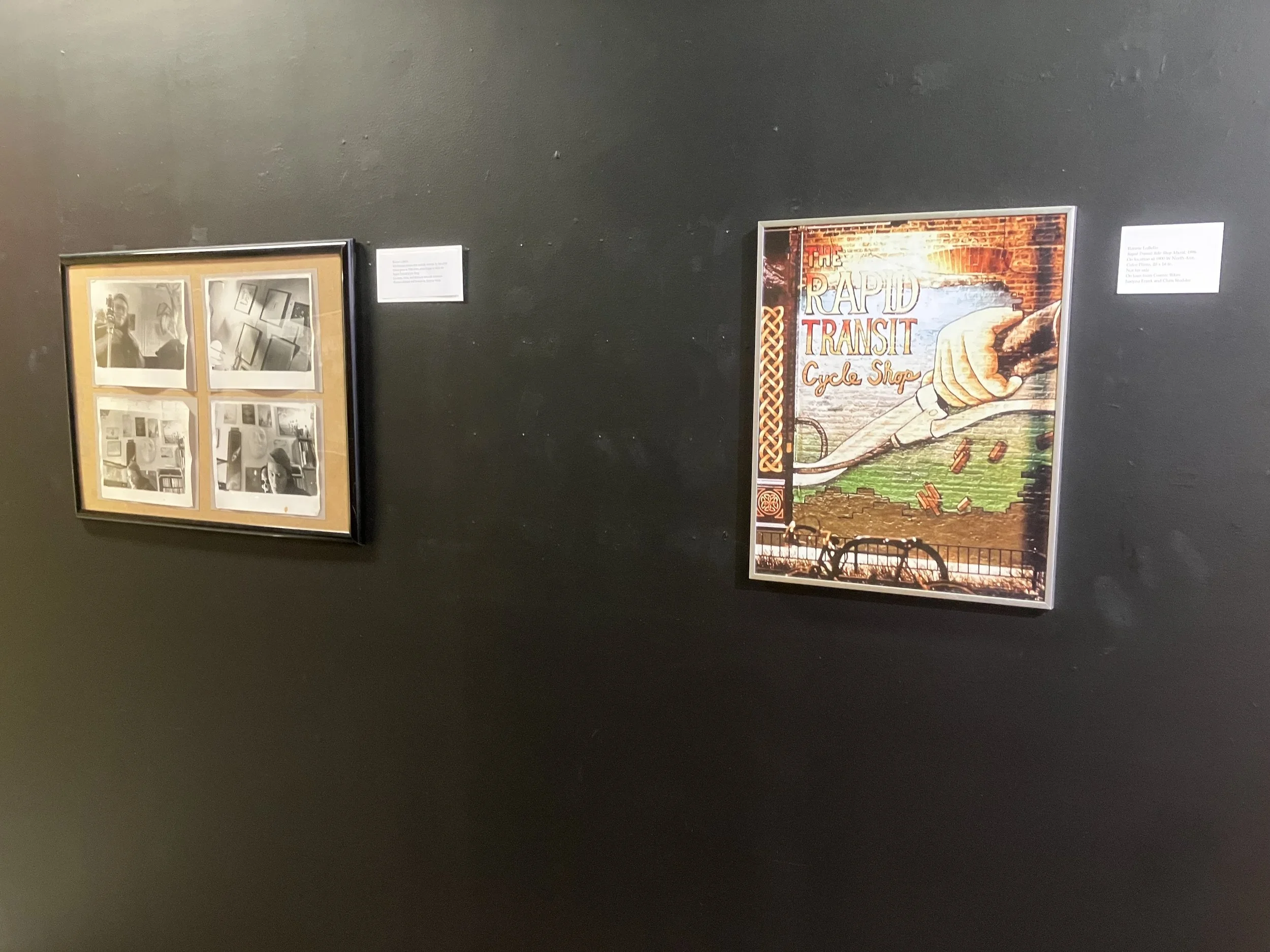
Installation views of Cosmic Traveler: A Ronnie LoBello Memorial Exhibition, October 2027. Included are Ronnie’s mural at the Rapid Transit Bikeshop 1994 to 2015 which was on 1600 West North Avenue and Wolcott Avenue in Chicago, as well as a wood panel logo design he made for the Rapid Transit Bike Shop.
The owners of Cosmic Bike Shop, Justyna Frank and Chris Stodder, who employed Ronnie, opened a new bike shop in 2016 called Cosmic Bikes. Ronnie helped prepare this new space and build whatever was needed for the bike shop and continued to work there until his untimely passing in March 2027.
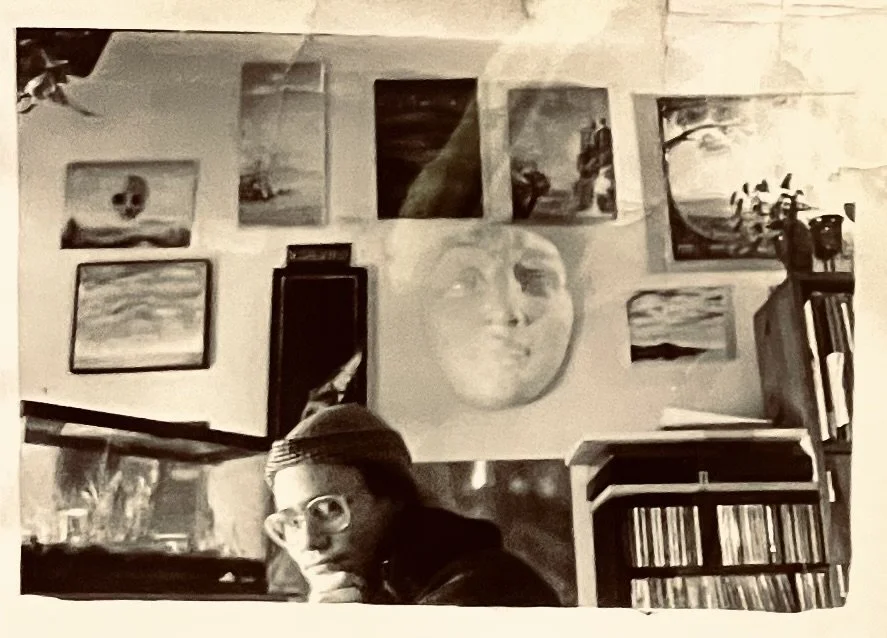
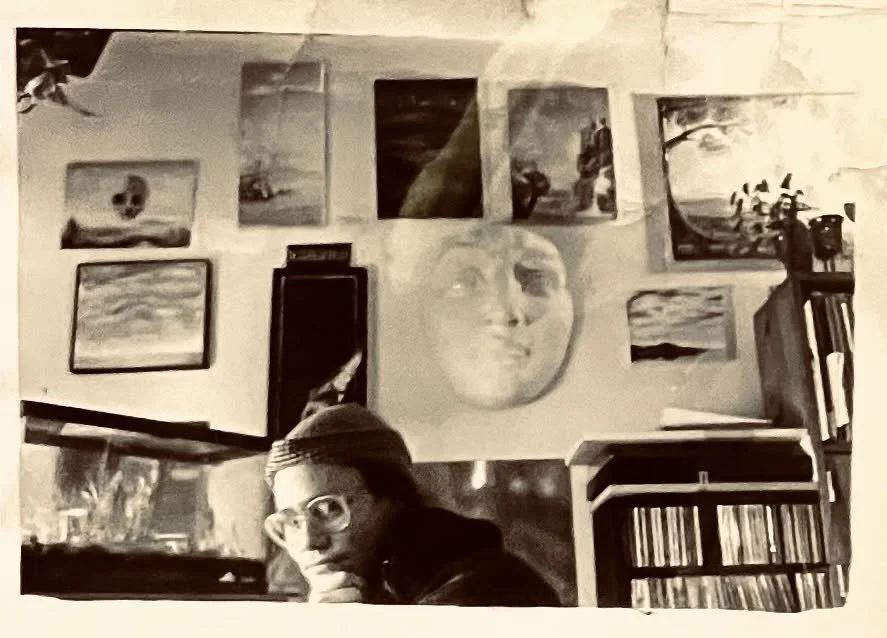
A Photo of Ronnie LoBello, a Self-Portrait with his Artwork. This photo dates to the early 1990s and includes eight of Ronnie's paintings on the wall behind him.
What directions will my art take is likely a question every artist asks themselves, as they review their prior artwork and look ahead.
We see Ronnie's initial focus in painting was land- and seascapes, with one space painting, and that he eventually branched out to include cityscapes and buildings, portraits and bicycles, submersibles, and other devices. And the scale of his paintings increased in size and ambition and complexity to 48 x 36 inch paintings that were done in the late 1990s and early 2000s when Ronnie's creative output reached its developmental peak.
No exhibition followed to mark this occasion; instead, like many artists who cannot find recognition or an internally motivated personal reason to continue painting in the face of a lack of critical recognition and/or financial success, Ronnie seems to have just stopped painting.
Agitator, as an arts organization with a gallery that recognizes underrepresented artists, however, has been able to offer some recognition, albeit, belated and posthumous, to Ronnie's paintings in the Cosmic Traveler: A Ronnie LoBello Memorial Exhibition.
It has been a heart warming, yet also sad, experience for me to curate this memorial exhibition to Ronnie.
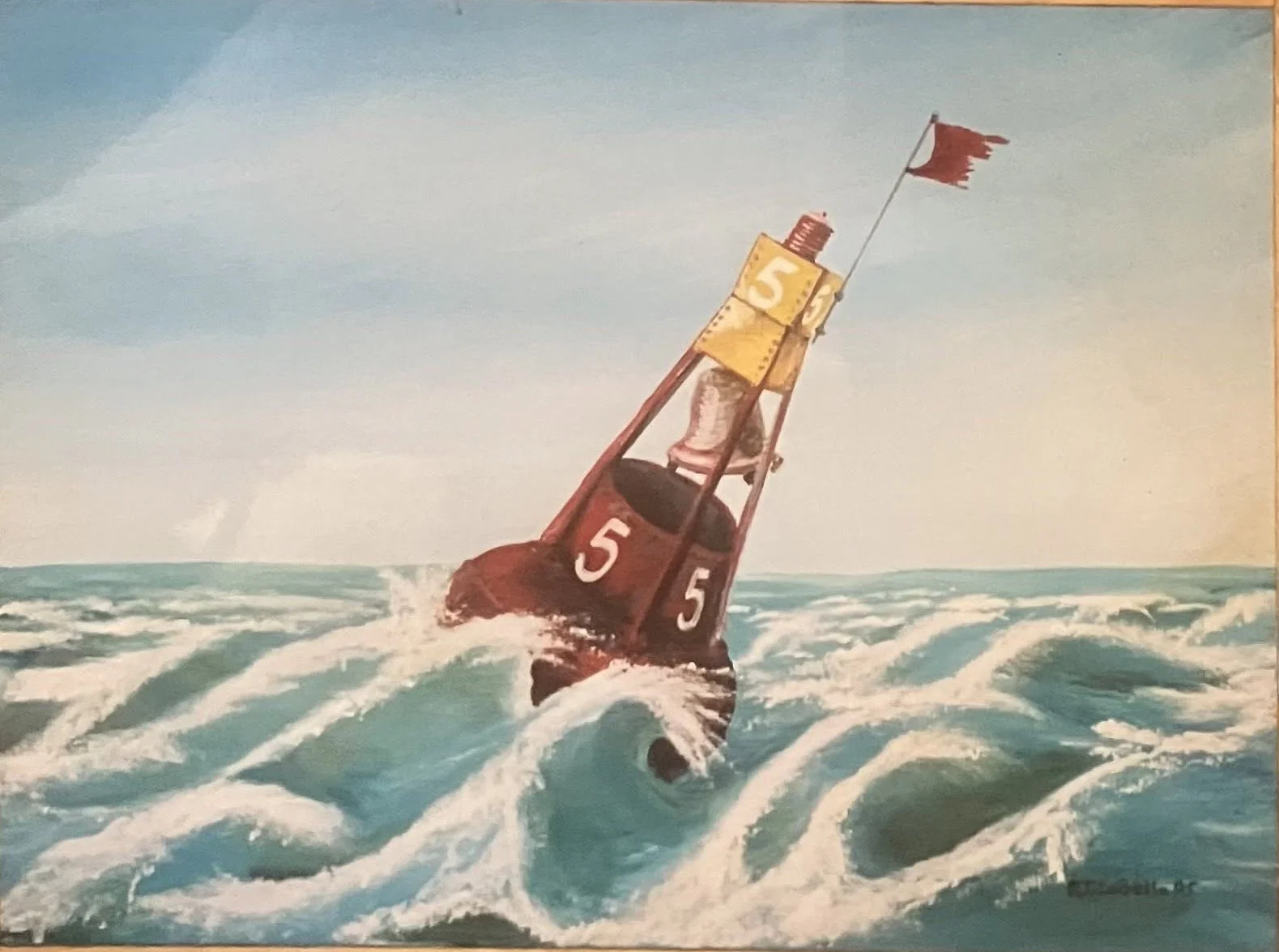
To the left: Ocean Bell Buoy, Oil on canvas, 2005, Location and Status unknown
Ronnie LeBello's seascapes features an Ocean Bell Buoy with a pair of numerals 5 (or the number 55?) and a tattered red flag. Likely the artist identified himself with this ocean buoy being rocked by high, choppy waves, yet still performing its duty to sound a warning to approaching ships.
The Ocean Bell Buoy painting also relates to land- and seascape scenes in which Ronnie features or includes a lighthouse, another guide that ensures safe passage to maritime traffic. And it relates to Ronnie's abiding interest in mechanical devices, like a suspended traffic light in another painting which also functions to ensure safe transit, as well as a bicycle derailleur, which allows the cyclist to adjust the force needed to pedal based on riding conditions, and an imaginary hybrid fish-submersible.
Cosmic Traveler: A Ronnie LoBello Memorial Exhibition
Personal ReflectionS
By Andrea Kaspryk, Agitator Member Artist-Curator
I first met Ronnie LoBello in 2000 when I moved into the Artist in Residence building in the Edgewater neighborhood of Chicago, and Ronnie was living in the building next to mine. Our paths crossed in the art world when a new cafe opened near us, Metropolis, where I exhibited artwork during their initial opening month and Ronnie did in the following month. And now around twenty-five years later, our paths have crossed again. After I learned of Ronnie's passing, the idea came to my mind to see another exhibition of Ronnie's artwork at Agitator Gallery where I am a curator-artist member who is allotted one month for an exhibition of my choiceAfter meeting Ronnie in 2000, I also became a regular customer of Rapid Transit Cycle Shop, and it was Ronnie, seeing me coming and going on my bike from a neighboring building knew that I was avid cyclist, who recommended I visit this bike shop where he worked as a bike mechanic. I got to know Ronnie from my frequent visits to the bike shop, as I rode a lot, so my bike needed a lot of maintenance and repair.The owners of Rapid Transit Cycle shop, Justyna Frank and Chris Stodder, who also previously owned and operated Rapid Transit, and who owned a large collection of Ronnie's paintings and artwork, have generously offered to share the collection of Ronnie's paintings and artwork, which constitutes most of the artwork in the exhibition. Estranged from his own family, Ronnie became not only their long-time reliable and resourceful bike shop employee, but a part of Justyna and Chris's family.Ronnie was a self-taught artist and painter, who as far as I know did not take formal art classes. Ronnie, however, did have some on the job art experience as a painter of signs and designer of structures for a time. Likely, he got this sort of creative applied art position because he was blessed with an intrinsic talent to envision, build, remodel, and repair whatever he set his hands on or mind to—bicycles, motorcycles, furniture, floors, and all sorts of mechanical devicesThus, Ronnie was an artist who did not need to attend art classes or school, and likely the better off as a result, as he could freely explore his own quirky perspectives. And though firmly rooted in this physical world of ours, Ronnie was also a dreamer in his paintings, who envisioned and traveled to other places and times, a cosmic traveler.
I had seen only some of Ronnie's paintings, but not all of them in the current exhibition. I had no idea that Ronnie had been such an active painter in the 1990s and early 2000s. He seems to have stopped painting in the mid-2000s and did not talk about it much with me. In the 1990s Ronnie was part of DIY art and creative space in the Pilsen neighborhood in Chicago, and about half of Ronnie's dated paintings in this exhibition could likely have been made there. In this exhibition, land- and cityscapes constitute most of Ronnie's subjects for his paintings, with three featuring idyllic landscapes with a home and castles, as well as three with UFOs flying in them.
Portraits are also a common theme in this exhibition, with a fish humanoid alien, perhaps part of the crew of one of the UFO-themed paintings, and a man wearing a dark blue Fedora hat a coat with a high collar.
Perhaps the most striking image of the exhibition is the hybrid fish-submersible with its bright red surface encased in a yellow frame that wraps around its surface. This image perhaps can stand in for the unique spirit of Ronnie, the builder and artist, who astonishes the viewer with his unique designs and perspectives, and flashes an appreciative smile as viewers and customer marvel at his handiwork. ———