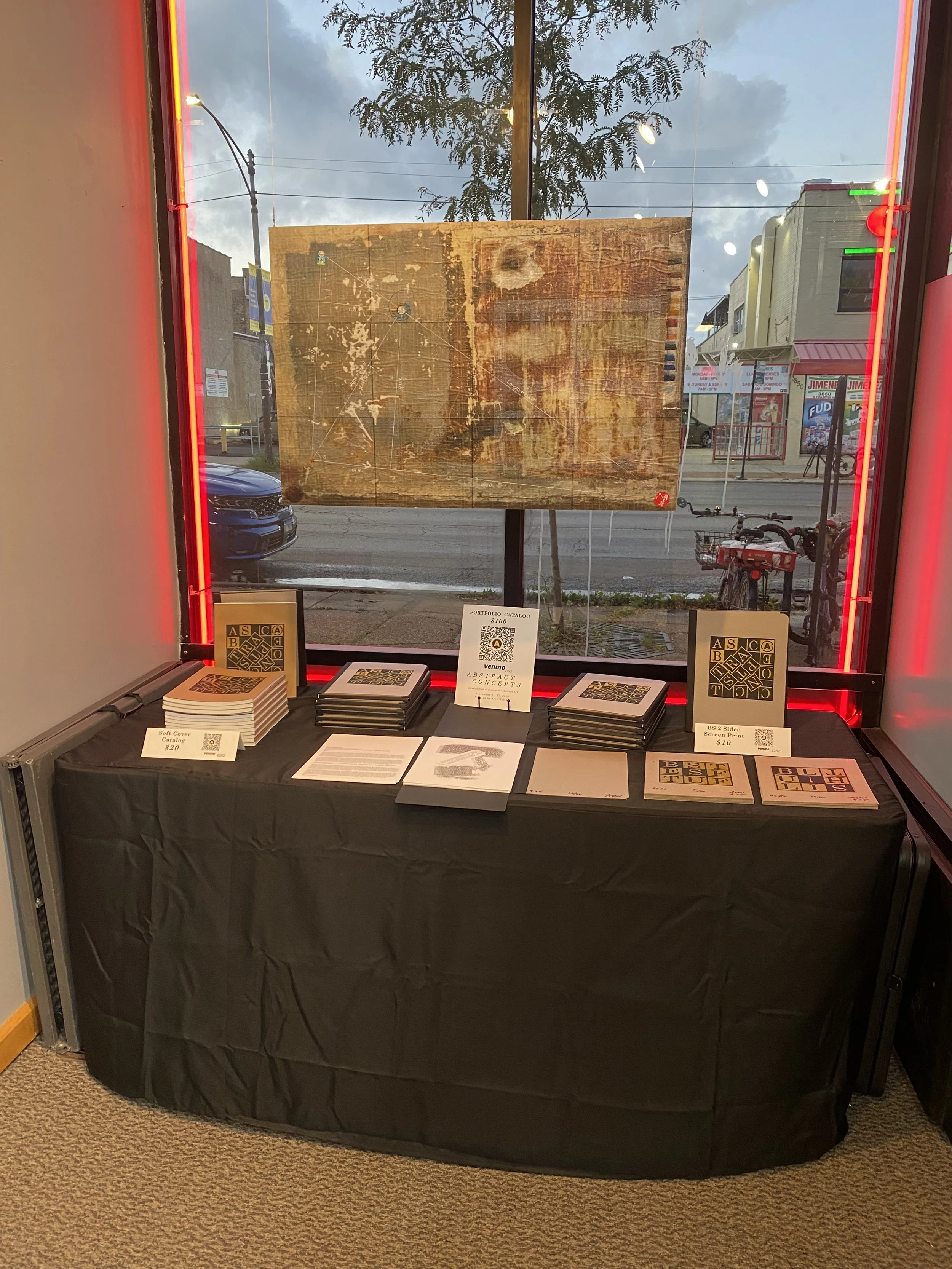
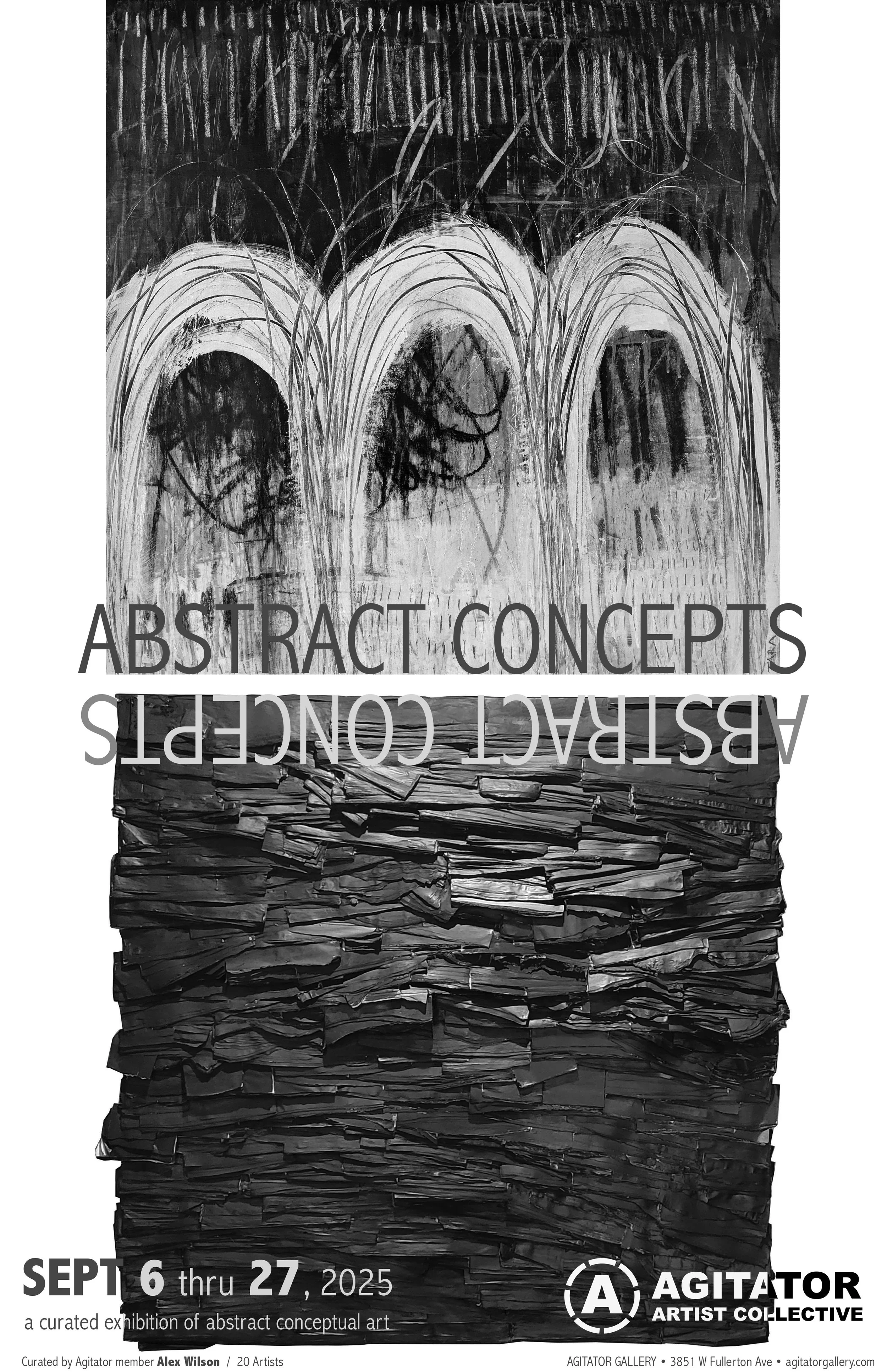
Abstract Concepts
Driven by curiosity and built on purpose, this is where bold thinking meets thoughtful execution. Let’s create something meaningful together.
Abstract and conceptual art have been part of image making since the dawn of time. How large of a role either have played in art history has waxed and waned over the centuries. Since the development of photographic processes abstraction has played a larger and more significant role. As abstraction grew so did the concepts behind making art, leading to new styles and schools of thought. These modern movements, including Impressionism, Symbolism, Fauvism, Expressionism, Cubism, Futurism, Dada, De Stijl, Surrealism and Social Realism would teeter back and forth between abstraction and represen- tation as well as aesthetics and ideas. The Abstract Expressionists would ultimately come to define the popular idea of what Abstract Art is in the minds of most viewers. This would be an abstract art using a visual language of shape, form, color and line to create a composition which exists independently from representational reference and places importance on the emotional response that the image evokes.
If Abstract Expressionism came to represent what most came to think of abstract art, Conceptual Art came to represent nearly all art that wasn’t traditional painting or sculpture. During the 1960’s, in response to Abstract Expressionism, a number of artists prioritized the idea or concept behind a work over its physical execution, aesthetics, or material form. Of course this was pre-dated nearly fifty years earlier by Marcel Duchamp with his ready mades, as well as other Dada artists. These new Conceptual Artists used various media, including text, performance, ready made objects, and documentation, to convey their conceptual basis. The physical artwork becomes secondary to the underlying idea, which challenges traditional notions of art and prompts viewers to consider the definition of art itself.
Conceptual Abstract Art combines the philosophical emphasis of Conceptual Art with the non-repre- sentational techniques of Abstract Art. While Abstract Art focuses on visual and emotional expression through elements like color and form, Conceptual Abstract Art uses these visual elements to explore deeper ideas and questions about existence, society, and the nature of art itself. The idea or concept behind the artwork is the most important aspect, with the final piece acting as a physical manifestation of that thought. Key trends in contemporary Conceptual Abstract Art involve the integration of technol- ogy, a focus on sustainability, and explorations of social and political themes. These trends push beyond traditional painting and sculpture to create immersive, multi-sensory experiences that challenge and engage the viewer
Agitator Gallery is pleased to present Abstract Concepts, an exhibition of Conceptual Abstract Art.
Beyond just shape, form, color, line and gesture, the work included in this show seeks concepts that engage in a larger dialog about issues and ideas important to the artist. The messages match, mirror and surmount the aesthetics of the visual image. The work addresses politics and philosophy, symbols and language, history and religion, location and geography, and other ideas that challenge convention. Twenty Chicago artists are participating in this exhibition with wide array of style and motivation, representing diverse backgrounds, experience and perspective. The group of work both compliments and contrasts individual pieces by the different artists. Included in this catalog, in addition to the images of the displayed work, are the artist’s statements that will help inform the viewer about the deeper content.
Abstract Concepts is more than just a collection of pretty pictures. It takes abstract imagery beyond the surface, inviting viewers to interpret and engage with the artwork on another level.
Alex Wilson, Curator September 6, 2025
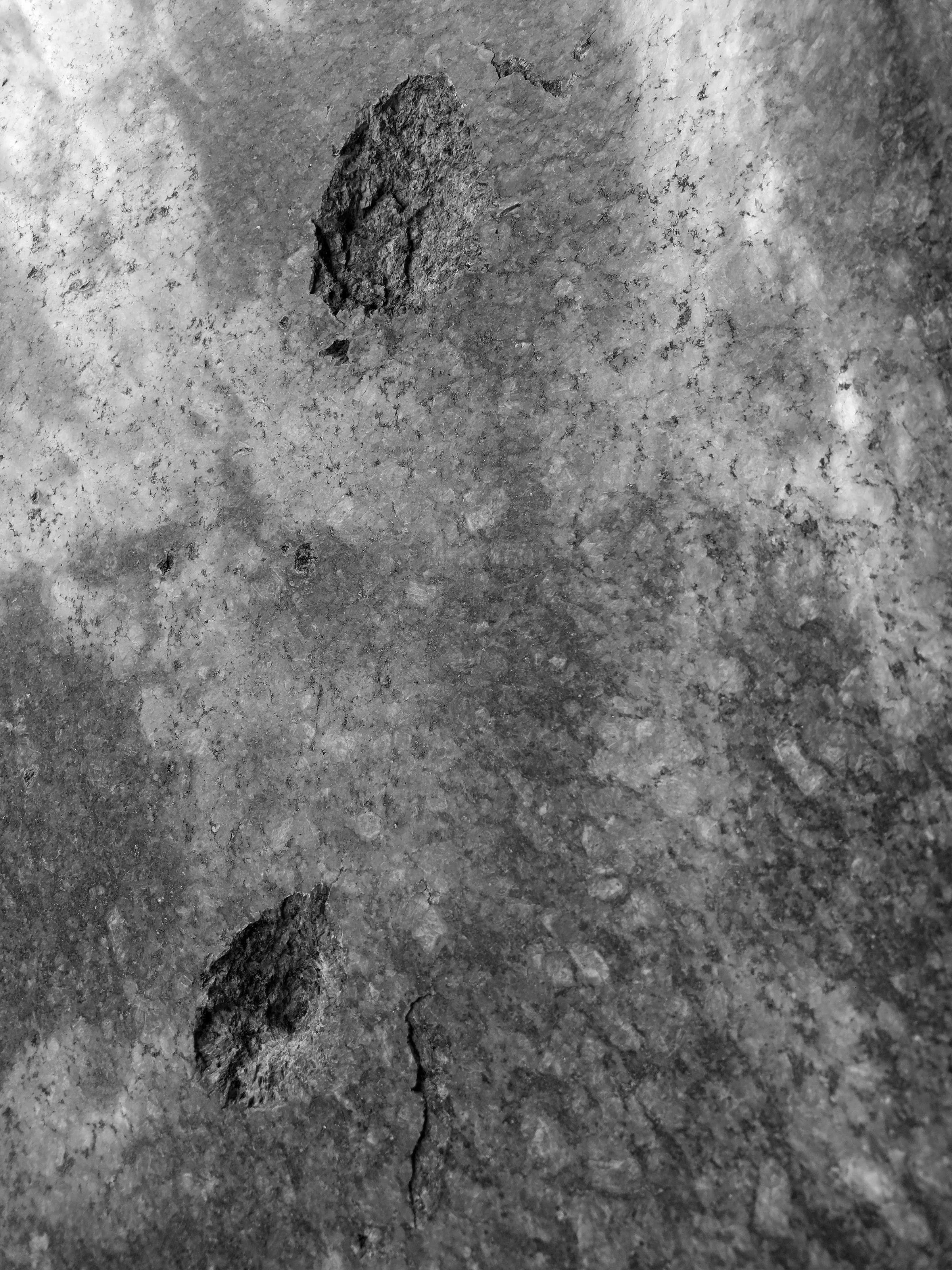
Heitor Alvelos
War Wounds II (Berlin 1945)
Photograph 40cm x 30cm 2025
Close-ups of bullet-hole marks on the red marble base supporting the Siegessäule, Berlin - actual rem- nants of the 1945 battle that liberated Berlin from the Nazi regime. All ceases to be abstract when context emerges.
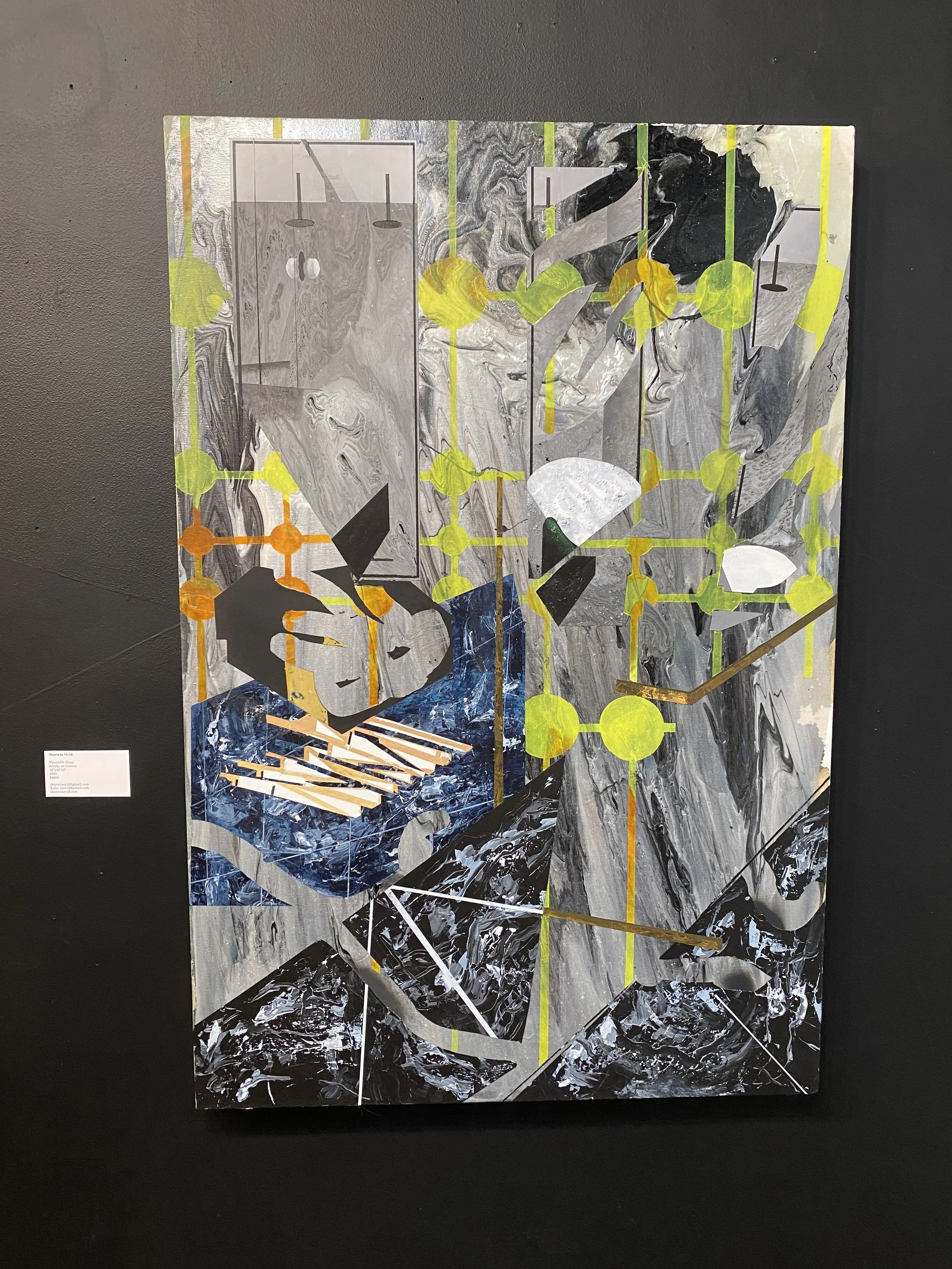
Sherwin Ovid
Wavetable Decay
Acrylic on Canvas 40”x30”x2”
2025
In this painting, partial glimpses of the pictorial and representational are situated within an array of flat and modeled compositional elements and are often enveloped by formal systems of abstraction. Digital collage techniques are integral to the processes of constructing the work high- lighting the entangled relationship between the virtual and its material surface. Ovid also makes use of the language of rational geometric diagrams, but upends them by making improvisational gestures through pours of slow-drying liquid mediums. This produces cascading layers of paint that act in contention to the rigid structures. Mixtures of contrasting iridescent color create visual vortexes, while undulating waves of marbled visual patterns catapult the viewer through different perceptual registers and visual scales.
Ovid’s paintings explore the interface between the built and natural world. He investigates dif- ferent approaches to spatial organization using a combination of precise, almost trompe l’oeil-like painted renderings, areas of poured paint that create marbled effects, and sharp, angular planes (painted with iridescent pigment) that appear to change color, recede or come forward based on the placement of light and the viewer’s position before them. Pigment, resin, bubbles, and dirt are some of the materials that Ovid accumulates on the surface while constructing the illusionistic spatial environments of his works.
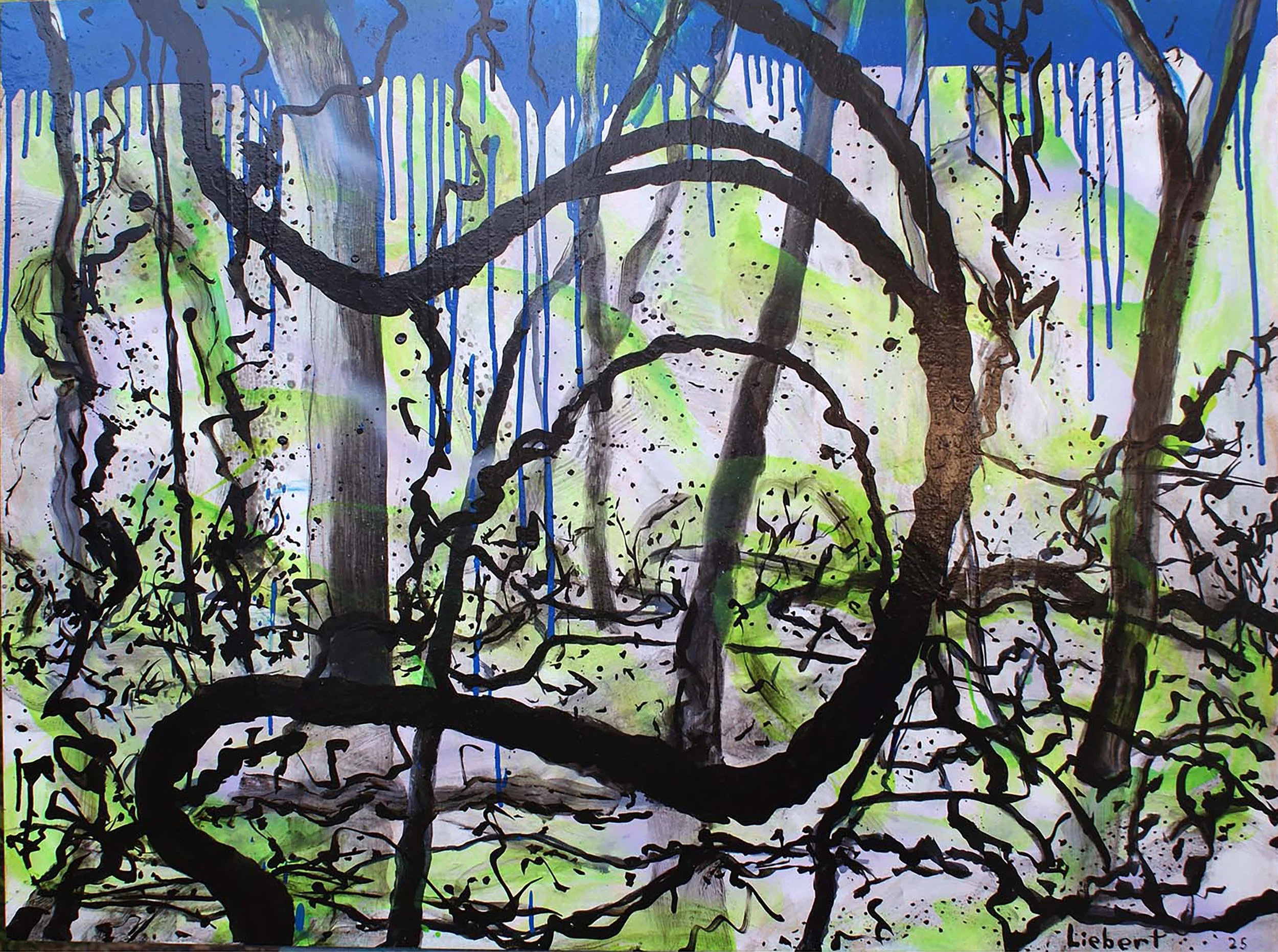
George J Liebert
Untitled
Acrylic Polyurethane on Birch Plywood Panel
30”x40”
2025
I’m interested in the coding and translation of experience. This painting is made with acrylic urethane on a birch plywood panel. It’s a transla-
tion of a drawing made in situ with ink.
I think the original ink drawing is rather romantic, tender even. This translation into acrylic urethane, with its rather industrial feel, renders
the image rather harshly.
“No poet, no artist of any art, has his complete meaning alone. His significance, his appreciation is the appreciation of his relation to the dead
poets and artists. You cannot value him alone; you must set him, for contrast and comparison, among the dead.” This is T. S. Eliot from Tradi-
tion and the Individual Talent, 1923. It still works for me fairly well.
I suppose, as a painter, and as a teacher, I am kind of a Janus figure, something of an arbiter between the past and possible futures.
So I see my work as a navigational tool, something to help me understand where I have come from, and where I might yet go.
Another line from a poet, Robert Duncan:
“Often I am permitted to return to a meadow
as if it were a scene made up by the mind,
that is not mine, but is a made place.”
@georgeliebert
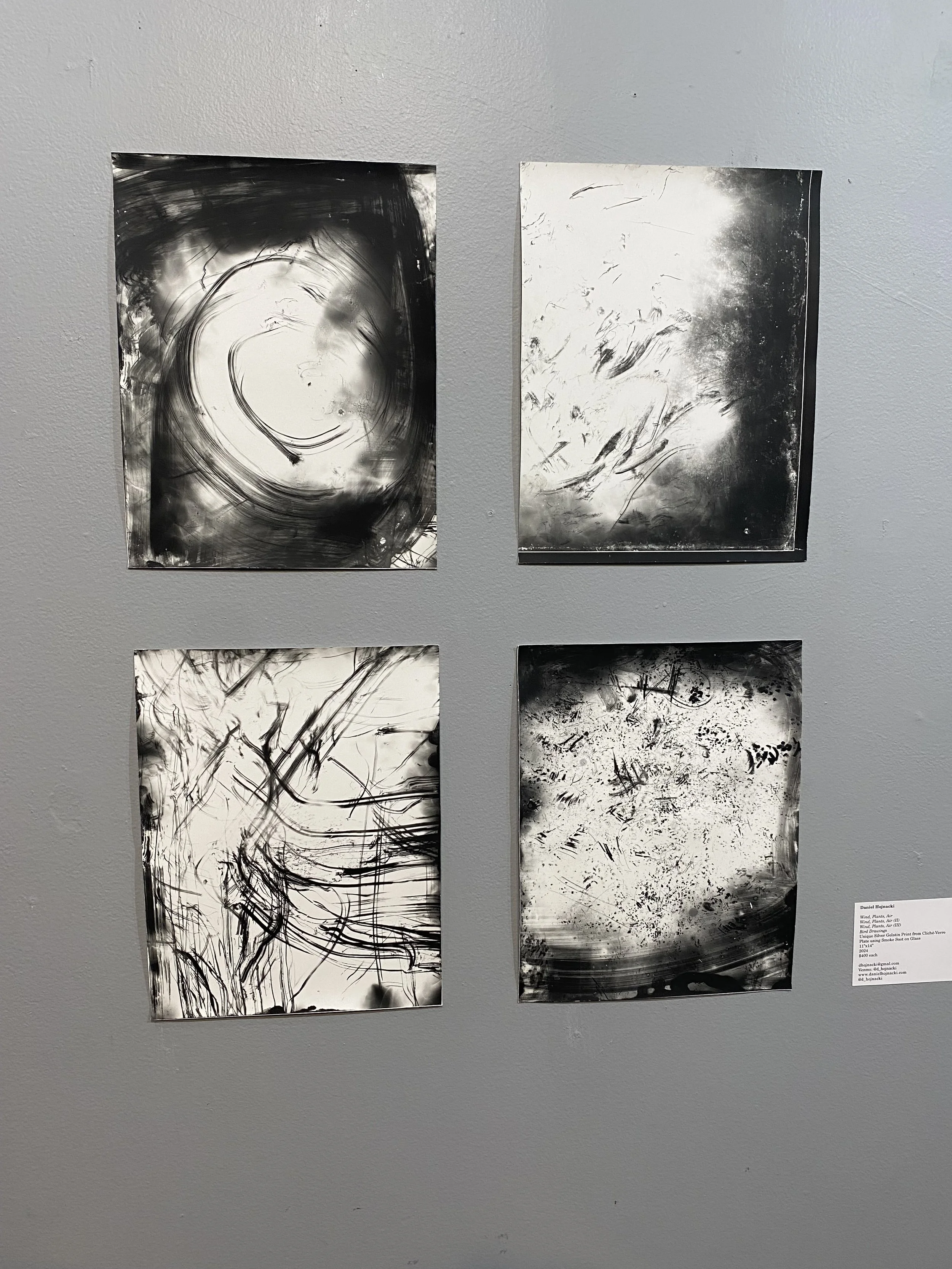
Daniel Hojnacki
Bird Drawings
Unique Silver Gelatin Print from Cliché-Verre Plate using Smoke Soot on Glass 11”x14”
2024
For this series of photographic images I have used a 19th century photographic printing technique called cliché-verre. One of the oldest methods of this technique is created by applying smoke soot to glass from an oil lamp flame. The vapors of the fine soot naturally adhere to the glass which then be- come my drawing surfaces and are then later contact printed in my darkroom upon light sensitive paper.
The process invites for the most subtle and delicate drawings to be made, by allowing the trees and plants to move in the wind pressed against the plate, their memory is preserved in real time, and when bird seed is laid upon it, each mark and trace left by the movement of a bird’s body feeding is remem- bered. These marks are the vestiges of chance interactions in collaboration with the natural world. By trusting these performative happenings to unfold, I can slow down and still the often overlooked and understated importance of the fleeting world around us.
Cathy Haibach
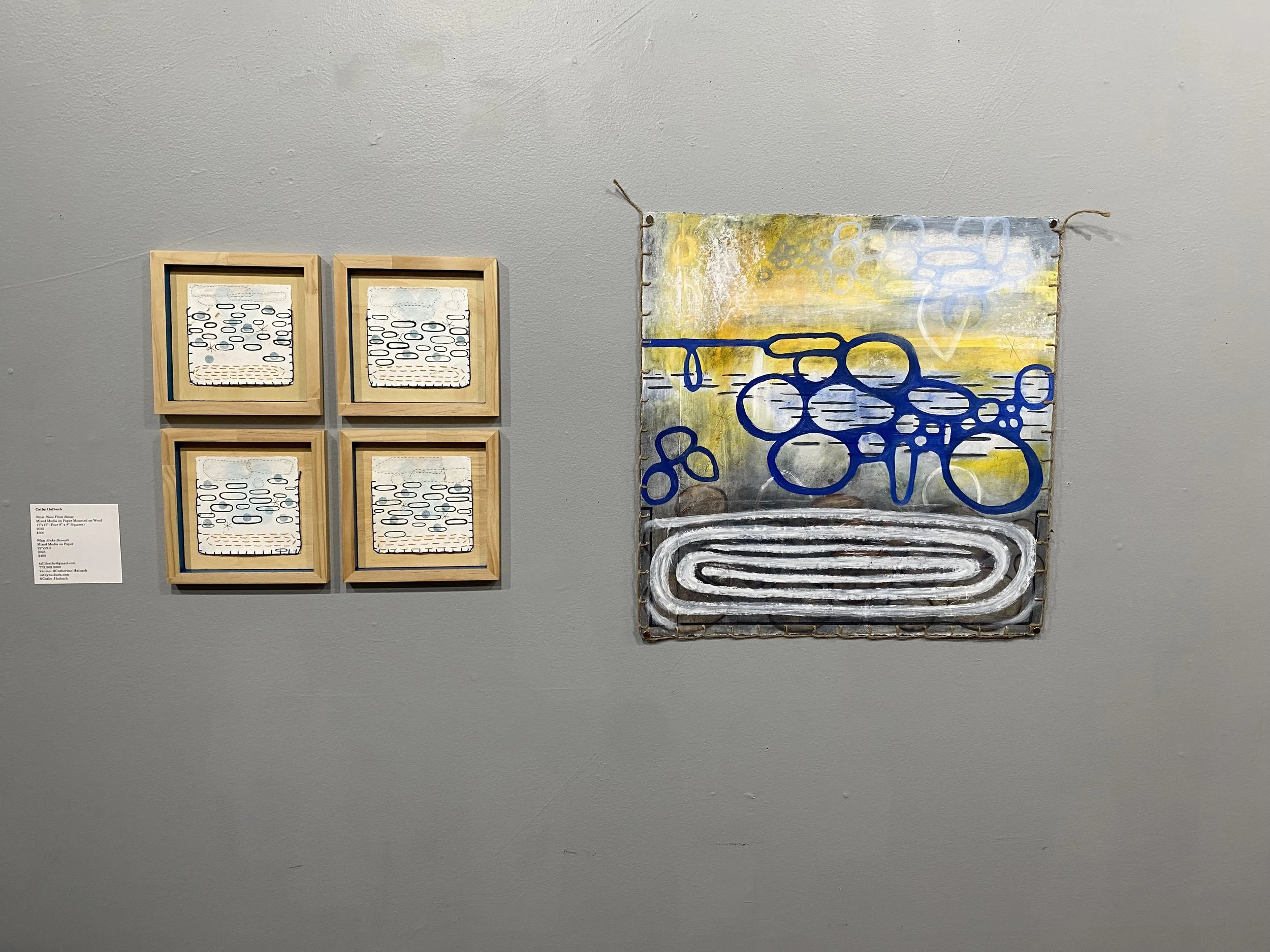
What Rises From Below
Mixed Media on Paper Mounted on Wood 17”x17” (Four 8” x 8” Squares)
2025
What Rises From Below includes four vignettes that consider how we humans are destroying our own water supply. Abstract shapes are references to clouds, raindrops hitting toxic pools, and underground aquifers in which surface toxins have accumulated. The vignettes are constructed from throw-away ma- terials including careworn paper, oil and acrylic paint, and bits of thread.
My work explores our evolving human mythology, which shapes our relationships, informs our choic- es, and defines the structures we build, both consciously and subconsciously. I aspire to frame these narratives through visual storytelling that describes both our micro (personal) and macro (collective) perceptions.
I am particularly drawn to human constructs, both metaphorical and literal, and how they shift over time. My art investigates moments when structures, whether societal or ecological, teeter on the bound- ary between control and collapse. Themes such as the destruction of our native landscape and species, the instability of our financial infrastructure, and our obsessive relationships with objects are central
to my work. These elements are formative to our identity and our survival, yet they often dictate our lives in ways we do not fully recognize. By deconstructing and reassembling these narratives, my work creates a space where familiar objects strike a chord of recognition while leading the viewer to new interpretations.
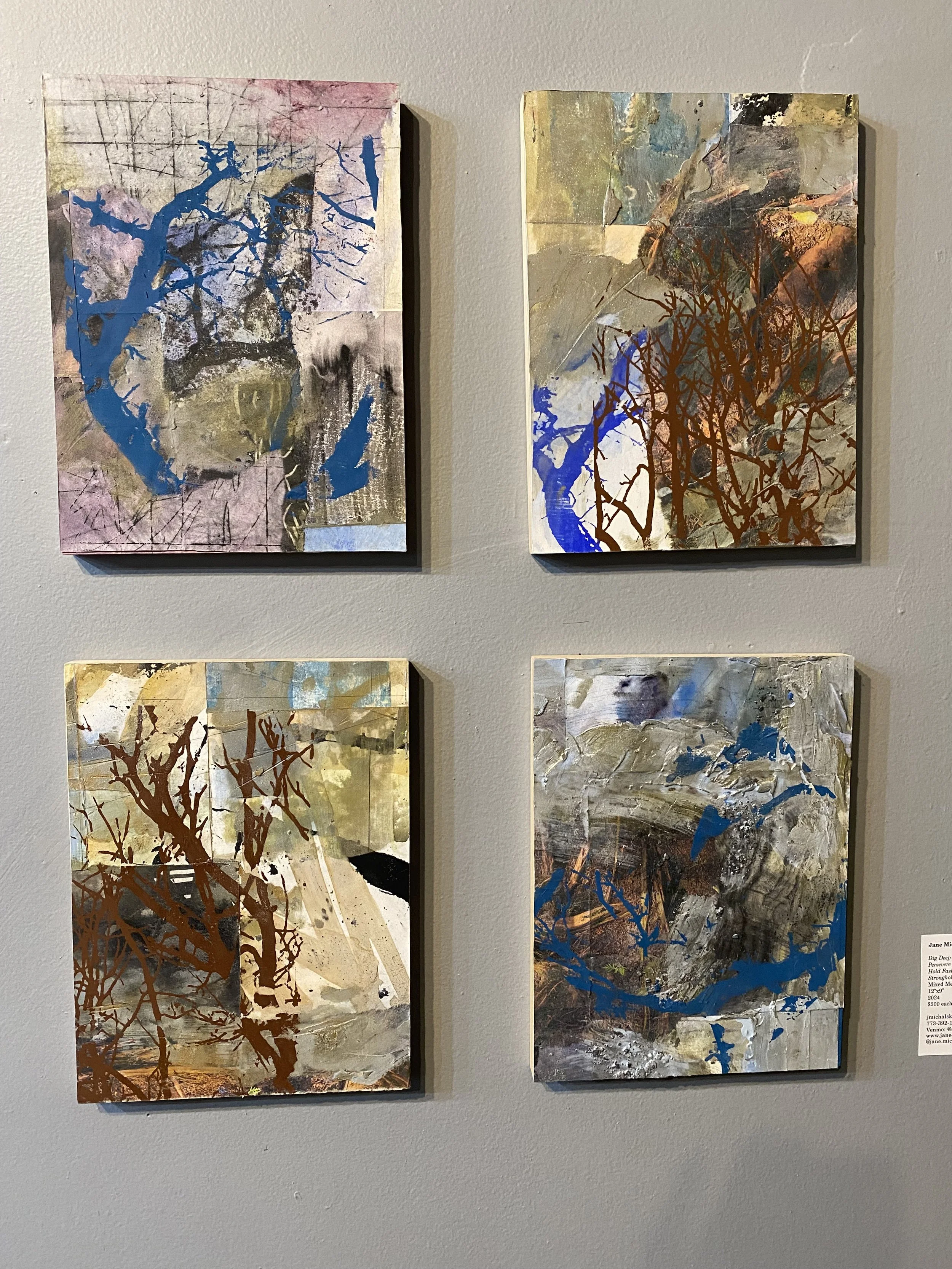
Jane Michalski
Hold Fast
Mixed Media on Paper, Mounted on Panel 12”x9”
2024
Photographs used in these abstract works are from Cave Point Park, a place of high limestone cliffs along the shore of Lake Michigan. The trees’ roots cling to the rocks, keeping them stable against the elements- a lesson in strength and endurance. The rocks show marks from past glaciers and exposure to the cycle of the seasons. I approach this work from the perspective of risk taking, following my intuition in a multi-step process. I honor my persistence as an artist, exploring my creativity in a new way. I intend for the work to echo the lessons of exploration, intuition, survival and persistence.
In this work, I am stepping away from my usual medium of encaustic. The multi-step process in creat- ing these pieces involved experimental printmaking and drawing/painting onto paper which was then cut up and reassembled.additional steps of printmaking and painting followed. Materials include wa- terbased paint, and spackle, along with printmaking techniques like geli plate, silkscreen, and linocut. Finally the pieces were mounted on to cradled 12 x 9 in.panels.
As an abstract painter I believe in the power of painting to communicate ideas and emotions without words. Since 2006 I have focused on mastering encaustic, a medium created from bee’s wax . I use per- sonal photographs as sources for content, including bedrock from North Point along the shores of Lake Michigan in Wisconsin, and interior views of forests.
Methods I use to build my encaustic paintings include manipulated photographs printed onto rice paper and incorporated into the surface of the wax. I use a photo-silkscreen technique over and under the wax to add reductive elements of natural features. This combines the suggestion of the physicality of the earth with abstract forms, lines and color creating a layered space.
I see beauty in the balance between horizontal and vertical lines, the contrasts of light and dark, com- plementary colors and the opposition of hard and soft edges. Through my work, I seek to make sense of this world, to feel myself as fully present and to ground myself in the experience of being alive. The physical nature of the world captivates me. I feel the presence of a past that is revealed through struc- tures, landforms, rock, water, and earth.
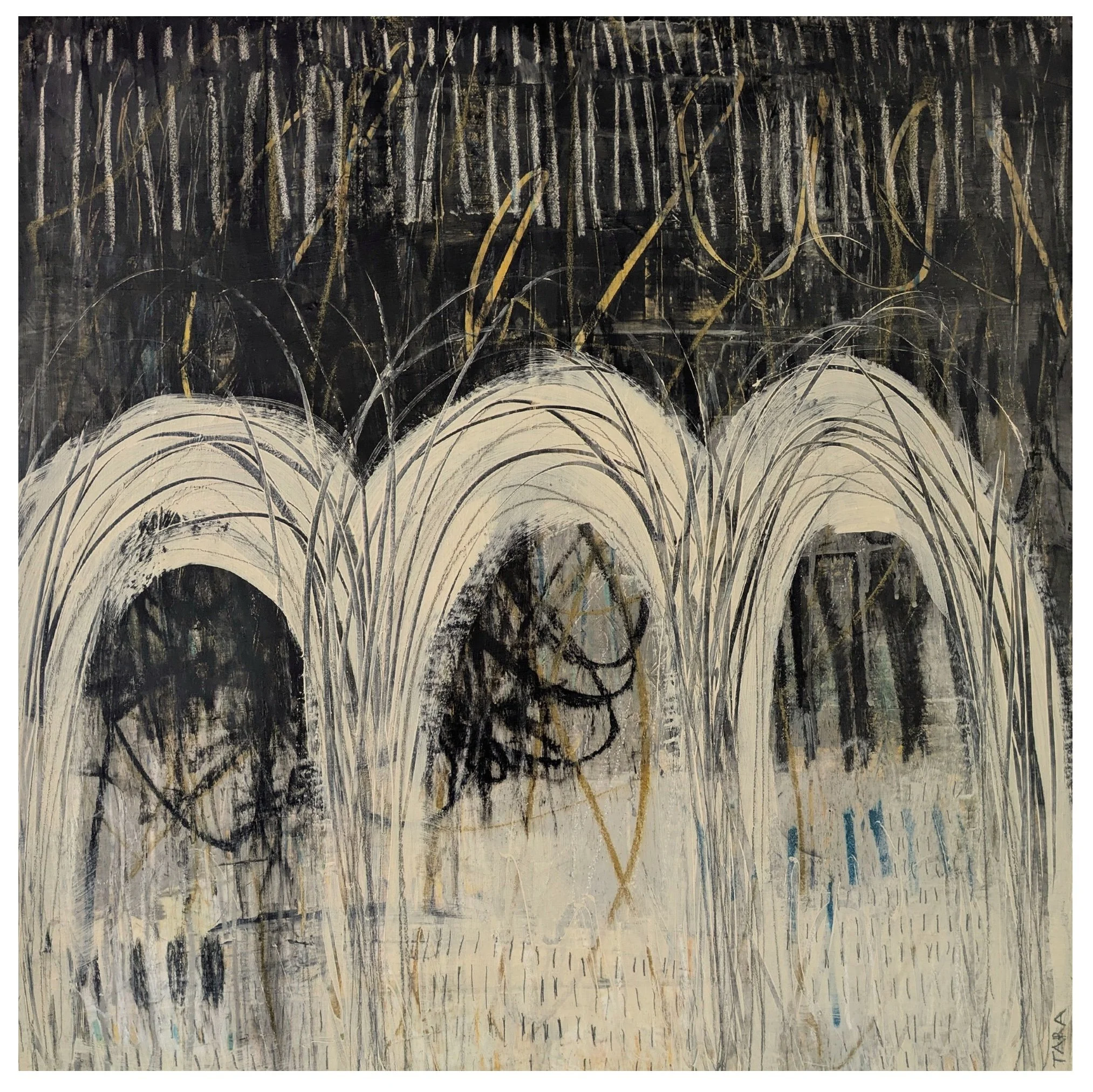
Tara Keating
I Carry My Past Forward
Mixed Media on Canvas 24”x24”
2024
As the title implies, this painting is about how even as we change and grow, our personal history travels with us into adulthood. The colors and marks in the upper third of the painting reference school black- boards, while the large black scribble which is partially hidden hints at trauma or violence. The lower portion of the painting is lighter in color and the marks are more delicate and structured, denoting pe- riods of calm. The large light-colored arches which obscure much of the work hint at an overriding sense of peace or joy. This work reflects themes I continually return to: How do I find peace within struggle or create order in chaos? Can I embrace the messy reality of who I am?
Flaws are human. My art attempts to convey the importance of this principle and celebrate the human touch through irregular marks, textures and natural colors.
A recurring motif in my paintings is imperfect repetition. By repeating hand drawn marks throughout a piece, I meditate on the beauty of imperfection. No two marks are the same. Some don’t come out as I intend. Their variation adds to the energy and complexity of the whole. The juxtaposition of uncertain and confident marks, the covering of failed attempts, repeated revisions and spontaneous gestures all emphasize and support the humanity present in the work.
I often build complex surfaces using multiple layers of acrylic paint and a variety of media. Currently I am exploring materials such as plaster, fabric, powdered marble, wax, sand, salt, tissue paper, metal and twine in my work. My studio time is full of curiosity, play and experimentation.
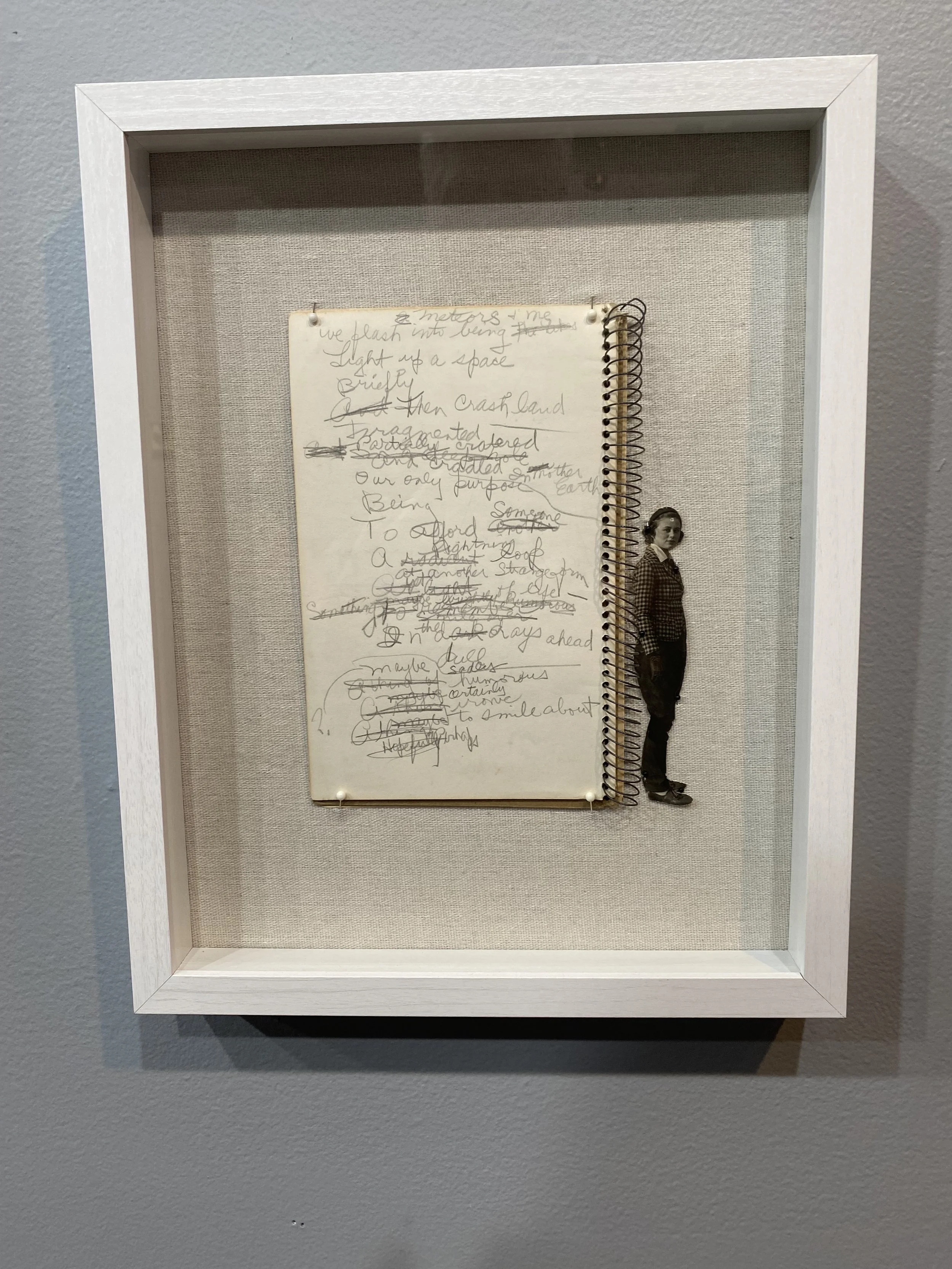
Martina Nehrling
June K. Nehrling
Notebook in Shadowbox 7”x5”x3” approx. Undated
Maybe Maybe Maybe Hopefully, is a six-color limited edition silk screen print I created in the spring of 2021 through the facilitation of printmaker Vic Barquin.
I think of the piece as a collaboration with my grandma, June K. Nehrling, who was a poet and the light of my childhood. The imagery in the print comes from a page in one of her notebooks where I found
a rough draft of a poem in her unmistakably passionate handwriting with multiple lines crossed out and reworked. By isolating and offsetting with each color the just legible words Maybe Maybe Maybe Hopefully I sought to illuminate the compelling visual rhythm of her thought process. These words also strike me as a poignant distillation of the contemporary human condition—especially during the first year of the pandemic when this print was made.
My Grandma June inspired my love of art and music and most especially reading. Her spirit remains an ever-present companion in my thoughts and creative practice.
Jacob Futhey
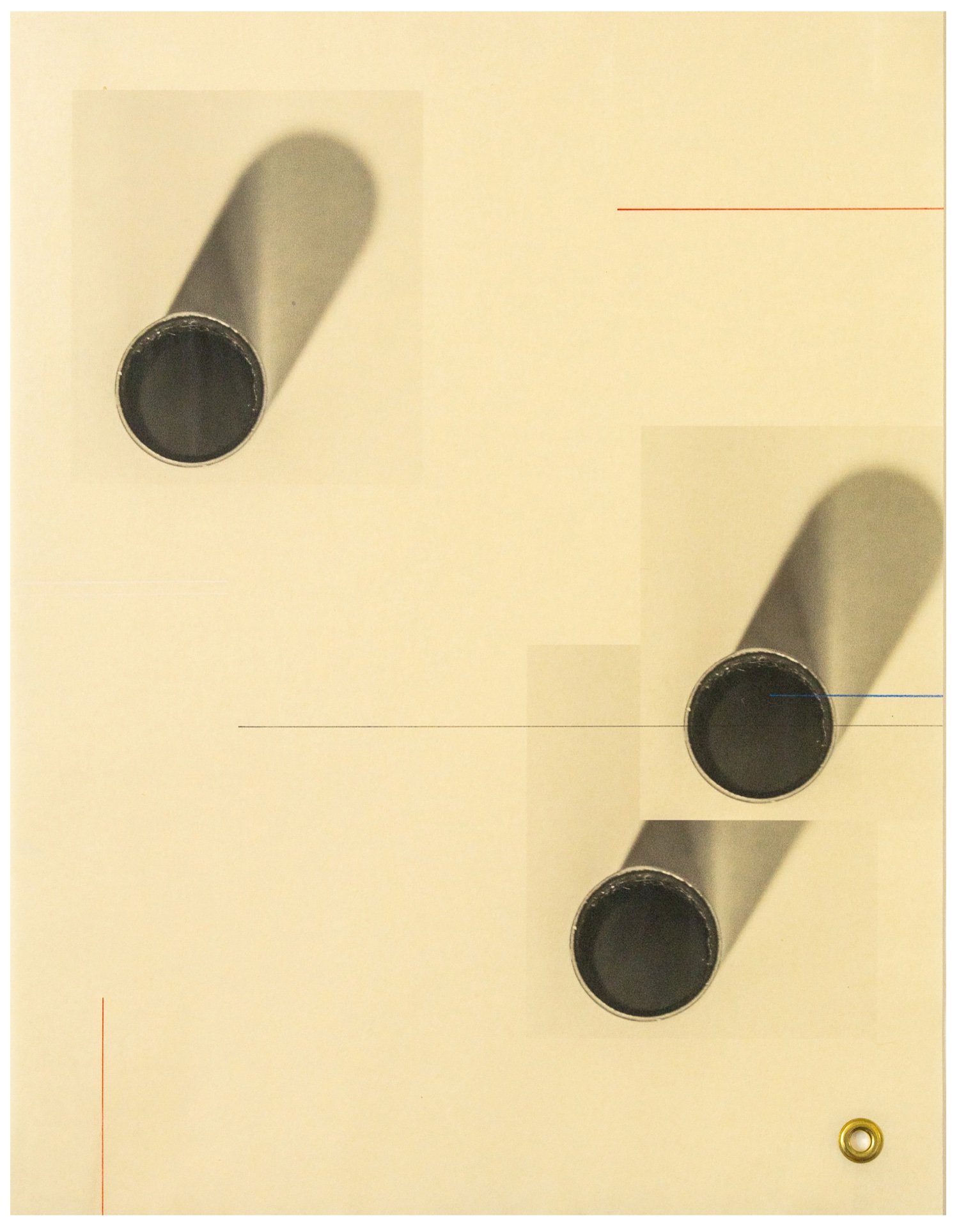
tonal
Mixed Media (Archival Pigment on Niyodo Paper with Colored Pencil and a Brass Grommet) 17”x22”
2025
Jacob Futhey is a Chicago-based artist who transforms photographs into abstract, mixed-media works using paint, pastels, colored pencils, grommets....
His art explores perception—the act of seeing and the subtle shifts in awareness that come with it. His works function as visual spaces: invitations to disengage from the overactivity of daily life.
They serve as quiet companions—portals for pause www.jfuthey.com
Katherine Nemanich
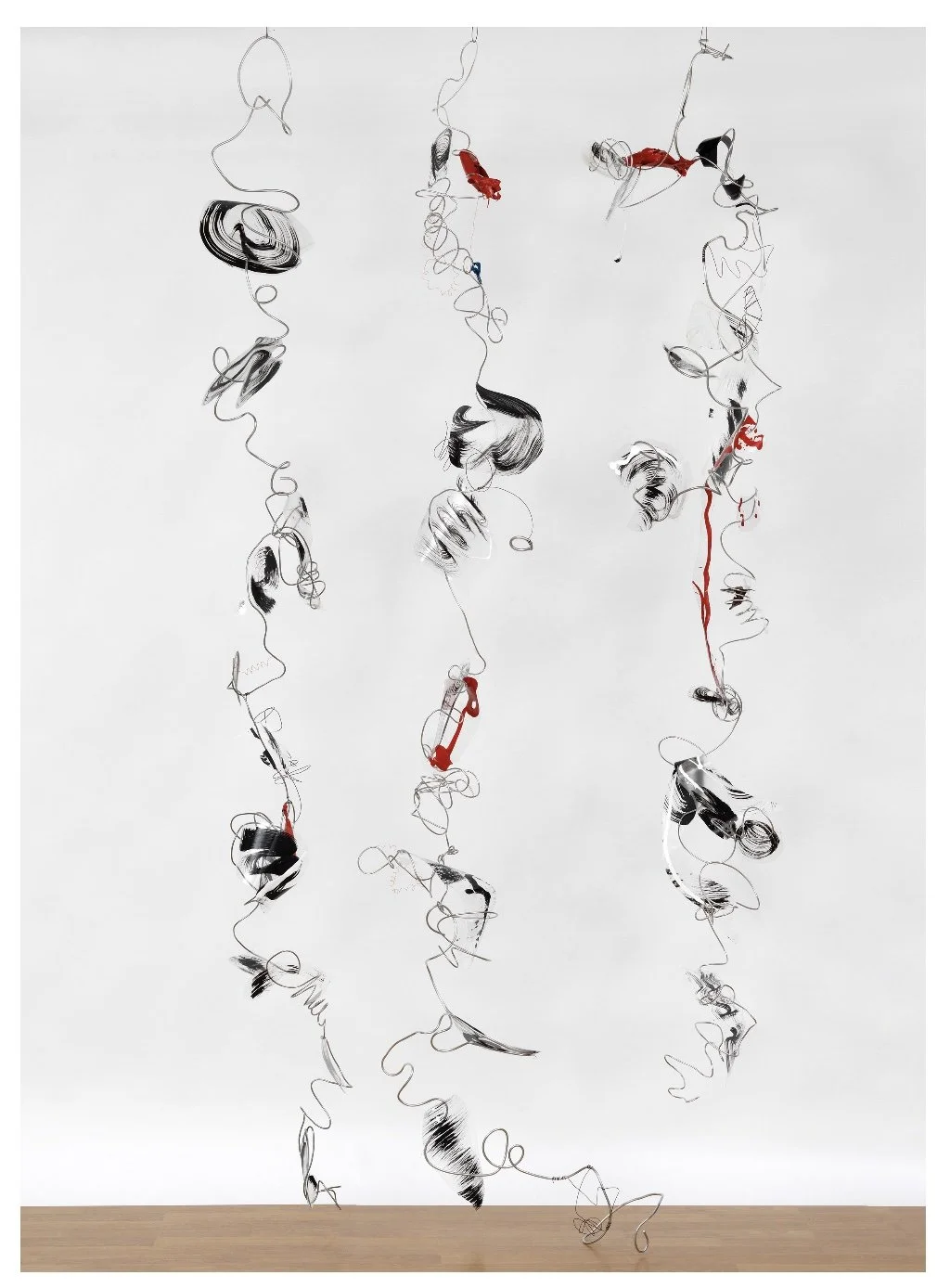
Trio Dance
Wire, Acetate Film, Acrylic Solids and Acrylic Paint 71”x43”x36”
2025
Katherine Nemanich uses marks that are gestural abstractions derived from her longstanding work with calligraphy and calligraphic forms, and her lifelong study and love of music. As a harpsichordist and pianist, music is integral to her life and to her art. Her interest in musical rhythms and gestures drives much of her mark making, as does her study of hand-drawn musical scores and notation. She lis- tens keenly to many kinds of music, and keeps notebooks of particular works or passages that she finds especially conducive to translating into visual marks. The phrasing, gestures, rhythm, and emotional feeling in the music are the source for many of her gestural ink marks. Visuals of hand drawn musical scores, with the energy of the notations and markings depicting the energy of the music also inspire her painted gestural marks.
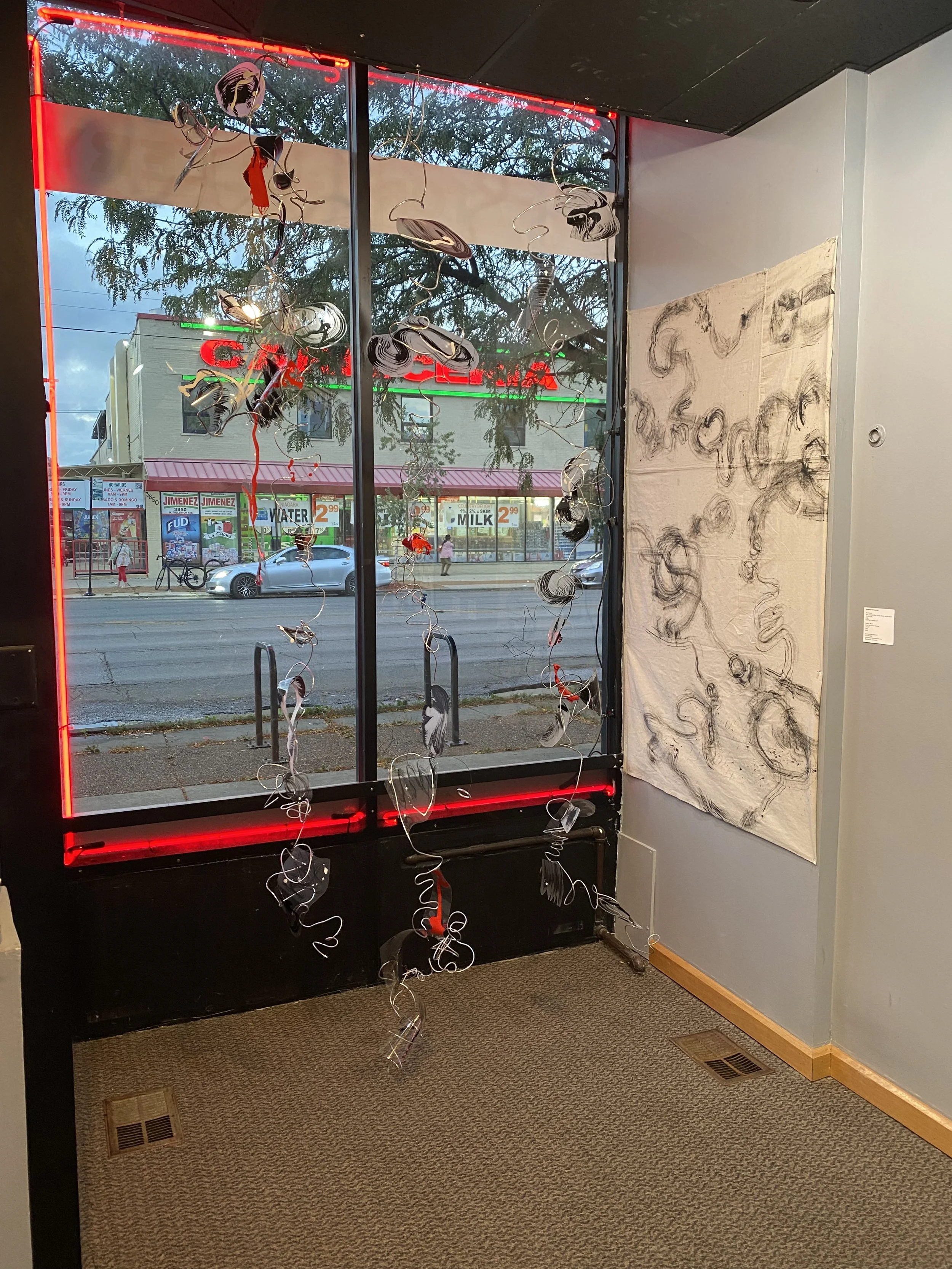
Working with wire, Nemanich draws with the wire itself so that it becomes the drawn line. Then, inter- spersed within the wire lines, she places calligraphic marks in transparent film, the two components becoming one gestural drawn and formed physical sculpture. Nemanich’s method with layering and transparency allows the painted marks to float literally in space.
Her 2-dimensional and 3-dimensional works presented here include gestural ink drawings on canvas; and sculptural constructions made of wire, acrylic on acetate film, and solid acrylic. Each work in its own way is a gestural and linear abstraction, a graphic activity existing in space. This graphic activity continually recreates itself as the viewer moves through and responds to the physicality of the lines and inhabits the space within and around.
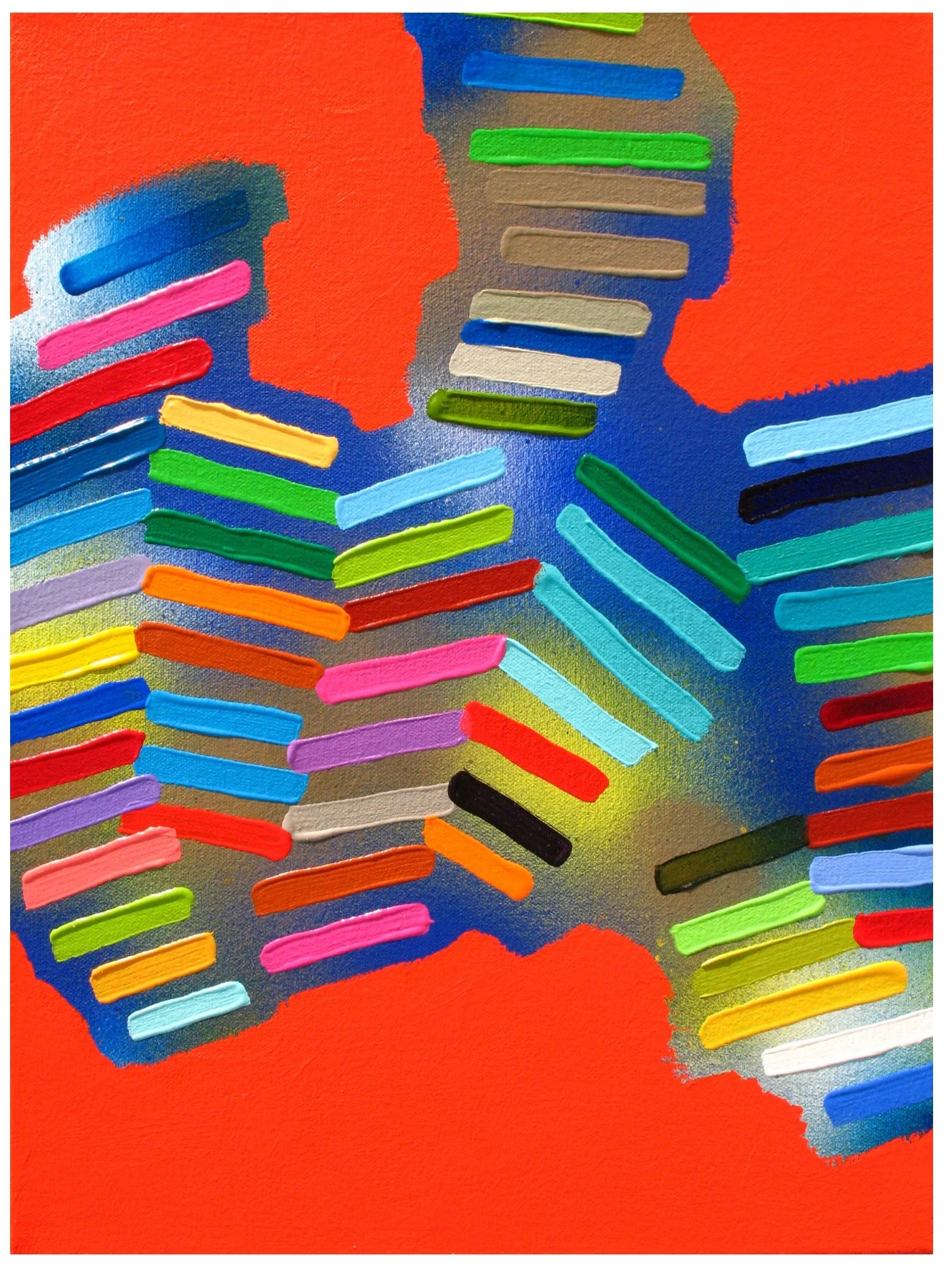
Robert Vargas
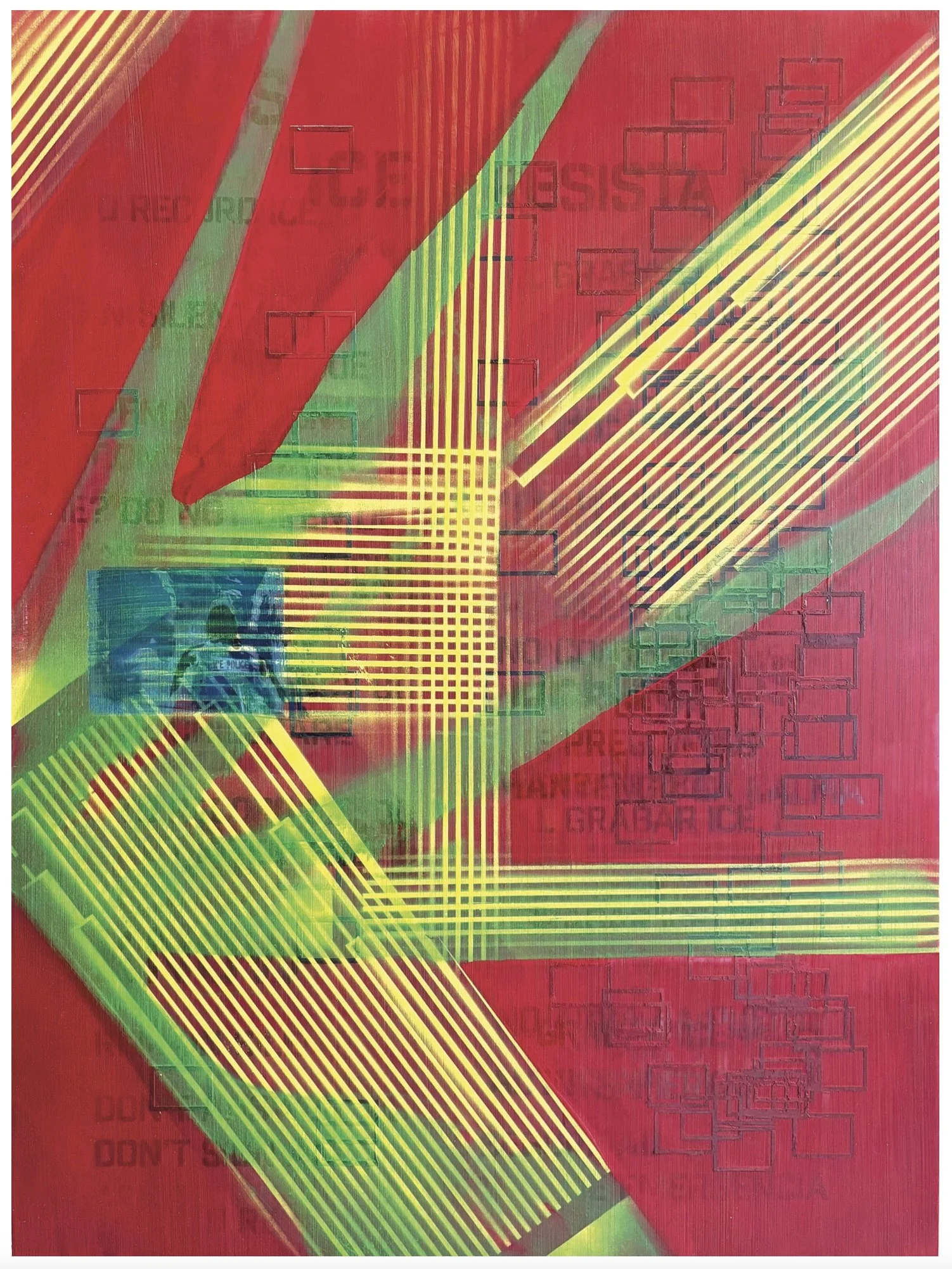
Encrypted Message (Red)
Oil and Spray Paint on Wood Panel 40”x30”
2025
Encrypted Message (Red) honors the brilliance and strength of immigrant communities navigating power in the shadows. The photos and words meant to alert, protect, and organize come from real messages sent by Chicagoans resisting ICE. The stripes and colorful bands depict the movement of these digital messages via fiberoptic cables. The color palette reflects the acts of care, solidarity, and coordination among community members organizing in digital space. The painting combines image transfer techniques, stand oil glazes, and transparent spray paint applied with vinyl and mylar stencils.
I paint because art visualizes the workings of power in ways that words or data alone cannot. Mexican muralists like Diego Rivera, whose art spoke truth to power, were my earliest influences. Seeing Rivera’s “La Gran Tenochtitlan” as a teenager visiting Mexico City taught me the power of art to reconstruct history.
My art is shaped by a lifetime of experience living and working in systems where authority was unquestioned and silence carried meaning. Through painting, I revisit those systems to reveal what they obscure and what they teach people to overlook. Born and raised in Chicago, I have wit- nessed the human cost of state violence and the ideologies that legitimize it. My paintings explore this friction—not as a detached critic, but as someone shaped by its contradictions. I paint the systems I cannot accept and the actions of communities working to dismantle them.
I work in a variety of mediums, but I mostly work with oil paint because the slow drying times enable me to work on three or four series at a time. My process often begins digitally, within the minimalist interface of R-Studio on my laptop. I treat its plot window as a blank canvas, coding geospatial maps or data visualizations to generate unique visual forms. I transpose my digital compositions onto canvas or wood panel through projection, stenciling, or layered mark-making. Whether grounded in data or drawn from lived experience, each painting gives form to what sys- tems suppress and what communities remember.
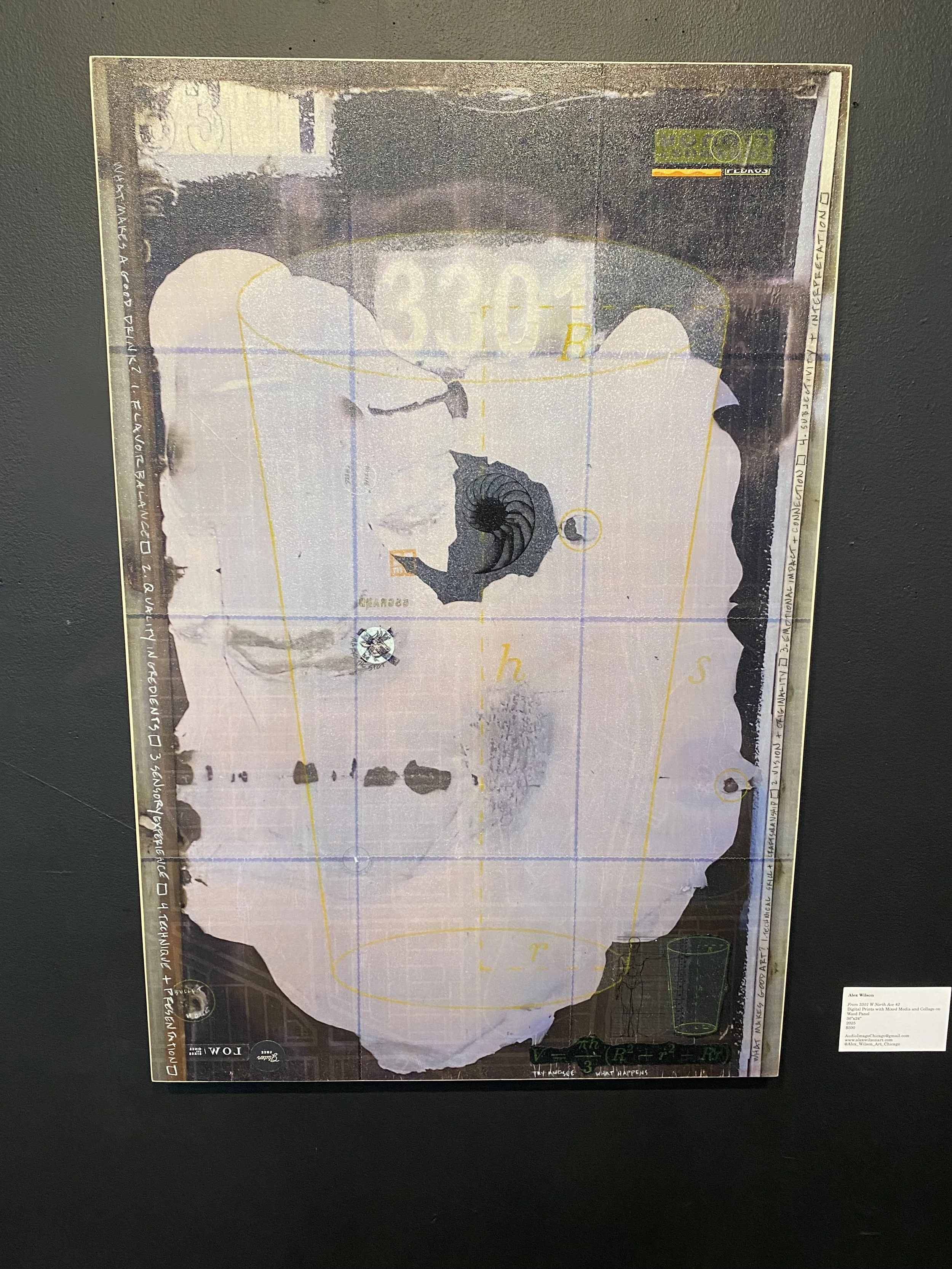
Alex Wilson
From 3301 W North Ave #2
Digital Prints with Mixed Media and Collage on Wood Panel 36”x24”
2025
The series From is built upon photographs of interesting images taken from the environment. These images may be a mark, blotch, blemish, smear, stain or other imprint that caught my attention and
left an impression. Over the image I superimpose a subdued map of the area around where the image was taken from. This part of the process is done with digital files that are printed onto several pieces
of paper that are tiled together to make a single image the size of the panel of the completed piece. Two versions of each piece are made; one that is printed on opaque paper and one that is printed on trans- lucent. After the individual prints are laid out and tiled together they are adhered to a wood panel. The opaque version keeps the color close to the original prints while the version on translucent paper chang- es its color pallet as the warm wood tones of the panel show through. Also on the translucent version, the laps of the individual prints become much more apparent and create a visible grid.
With a graphic or collage element, I mark the specific location on the map where the original image was taken. I add additional collage, drawn and painted imagery that relate to the original image and its location as well as expand upon ideas that the process inspires. After all collage, drawing, painting and other mark making is completed the piece is glazed. Several layers of glaze are added with masks used to create ‘invisible images’ that are seen when viewed at different angles. Opalescent glaze is used in certain areas to accent stenciled images. A final glaze of gloss medium is applied, stippled on to create
a pebbled finish. The glaze and other water based mediums can effect the paper prints causing them to wrinkle, shrink and expand in places. The end result could be compared to leather, hide or a sort of skin.
The base image in From 3301 W North Ave #2 is of the back door of Foremost Liquors located at that address. A map of the area is subtly overlaid and the location is marked with an X over a collaged im- age of a bulls head taken from the label of a bottle of vodka. There is a diagram that looks like a pint glass that has the formula to find the volume of a conical cylinder. Other markers are placed on the map including the location of 65 GRAND gallery and my home. Two lists run up and down the sides of the piece that number ingredients for What Makes Good Art? and What Makes A Good Drink? There are several other drawing and collage elements that reference art, environment, emotion and inebriants. Building upon an image of the back door of a liquor store, I explored the idea of how intoxicants calcu- late into a formula for Art.
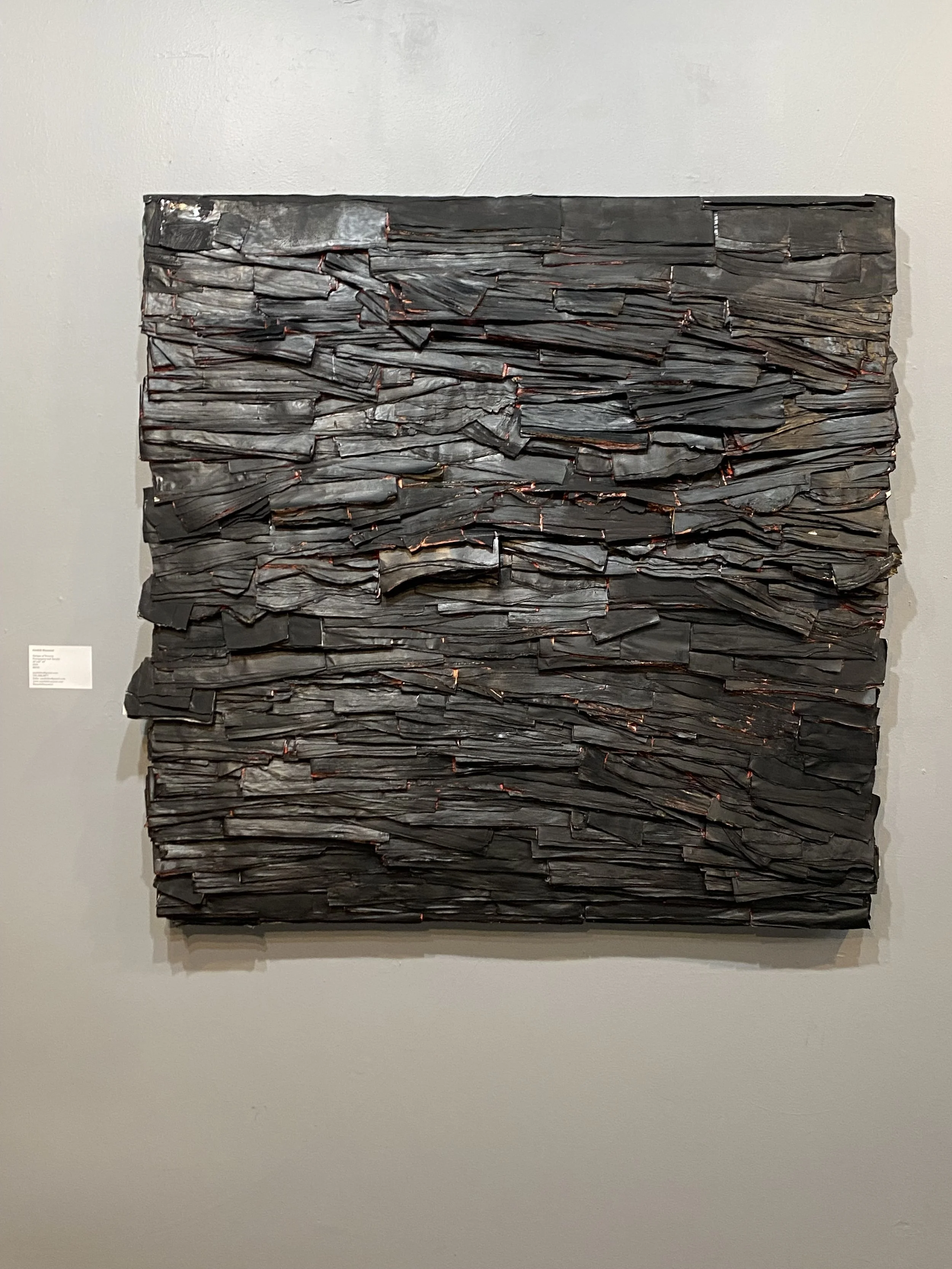
Azadeh Hussaini
Vestiges of Veracity
Newspapers and Acrylic 48”x48” x5”
2024
Vestiges of Veracity transforms layers of newspaper into a blackened surface, erasing words and images until only the ghost of information remains. It reflects a world where mainstream media obscures more than it reveals, leaving only traces of truth buried beneath the noise.
In my artistic practice, I explore the human condition within the contemporary status quo, informed by my lived experience as a bicultural immigrant and my observations of society. My work spans sculpture, installation, drawing, and installation-based performance. Using materials such as recycled newspa- pers, personal notes, and found images, I reflect the struggles, resilience, and complex realities people navigate. These materials are not merely formal choices—they carry the weight of memory and testimo- ny, becoming symbolic elements that weave individual stories into a shared collective memory.
I engage with ideas of home, displacement, and the politics of space. Multiple migrations throughout my life have forged a deep connection between my personal experiences and those of others, prompting me to think of human existence as a shared, intertwined reality. This perspective has led me to approach art as a research-based practice—conceptually driven yet materially grounded.
My artistic life is inseparable from my concerns as a human, a woman, and an immigrant—each work a reflection of that entanglement.
Jeannie Hua
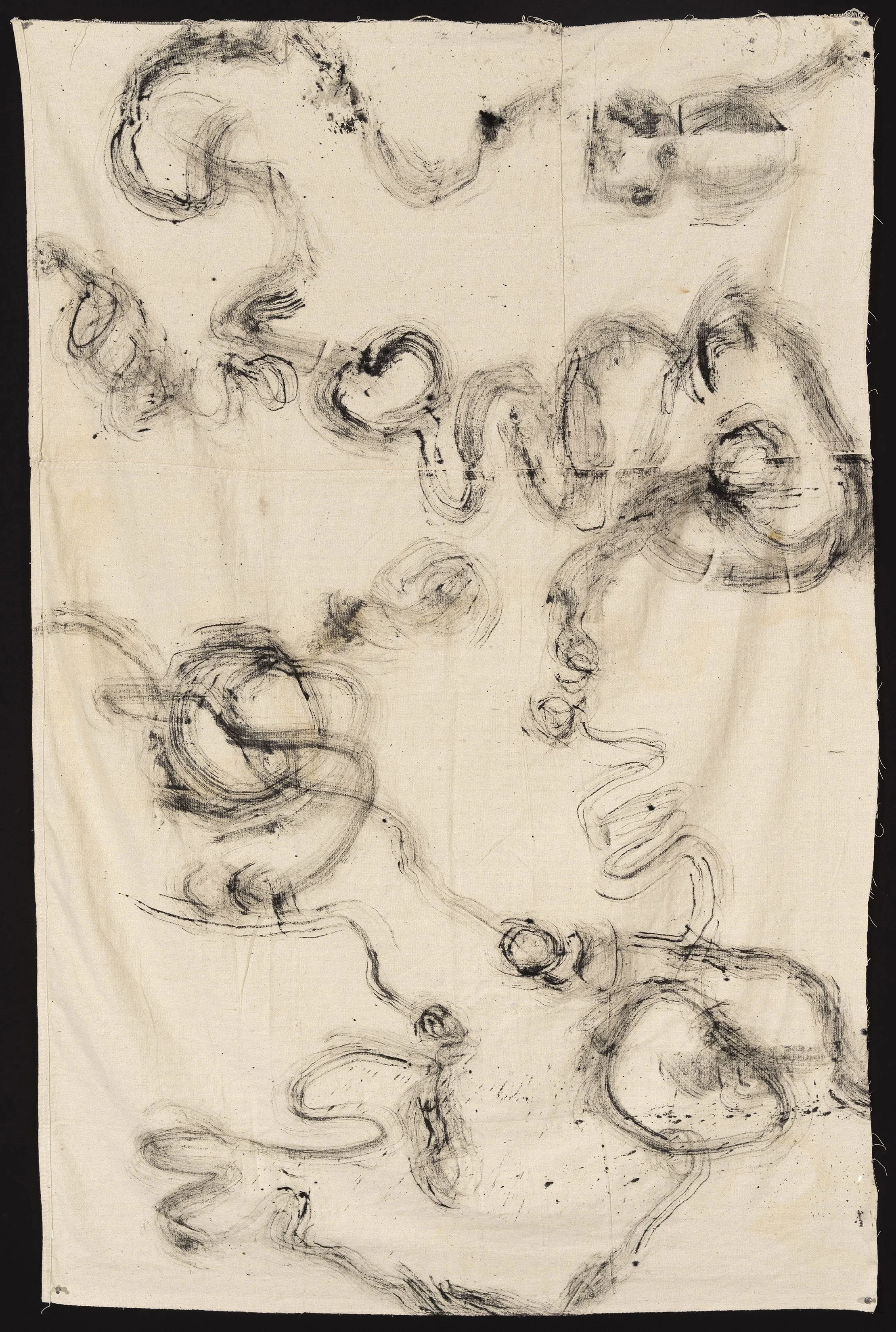
Birthmarks I
Handmade Kozo and Black Denim Paper 24”x18”
2025
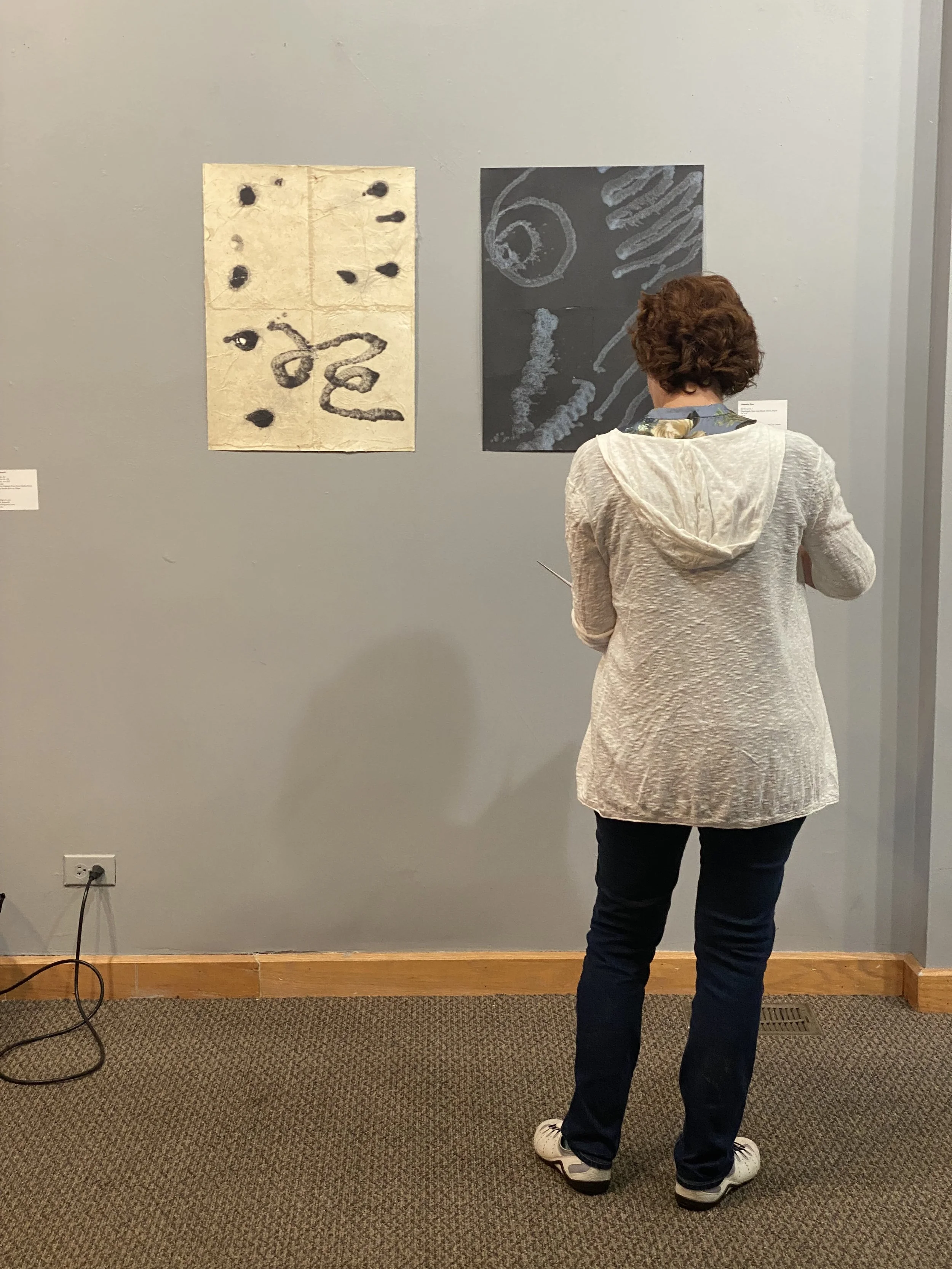
Birthmarks I and II are handmade papers. The marks on the papers appear to be paint marks applied to the paper after its formation. In reality, the marks were made during the formation of the paper. The marks were part of the birth of the papers. It’s like how people are marked not from exterior forces, but by forces that existed within, prior to birth. Like Lady Gaga said, we were born this way.
I am a multidisciplinary artist. I use ephemera such as magazine and newspaper as well as acrylic and oil to make mixed medias. I also use joss paper. Chinese people burn joss paper to worship our ancestors. I use locally sourced clay mixed with chemical compounds that human bodies release when decaying in soil, ie. magnesium, nitrous, calcium, phosphorus, potassium, to make sculptures. These sculptures are designed to dissolve back into earth when exposed to the elements and benefit the sur- rounding soil. I also use my body as ephemeral sculptures to situate in nature.
I chose these mediums to show the journey that the material traverse in becoming the immaterial as filtered by socio-economic, ecological, and political systems. I use oil paint to illustrate and situate how within the context of patriarchy and colonialism, the role of joss paper, greenware mixed with human composition to dissolve back into soil, and ephemeral body sculptures, serve to reenact, reanimate, and reclaim the unspoken. So much of Asian American diaspora is a reaction to and against nothingness, unrecorded narratives.
My influences are the poems of Victoria Chang, earth/body sculptures of Ana Mendiete, collages of Mary Delaney, and Minoan frescoes and sculptures.
Jason Greenberg
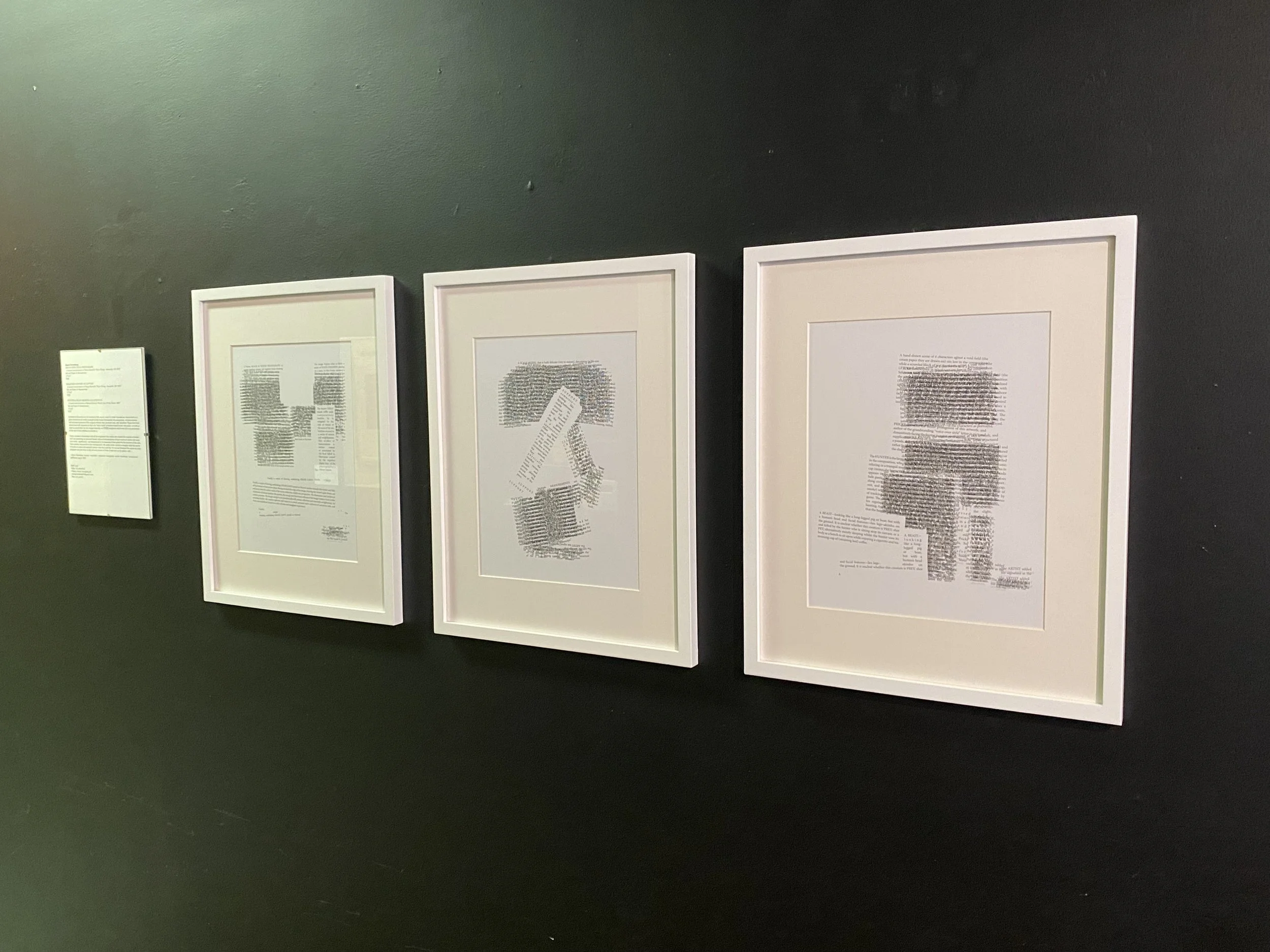
THE FOURTH CHILD: PHOTOGRAPH
A layered interpretation of Nancy Rexroth’s “Boy’s Flying - Amesville, OH 1976”
Ink and Paper, three 11”x14” prints (Simulacrum Series)
2025
Artworks in this series are all simulacra; they are my visual to verbal translations, transcribed to ciphers (letterforms & words) arranged in text blocks that emulate the composition, volumes and spatial/relational structures of the original artworks that are never seen, only described. These three text abstractions both represent as their own “stand alone” artworks created by me—the artist—as well as stand as placeholders for the original artworks (or THEIR simulacra) which were all in my possession at the start of this exhibition’s conception.
I have a personal relationship with all the originators (the artists who created the original artworks) and I am presenting my personal biased, inflected interpretations of their source art pieces and materials which—significantly—are being stored in the basement of the gallery for the duration of the exhibition entirely inaccessible to the viewing public. My prints invite viewers to imagine what the source artworks are about and mentally picture what they look like. Or you can disregard the source as a doppleganger and just focus on the artwork present in front of your eyes on the gallery wall....
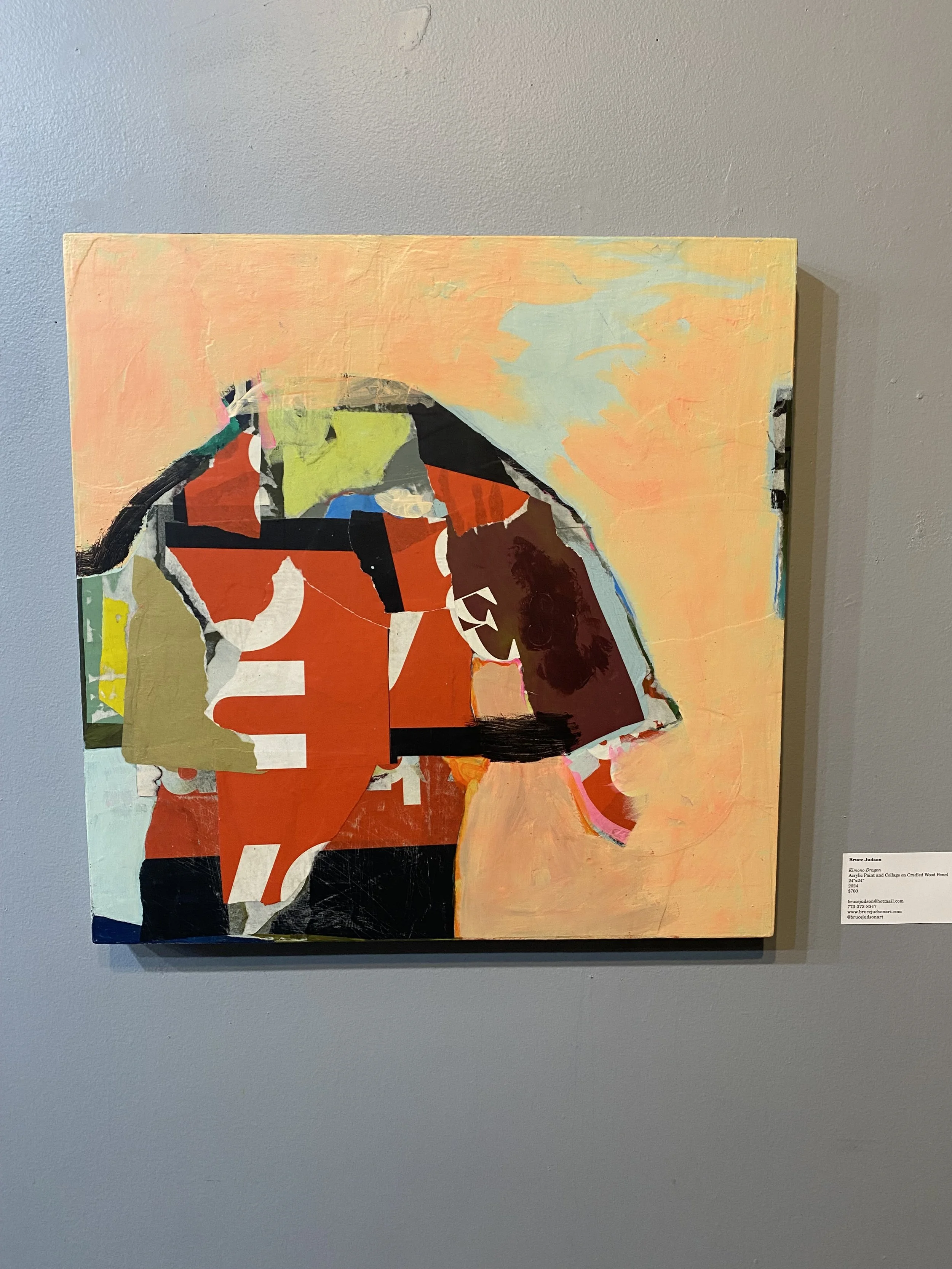
Bruce Judson
Kimono Dragon
Acrylic Paint and Collage on Cradled Wood Panel 24”x24”
2024
The idea that I can paint anything I want is not a good place for me to start a work. To counter this, I give myself simple frameworks and goals. For this piece, I began by placing red, black, and white paper, and working in acrylic paint.
I move quickly with no editing, and watch what unfolds. In this way, it works like a formula, which helps me tease out subconscious elements of content and image.
I believe that the profound comes out of both critical thinking and intuition. Much like a Roschach test, our psychological perceptions give meaning to the world around us. We can see complex images in the clouds that are just water vapor. We can see and hear stories on the news that turn out to be untrue. My piece is just color fields and line arranged in a composition on a wood panel. But differing perceptions can incite discussion on potentially deeper meaning.
Like lava flowing down a hill, Kimono Dragon explores the dichotomy of the Beautiful and the Dangerous.
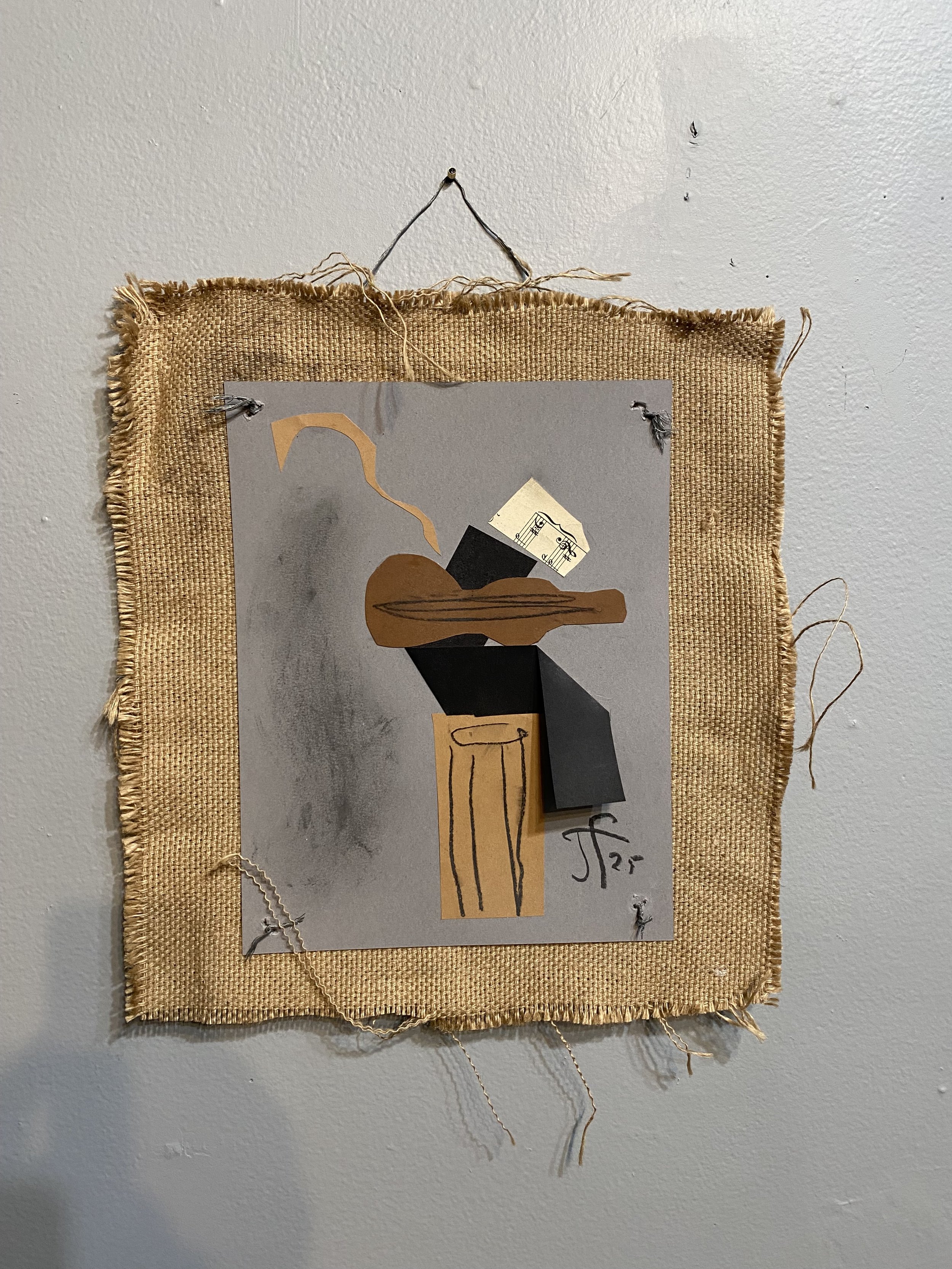
Joe Fournier
Guitarist from Kurosawa’s “Drunk Angel”
Cut Paper, Sheet Music, Charcoal, Wire and Burlap 15”x13”
2025
In Kurosawa’s “Drunk Angel”, not only is the town sick with rampant tuberculosis from the vile, con- taminated water around which they live, it even affects it’s music, with this guitarist playing (quite poorly) the same phrase of eight bars throughout the night.
Award winning, multimedia artist Joe Fournier, has been able to share with us his unique take on American life and love through an extraordinarily strong sense of curiosity and joy in his image/music/ animation making. Fournier works with a limited color palette in order to push the focus of each piece to his cutting wit and sensitivity, which is the strength of this artist. Fournier is a uniquely authentic artist, using an uncommon yet compelling visual language to help relieve us from an extremely divisive, relentlessly hostile, social climate. Fournier’s work has been shown at The National Gallery of Art, The Cannes Film Festival and has works in The Library of Congress. Fournier is also an award winning political cartoonist, whose satirical political strip appeared three times a week in The Chicago Tribune.
Oh, and he has zero cavities. Not a one.
Fournier’s work focuses on mental health, particularly since being diagnosed as a Highly Sensitive Person.
“I see a lot of myself in our anxiety-riddled society, and try to show the various constructive methods
I have found to be of benefit to me : meditation, yoga, Taoist teachings and the like. I show them as they’re being used and not prior to their need in hopes that the viewer will - at the very least - consider these ideas for relief or respite.”
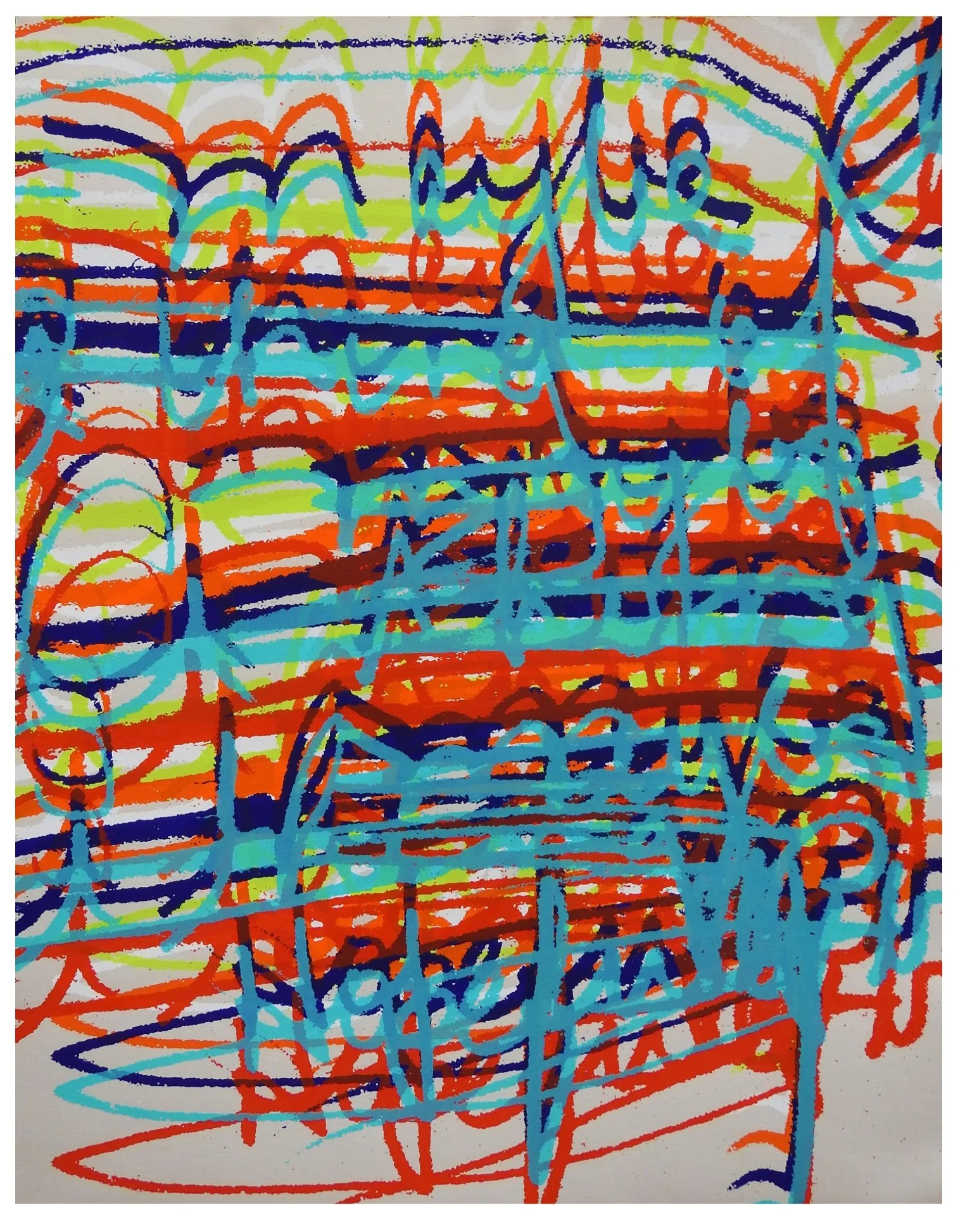
Martina Nehrling
Maybe Maybe Maybe Hopefully
Six Color Silkscreen Print on Pearl Grey Stonehenge Paper 20”x16”
2021
Maybe Maybe Maybe Hopefully, is a six-color limited edition silk screen print I created in the spring of 2021 through the facilitation of printmaker Vic Barquin.
I think of the piece as a collaboration with my grandma, June K. Nehrling, who was a poet and the light of my childhood. The imagery in the print comes from a page in one of her notebooks where I found
a rough draft of a poem in her unmistakably passionate handwriting with multiple lines crossed out and reworked. By isolating and offsetting with each color the just legible words Maybe Maybe Maybe Hopefully I sought to illuminate the compelling visual rhythm of her thought process. These words also strike me as a poignant distillation of the contemporary human condition—especially during the first year of the pandemic when this print was made.
My Grandma June inspired my love of art and music and most especially reading. Her spirit remains an ever-present companion in my thoughts and creative practice.
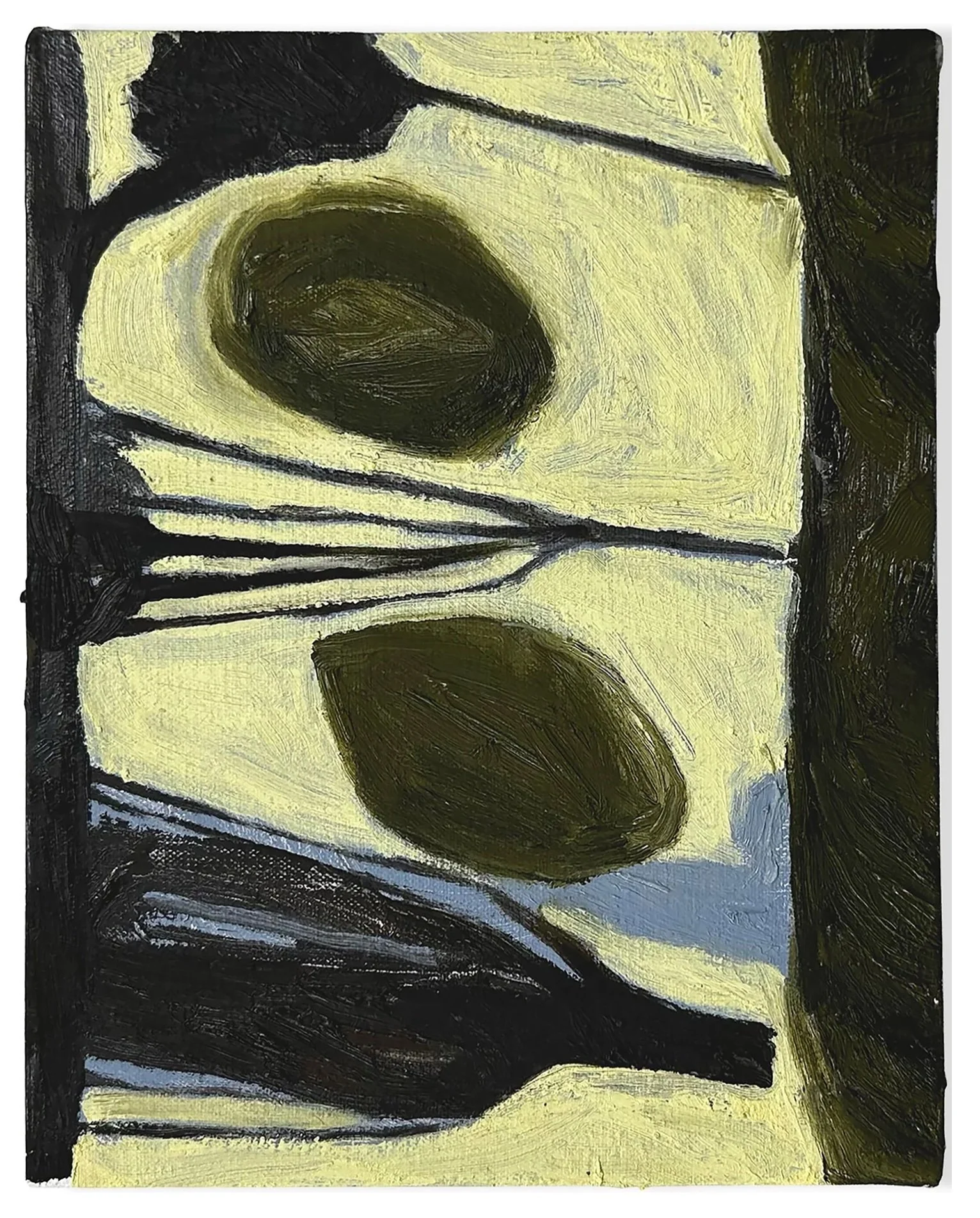
Eleana Grace Daniel
Untitled (landscape holes)
Oil on Canvas
8”x10”
2024
My work begins with the consideration of a landscape, be it interior or exterior, observed, imagined, or synthetic. The shapes in my paintings
are non-representational emblems for states of feeling. My painting practice is where language can be freed. Through painting, I am looking for
alternatives. I am trying to sit in-between a binary. Abstraction is important now because it is flexible; it allows for the unnamable, ineffable,
and ambiguous. Oil paint is the material that mediates. My work is a negotiation of control and an exercise in trust.
Martina Nehrling
Else
Acrylic on Canvas
16”x20”
2014
The painting, Else, looks to me like a secret whispered loudly.
In addition to the affinity in their overall color schemes, the pairing of Maybe Maybe Maybe Hopefully and Else suggest writing as drawing and
drawing as writing. For example, the opaque red ground carves out a central shape in Else that resembles a speech balloon with the groupings
of brushstrokes standing in as words, while repetition of the image in Maybe Maybe Maybe Hopefully gives emphasis to the gestural energy
and visual rhythm of the strikethrough lines. Illusion of depth, created through layering and combining of soft and hard-edge paint and opaque
and transparent ink, is relevant to the utterly nonlinear, often tangential thought space or imagination that all types of visible language trig-
gers for viewers and readers. Lastly, Maybe Maybe Maybe Hopefully is an image cropped from a page of writing and compositionally Else, with
the figure/ground relationship intersecting the edge of the painting, appears also to be an image cropped, suggesting that each piece captures
but a phrase in the ongoing of words.
Frederick Nitsch
Decay Is Natural
Mixed Media on Canvas 24”x18”
2025
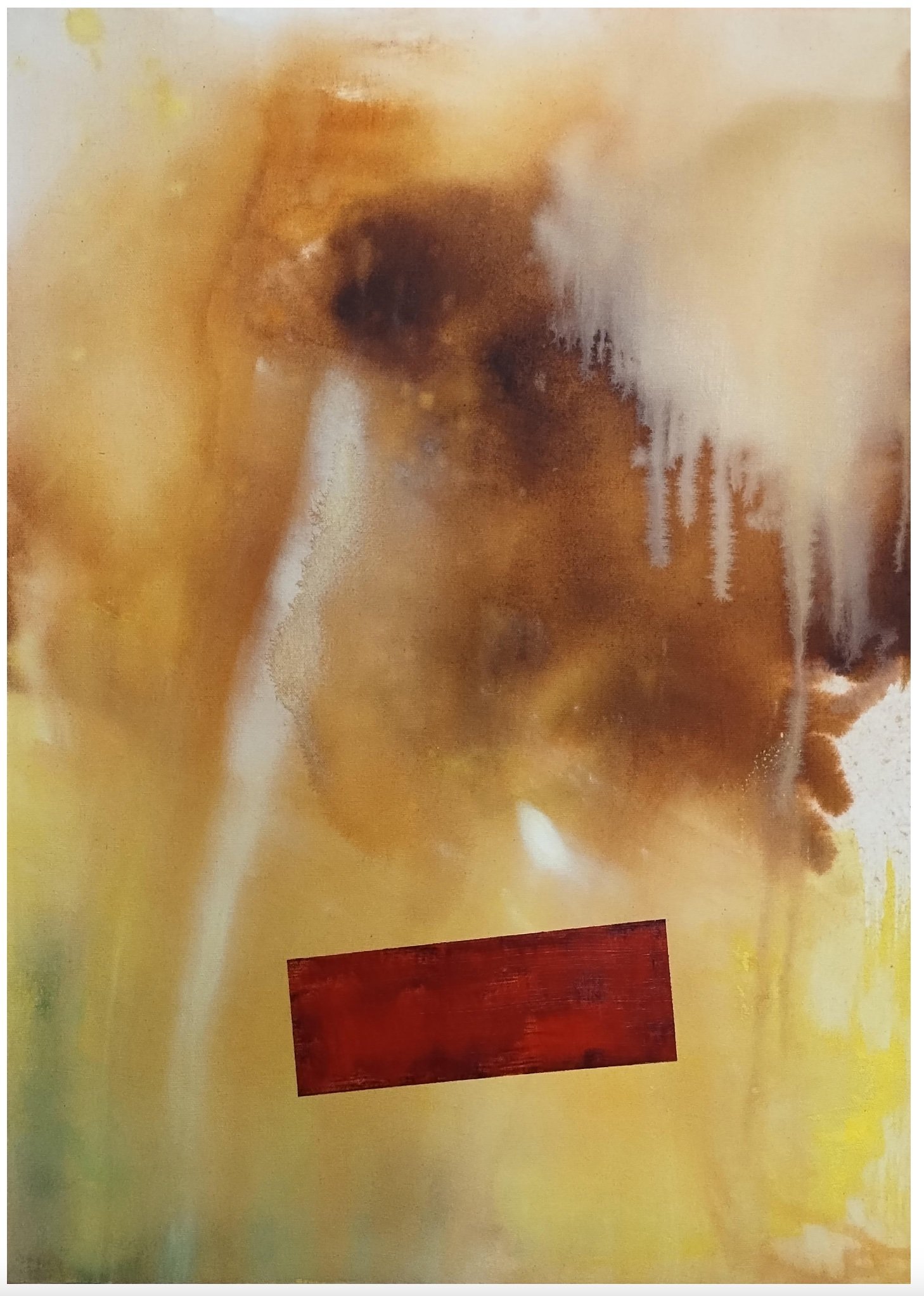
This piece was inspired by my daily morning walks along Lake Michigan this past winter. As I wit- nessed the freezing, melting, and refreezing of the water by the shore, it occurred to me that I’ll never be able to create anything as beautiful as the way water naturally moves. So, using watered-down acryl- ic, gouache, and liquid watercolor I began to lay the background. Meditating on the impermanence of nature (which of course includes ourselves), I decided to juxtapose the organic movement with the red rectangle.
Paul Wear
Spoon Bender
Acrylic on Canvas
16”x20”
2025
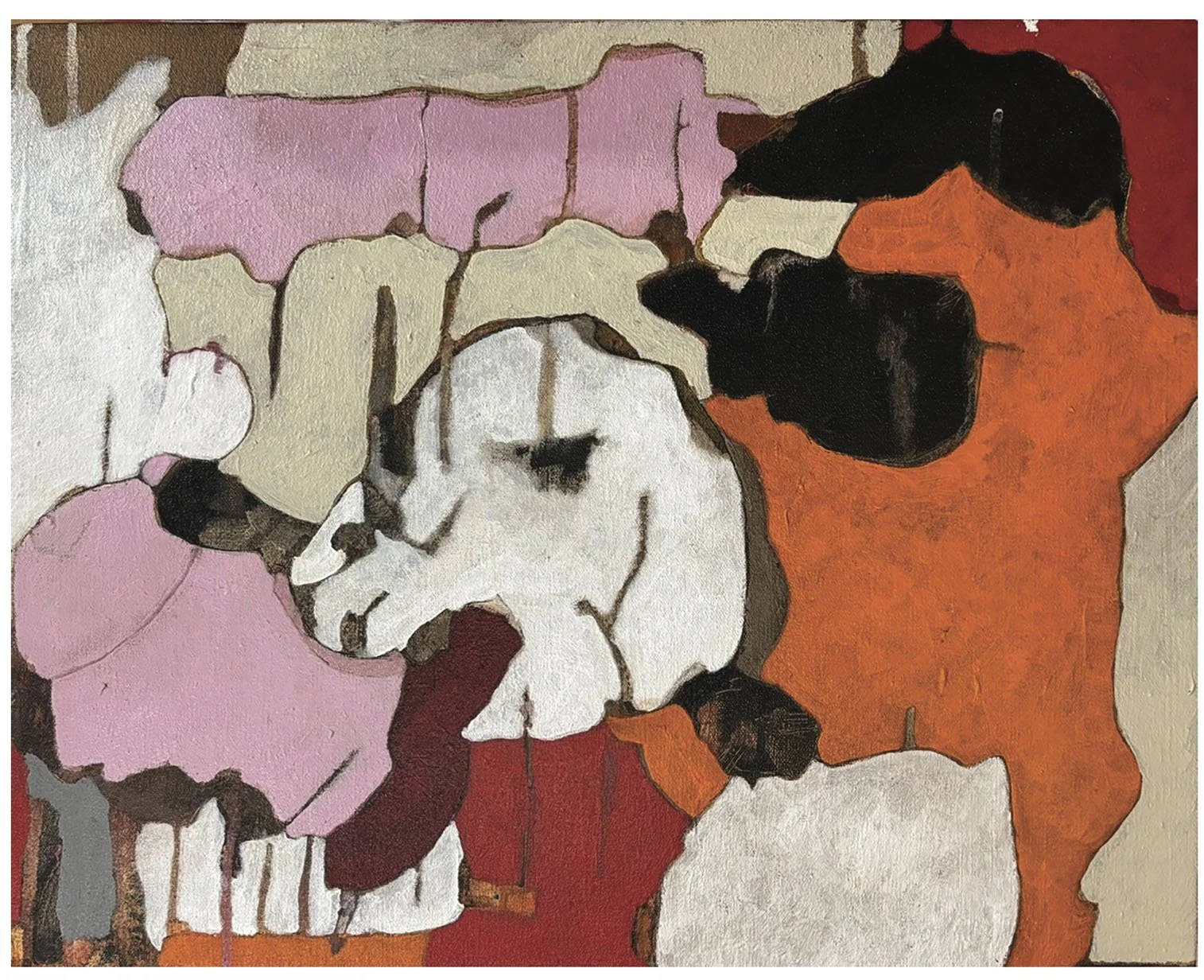
As an artist, PROCESS is as important to me as the final image. Every painting I create starts as chaotic mess of dripping paint, smears,
muddy colors, and undefined shapes. As I pile on the mess, shapes and images begin to suggest themselves to me. I keep my critical brain
turned off during this part of the process, and instead rely on my intuition. As the image begins to emerge, I push to bring conflicting elements
into balance. Bright clean colors sit next to distressed dirty colors. Refined shapes and lines neighbor areas that have not been touched. Flat-
tened shapes of color take on heavy phyiscality. Representational images, such as a bird or figure, act as a scaffolding to hold up purely ab-
stracted shapes. Order is imposed on the chaos.
Paul Wear is a contemporary abstract painter who was born in the Midwest and grew up on the East Coast. He discovered a passion for
painting at community college, and went on to study at University of Maryland. He has been living and working in Chicago and its sub-
urbs since the mid 1990’s. Paul draws constant inspiration from the city and its vibrant culture, architecture and energy. He currently
has a studio behind his home in Evanston, IL.
In his work over the last 30 years, Paul has developed a distinctive visual language and style. He juxtaposes bright clean colors with
dark distressed surfaces, flatness with physicality, figurative representation with pure abstraction. The images in his paintings are
built up gradually, starting as chaotic splashes and random strokes of paint on the canvas. As the paint layers build up, Paul draws into
the surface with a needle tool, pulling out images suggested to him by the paint itself. The act of painting is a conversation, sometimes
an argument, between the painter and his materials.
www.paulwearart.com
@wearpaul